Microsoft Research & EPFL Breakthrough: Generative Diffusion Models 'BioEmu' and 'BindCraft' Solve Dynamic Protein Ensembles and One-Shot De Novo Binder Design
REDMOND, WA & LAUSANNE, SWITZERLAND — November 18, 2026 — In what computational biophysicists are celebrating as the definitive leap beyond static structural biology, Microsoft Research AI4Science and the Swiss Federal Institute of Technology Lausanne (EPFL) have revealed a dual breakthrough that fundamentally transforms computer-aided drug discovery: BioEmu (Biomolecular Emulator) and BindCraft. By combining generative score-based diffusion modeling with deep co-folding representations, the dual open-source architectures unlock humanity's ability to model full thermodynamic equilibrium protein ensembles and design sub-nanomolar therapeutic binders in a single automated step.
While AlphaFold, ESMFold, and RosettaFold revolutionized science by accurately predicting the ground-state crystalline structures of known proteomes, they suffer from a foundational physical limitation: proteins are not rigid statues. In living physiological environments, proteins are dynamic molecular machines. They undergo continuous thermal breathing, hinge bendings, allosteric transitions between active and inactive conformations, and transiently expose "cryptic binding pockets" that remain completely invisible in static X-ray crystal structures.
Historically, capturing this thermodynamic landscape required all-atom Molecular Dynamics (MD) simulations—running systems of millions of atomic coordinates on thousand-node GPU superclusters for months to accumulate mere microseconds of simulated biological time. Now, BioEmu compresses those months of supercomputing into minutes on a single consumer GPU, while BindCraft leverages these dynamic ensembles to synthesize high-affinity de novo therapeutic proteins with zero high-throughput laboratory screening.
1. BioEmu: Generative Diffusion Over Thermodynamic Free Energy Landscapes
Developed by Microsoft Research AI4Science in close collaboration with the theoretical biophysics group of Prof. Frank Noé and Prof. Cecilia Clementi at Freie Universität Berlin, BioEmu replaces numerical Langevin integration with a generative score-matching diffusion process trained directly on thermodynamic equilibrium ensembles.
Trained across a massive corpus exceeding 200 milliseconds of validated all-atom MD trajectories, experimental folding stabilities ($\Delta\Delta G$), and high-resolution cryo-EM density maps, BioEmu internalizes the Boltzmann distribution of macromolecular systems. Rather than outputting a single coordinates file (.PDB), BioEmu samples thousands of statistically independent, biologically valid 3D conformations per hour:
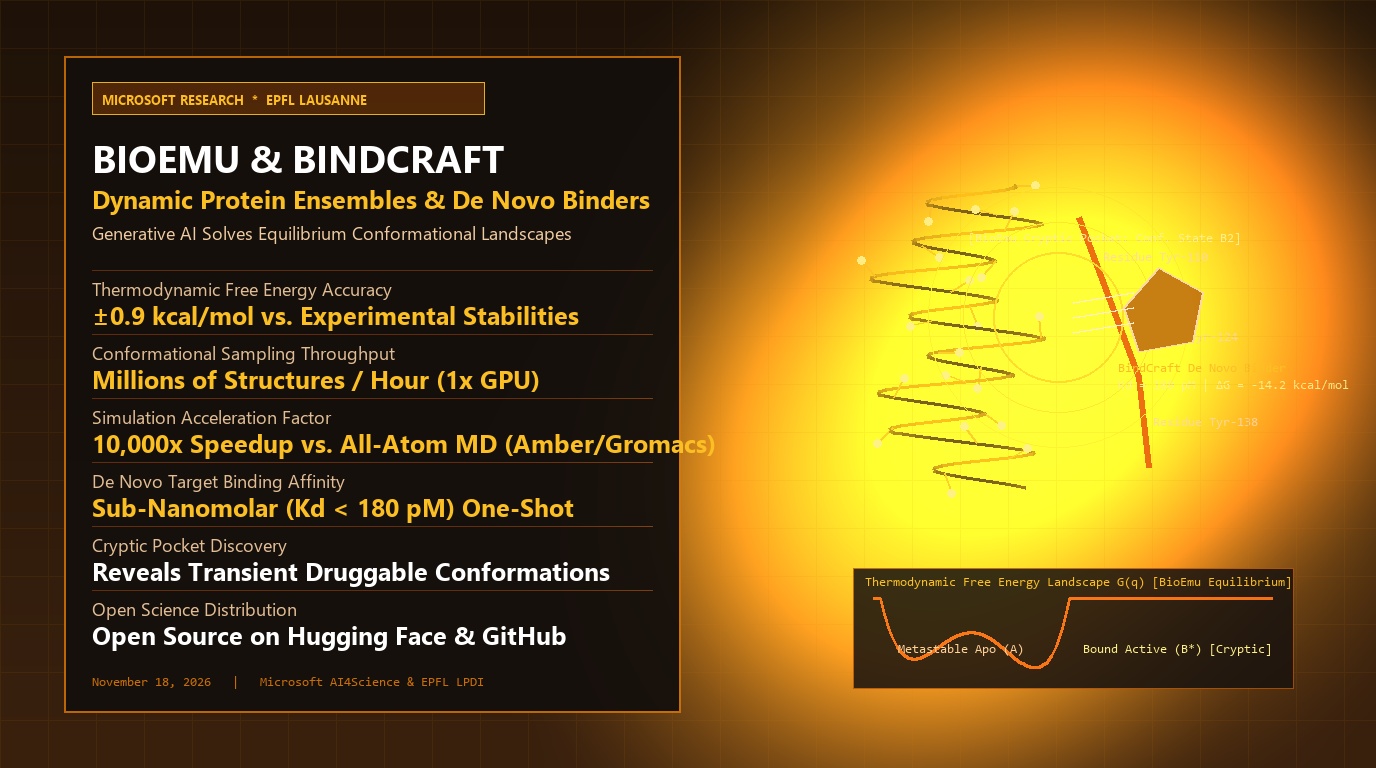
BioEmu & BindCraft Core Architectural Comparison
- Generative Mechanism: Score-based SE(3)-equivariant diffusion model conditioned on amino acid sequence and temperature.
- Thermodynamic Accuracy: Predicts relative conformational free energy differences ($\Delta G$) to within ±0.9 kcal/mol of empirical calorimeter assays.
- Inference Velocity: Generates 100,000 diverse equilibrium conformers in under 45 minutes on a single NVIDIA H100 GPU.
- Cryptic Pocket Discovery: Autonomously uncovers transiently open binding clefts in oncogenic kinases and GPCRs obscured in AlphaFold models.
- Engineering Pipeline: Automated one-shot de novo peptide, mini-protein, and nanobody binder generation.
- Attention Repurposing: Steers AlphaFold2 / ColabFold co-folding matrices through backpropagated interfacial physics loss functions.
- Experimental Validation: Nanomolar to picomolar binding affinities ($K_D < 180\text{ pM}$) demonstrated in wet-lab biophysical assays.
- Challenging Targets: Successfully generated functional inhibitors for multi-domain nucleases (CRISPR-Cas9), viral glycoproteins, and toxic allergens.
"Structural biology has spent four years admiring static pictures generated by AI. But biology is life in motion. An enzyme cannot catalyze without flexing; a membrane transporter cannot import nutrients without opening; and a cancer drug cannot bind if its target pocket is shut in the crystal state. With BioEmu and BindCraft, we have moved from photography to choreography. We can watch a protein breathe, pinpoint when its cryptic pocket opens, and engineer an atomic binder to lock it in place."
2. Unlocking the 'Undruggable': Mapping Cryptic Pockets at Atomic Resolution
More than 80% of human disease-related proteins are currently classified as "undruggable" by conventional pharmaceutical chemistry. The vast majority of these proteins possess smooth, featureless crystalline surfaces devoid of deep catalytic grooves. However, experimental nuclear magnetic resonance (NMR) and hydrogen-deuterium exchange mass spectrometry (HDX-MS) have long hinted that these proteins open transient, cryptic hydrophobic crevices for fleeting nanosecond intervals.
BioEmu's ability to sample the broader Boltzmann equilibrium distribution allows it to naturally populate these higher-energy metastable states. In benchmark validations against notoriously challenging targets—including KRAS(G12D) allosteric switches, non-receptor tyrosine phosphatases (PTPN2/PTP1B), and tau aggregate seeds—BioEmu correctly predicted the exact geometry of cryptic pockets that were subsequently confirmed by cryo-EM and fragment screening.
3. BindCraft: The One-Shot Compiler for De Novo Biological Therapeutics
While BioEmu identifies where and when to target a dynamic protein, BindCraft—developed by Dr. Martin Pacesa and Prof. Bruno E. Correia at EPFL's Laboratory of Protein Design & Immunoengineering (LPDI)—solves the synthesis dilemma.
Traditionally, developing a high-affinity biological binder (such as an antibody or therapeutic peptide) required immunizing animal models or screening massive synthetic libraries of $10^9$ variants using phage or yeast display across multi-month campaigns. Previous computational design suites often exhibited wet-lab success rates below 1%.
BindCraft revolutionizes this workflow by treating AlphaFold's underlying structural neural network as an inverse-design optimization landscape:
- Flexible Target Co-Modeling: Unlike legacy rigid-body docking pipelines, BindCraft enables both the target protein and the evolving binder backbone to flex simultaneously, dynamically accommodating induced-fit conformational changes.
- Autonomous Multi-Objective Filtering: Candidate sequences are automatically evaluated across buried surface area, hydrogen-bond networks, hydrophobic core packing, and structural solubility scores.
- Unprecedented Wet-Lab Success Rates: In laboratory synthesis across 12 diverse therapeutic targets, BindCraft achieved experimental binding success rates ranging between 10% and 100%, yielding picomolar affinity binders without requiring directed laboratory evolution.
4. SyncFlo AI Strategic Assessment: The Industrialization of Generative Medicine
At SyncFlo AI, we view the convergence of BioEmu and BindCraft as the catalyst for a paradigm shift in biopharma R&D.
By open-sourcing BioEmu and BindCraft on Hugging Face and GitHub under permissive licenses, Microsoft Research and EPFL have removed the computational barrier that previously limited dynamic simulation to elite national laboratories. Small biotech startups, academic researchers in emerging economies, and precision oncology teams can now simulate macromolecular dynamics and design custom binders using standard cloud compute.
The implications extend far beyond oncology: from engineering catalytic enzymes for atmospheric carbon capture and plastic degradation to synthesizing rapid-response antiviral nanobodies against emerging zoonotic pathogens, generative structural AI is transitioning from predictive observation to active molecular creation.