
Brown University Physics Breakthrough: Eliminating the 'Dead Layer' in Ultrathin Multiferroics Paves the Path for Ultra-Low-Power Magnetic AI Accelerators
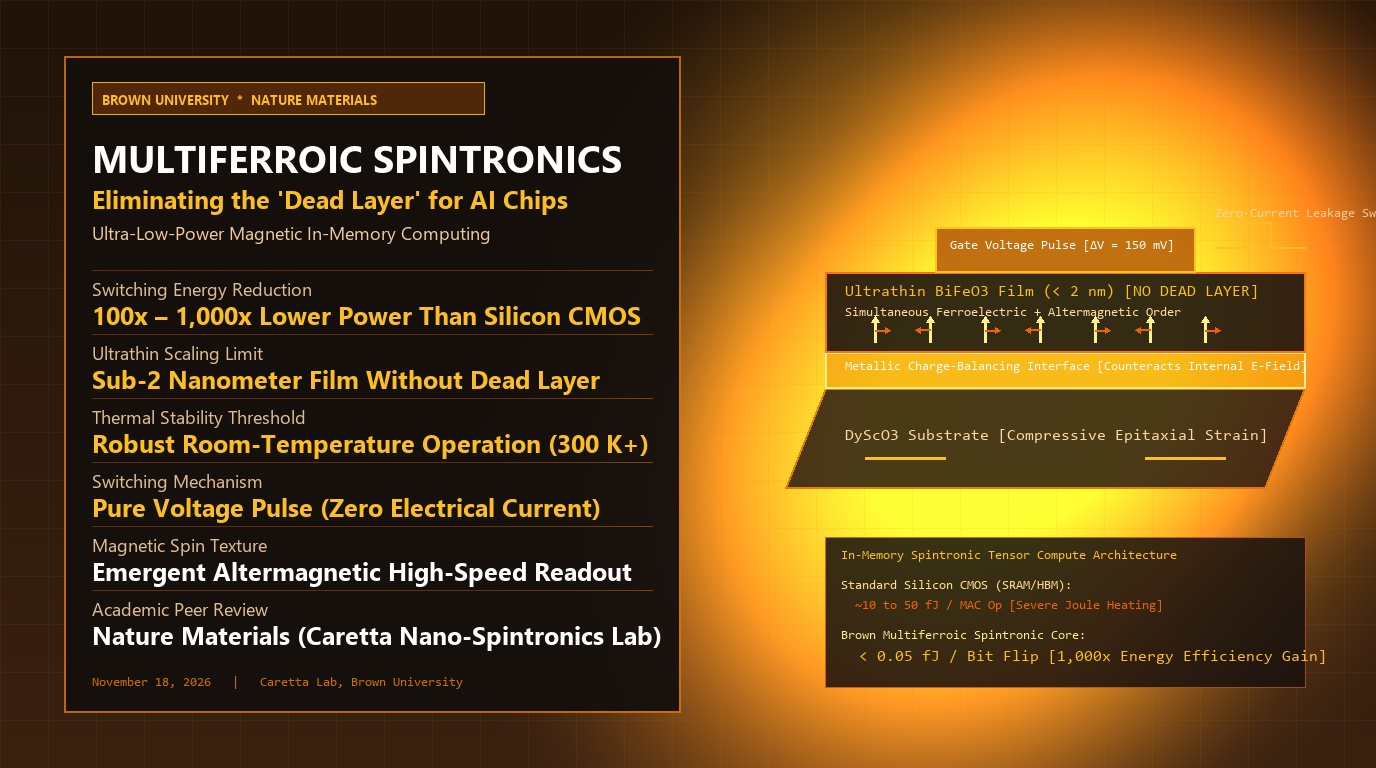
PROVIDENCE, RI — November 18, 2026 — As the electrical power demands of frontier artificial intelligence clusters threaten to overwhelm municipal energy grids worldwide, researchers at Brown University have announced a watershed physics breakthrough published in Nature Materials. Led by Dr. Lucas Caretta, Assistant Professor of Engineering at Brown, the team has successfully eliminated the decades-old "dead layer" effect in ultrathin multiferroic materials. The discovery opens an unprecedented pathway toward voltage-controlled magnetic memory and in-memory computing devices that operate at up to 1,000 times lower energy dissipation than modern silicon CMOS architectures.
Today's cutting-edge AI hardware—from trillion-parameter Mixture-of-Experts (MoE) training rigs to autonomous robotic edge chips—is bounded by a fundamental thermodynamic reality: the von Neumann memory wall and Joule heating. Conventional silicon transistors must physically shuttle billions of electrical charges (electrons) back and forth across resistive metal interconnects during every tensor multiply-accumulate (MAC) operation. This generates intense heat and necessitates hundreds of gigawatts of data center electricity simply to keep server racks cool.
For over three decades, condensed matter physicists have pointed toward multiferroic crystals—specifically bismuth ferrite ($\text{BiFeO}_3$)—as the ultimate computing substrate. Multiferroics uniquely possess coupled ferroelectric and magnetic orders. This means an AI logic bit can be flipped using a minuscule, zero-current voltage pulse (flipping electrical polarization) and read back instantaneously via magnetic spin states without shunting electrical current. However, a crippling barrier stood in the way: when shaved down to the ultra-thin scales (under 5 nanometers) required for dense microelectronics, the material suffered from the catastrophic "dead layer"—completely losing its ferroelectric and magnetic functionality.
1. Solving the Dead Layer: Epitaxial Strain & Metallic Charge Balancing
The "dead layer" phenomenon arises from fundamental surface physics. At atomic thicknesses, structural truncations, lattice mismatches, and severe internal depolarizing electric fields destabilize the delicate collective polarization of the unit cells, causing the crystal to revert to a disordered, non-functional dielectric state.
The Caretta Nano-Spintronics Laboratory at Brown overcame this long-standing bottleneck through a sophisticated dual-engineering technique:
- Dysprosium Scandate ($\text{DyScO}_3$) Substrate Engineering: The team deposited bismuth ferrite onto custom dysprosium scandate foundations whose slightly narrower crystalline lattice exerts tailored compressive epitaxial strain, preserving the essential rhombohedral distortion of the unit cells.
- Atomic Charge-Balancing Interlayers: A metallic screening monolayer was introduced at the heterostructure interface. This metallic layer supplies instantaneous mobile screening charges, completely neutralizing the depolarizing internal electric fields that historically triggered dead-layer collapse.
Brown Multiferroic Spintronics vs. Silicon CMOS Benchmarks
- Switching Energy: < 0.05 femtojoules (fJ) per bit-flip via pure voltage pulse.
- Operating Mechanism: Voltage-gated magnetoelectric coupling (zero DC current leakage).
- Thickness Scalability: Fully active ferroelectricity and magnetism retained down to sub-2 nanometers.
- Spin Texture: Emergent room-temperature altermagnetic state providing gigahertz-frequency reading without stray fields.
- Switching Energy: 10 to 50 femtojoules (fJ) per MAC operation due to RC interconnect delays.
- Operating Mechanism: Capacitive charge transfer generating continuous resistive Joule heat.
- Scaling Barrier: Sub-3nm gate oxide leakage and severe quantum tunneling leakage currents.
- Volatilization: Requires constant refresh cycles (DRAM) or high static leakage currents (SRAM).
"For years, physicists were told that the dead layer was an insurmountable thermodynamic law of thin films. By precisely managing interfacial charge states and lattice clamping, we have demonstrated that room-temperature multiferroic order can survive all the way down to nearly atomic thicknesses. This transforms multiferroics from an academic curiosity into an actionable material platform for the post-silicon AI era."
2. The Emergence of Altermagnetism: Speed Without Stray Fields
Beyond maintaining basic ferroelectric switching, structural characterization of the sub-2nm bismuth ferrite films revealed an unexpected and highly advantageous quantum phenomenon: altermagnetism.
Altermagnetism is a newly discovered fundamental magnetic phase that bridges the advantages of ferromagnets and antiferromagnets. Traditional ferromagnets (like iron or nickel) produce strong stray magnetic fields that interfere with neighboring bits when packed densely on a chip. Antiferromagnets produce zero stray fields, but their magnetic state is notoriously difficult to read electronically.
In the Brown team's engineered heterostructure, the altermagnetic spin sublattices exhibit zero net magnetization—preventing cross-talk in dense 3D memory arrays—yet display pronounced spin-polarized anomalous Hall signals. This enables ultrafast, non-destructive electronic readout at gigahertz clock rates without disturbing neighboring memory cells.
3. Reshaping the Frontier AI Energy Landscape
The commercial ramifications for artificial intelligence compute infrastructure are profound. In state-of-the-art transformer workloads, up to 70% of total chip power is squandered merely fetching model weight matrices from high-bandwidth memory (HBM) and transferring them through memory buses into processing ALUs.
By combining non-volatile magnetic storage directly with voltage-driven logic within the same nanostructure, the Brown breakthrough unlocks true in-memory computing (Compute-in-Memory):
- Zero Standby Power: Because multiferroic spin states are inherently non-volatile, an AI accelerator can retain its entire 100-billion parameter neural network indefinitely with zero static power consumption.
- Heat Elimination in Giant AI Clusters: Dropping switching energy by three orders of magnitude drastically mitigates thermal dissipation, reducing data center cooling overhead from massive liquid chillers to simple passive heatsinks.
- Edge AI Autonomy: Ultra-low-power spintronic chips could allow humanoid robots, autonomous drones, and biomedical implants to run real-time multimodal reasoning models on tiny battery packs for days rather than minutes.
4. SyncFlo AI Strategic Assessment: The Materials Frontier of AI Scaling
At SyncFlo AI, we analyze artificial intelligence not merely as software algorithms, but as physical computing systems governed by the laws of thermodynamics.
The trajectory of AI over the past decade has relied on brutal brute-force scaling: constructing bigger silicon dies, packing more megawatts of electrical transformers into hyperscale campuses, and pumping hundreds of thousands of liters of cooling water through server racks. This scaling regime is nearing physical and societal boundaries.
Breakthroughs in condensed matter physics—such as Brown University's conquest of the dead-layer effect—signal that the next performance leap will be driven by novel quantum materials. By decoupling computational state changes from electric charge flow, multiferroic spintronics offers a credible blueprint for sustaining exponential AI progress within the sustainable thermodynamic boundaries of our planet.