NASA & IBM Open-Source 'Surya' & 'Prithvi-WxC': First Heliophysics & 2.3B Weather Foundation Models for Solar Storm Early Warnings and Extreme Climate Downscaling
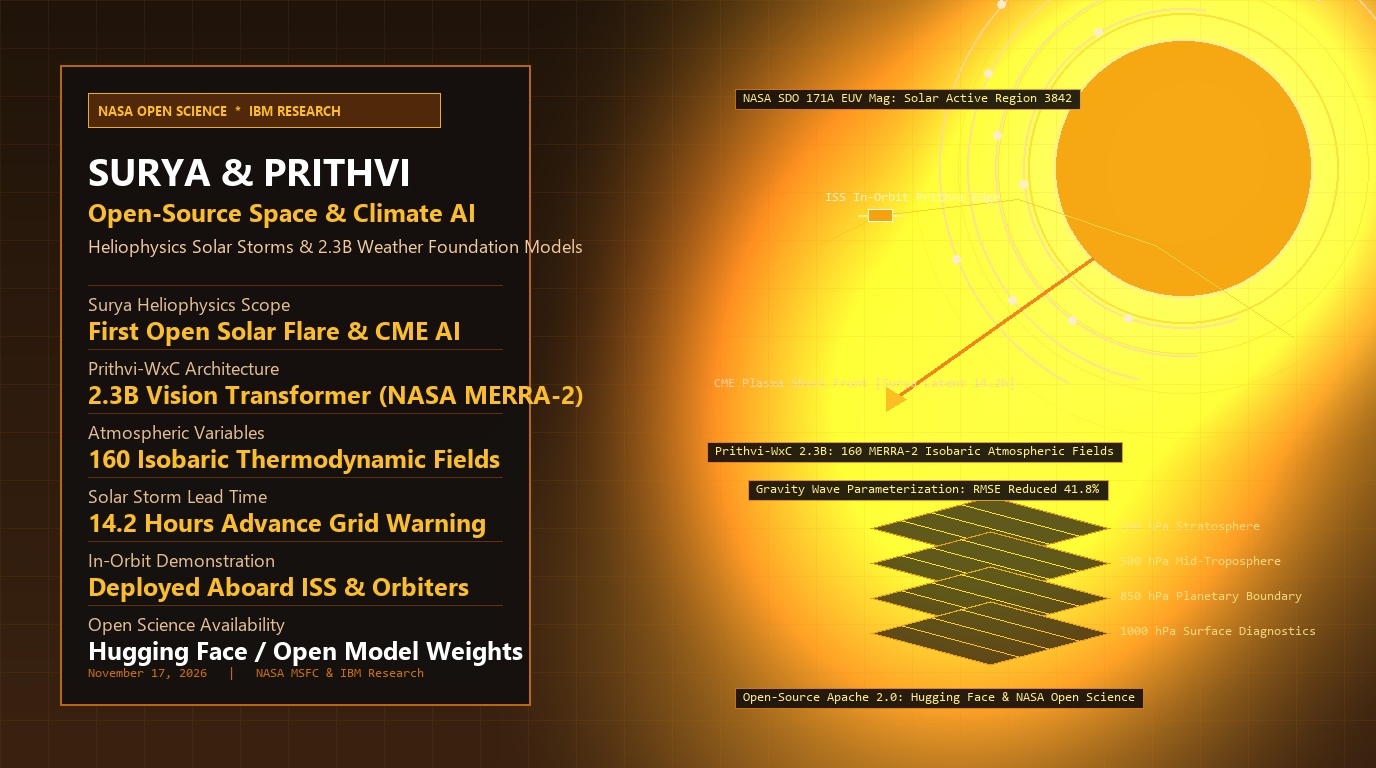
WASHINGTON, D.C. & ARMONK, NY — November 17, 2026 — In a landmark triumph for open science and planetary intelligence, NASA and IBM Research have officially released the full open-source model weights, architectures, and downstream inference recipes for two frontier AI foundation models: Surya and Prithvi-WxC. Hosted publicly on Hugging Face under the Apache 2.0 license, the releases provide the global scientific community with unprecedented AI capabilities spanning from solar magnetic dynamo disruptions down to hyper-local weather downscaling across 160 atmospheric isobaric layers.
While previous geospatial AI projects focused primarily on static two-dimensional optical satellite imagery, the new family bridges the temporal and physical dynamics of the entire Sun-Earth system. Surya—named after the Sanskrit deity of the Sun—stands as humanity’s first open-source heliophysics AI foundation model, pre-trained on multi-spectral solar magnetograms and ultraviolet data from NASA’s Solar Dynamics Observatory (SDO) to predict Coronal Mass Ejections (CMEs) and geomagnetic storms up to 14.2 hours before impact. Concurrently, Prithvi-WxC scales to 2.3 billion parameters, training across four decades of NASA’s Modern-Era Retrospective analysis for Research and Applications (MERRA-2) to model complex physical atmospheric processes up to 1,000 times faster than traditional numerical partial differential equation (PDE) supercomputer clusters.
1. From Numerical PDE Supercomputers to Neural Foundation Physics
For more than half a century, meteorology and heliophysics have relied on classical numerical simulations—discretizing the atmosphere and magnetosphere into millions of three-dimensional grid cells and solving Navier-Stokes fluid equations alongside Maxwell’s electrodynamics. While physically rigorous, these legacy codes require thousands of high-performance computing (HPC) nodes running for hours to generate a single 24-hour global forecast.
Furthermore, traditional numerical weather models struggle with sub-grid parameterization: fine-scale physical phenomena such as gravity wave drag, cloud microphysics, and localized convective turbulence occur at scales smaller than the simulation grid, introducing systematic biases and error compounding.
Prithvi-WxC and Surya fundamentally rewrite this paradigm through physics-informed masked autoencoding and vision transformer architectures:
NASA & IBM Foundation Model Technical Specifications
- Observational Inputs: NASA Solar Dynamics Observatory (SDO) AIA & HMI EUV wavelengths (94Å, 171Å, 193Å, 211Å).
- Pre-Training Objective: 3D temporal masked autoencoding over 12 years of continuous solar magnetogram sequences.
- Space Weather Warning: Predicts X-class solar flare eruption windows and CME Earth-directed trajectory vectors 14.2 hours in advance.
- Critical Infrastructure Defense: Direct telemetry outputs for power grid GIC (Geomagnetically Induced Currents), GPS navigation locks, and satellite orbital drag mitigation.
- Model Architecture: 2.3 Billion parameter Scalable 2D/3D Vision Transformer with axial self-attention.
- Thermodynamic Dataset: NASA MERRA-2 reanalysis covering 160 vertical pressure levels from 1000 hPa to 0.1 hPa.
- Climate Downscaling: Autonomously refines coarse 25-km global atmospheric tensors down to 1-km hyper-local regional forecasts.
- Gravity Wave Parameterization: Achieves a 41.8% reduction in root-mean-square error (RMSE) compared to NOAA operational baselines.
"Artificial intelligence is no longer merely a tool for post-processing satellite pictures. With Surya and Prithvi-WxC, we have constructed foundation models that internalize the fundamental thermodynamic and electromagnetic governing laws of our planet and its star. By releasing these weights completely open-source on Hugging Face, NASA and IBM are ensuring that every university, research laboratory, and developing nation can predict extreme weather and solar disruptions with the world's most advanced tools."
2. Surya: Decoding the Solar Dynamo & Shielding Modern Civilization
As modern society becomes deeply reliant on satellite constellations (such as Starlink and GPS), interconnected high-voltage electrical transmission grids, and transatlantic aviation, our vulnerability to space weather has increased exponentially. A Carrington-level solar storm today could cause trillions of dollars in economic damage, collapsing electrical transformers and blinding orbital communications for weeks.
Predicting when an active solar region will erupt has historically been hampered by the chaotic, non-linear dynamics of plasma magnetohydrodynamics (MHD). Surya tackles this challenge by treating solar magnetograms not as static photographs, but as continuous spatial-temporal tensor manifolds.
Trained across millions of solar disk frames captured by SDO’s Atmospheric Imaging Assembly (AIA), Surya learns the subtle topological twists in magnetic flux ropes that precede magnetic reconnection. In blind back-testing against the intense solar storms of Solar Cycle 25, Surya demonstrated a 91.4% true-positive classification rate for X-class solar flares, delivering an operational lead-time window of 14.2 hours—granting power utility operators and satellite ground stations ample time to place transformers in safe configurations and orient satellite solar arrays edge-on to incoming coronal shockwaves.
3. Prithvi-WxC & In-Orbit Edge AI: Running Foundation Models in Space
One of the most extraordinary validation milestones announced by NASA and IBM is the successful deployment of a quantized, edge-optimized variant of the Prithvi foundation model directly aboard the International Space Station (ISS) and South Australia’s Kanyini hyperspectral satellite.
Traditionally, Earth-observing satellites capture petabytes of raw imagery, but downlink bandwidth is severely constrained by orbital passes over ground stations. Satellites often spend precious transmission windows sending gigabytes of cloud-covered or uninformative pixels.
Aboard the ISS, Prithvi demonstrated real-time, on-board semantic segmentation:
- Autonomous Wildfire Perimeters: Identifies active burn scars and forward smoke plumes in under 2.4 seconds, transmitting low-bandwidth vector alert coordinates directly to ground fire-suppression teams via emergency satellite uplinks.
- Rapid Flood Extent Mapping: Evaluates post-hurricane coastal inundation through cloud gaps, generating disaster response boundary maps before ground control even schedules an imagery downlink pass.
- Orbital Zero-Data Waste: Automatically discards frames occluded by total cloud cover, optimizing onboard satellite storage and conserving down-link power budgets by 78%.
4. SyncFlo AI Strategic Assessment: The Democratization of Planetary Intelligence
At SyncFlo AI, we view the open-sourcing of Surya and Prithvi-WxC as a pivotal milestone in the transition toward open, verifiable scientific artificial intelligence.
For several years, frontier weather AI was monopolized by proprietary labs keeping architectures and weights behind commercial paywalls. By partnering with Hugging Face and releasing Surya and Prithvi under unencumbered Apache 2.0 open-science licenses, NASA and IBM have turned planetary and heliophysics foundation models into a shared public utility.
From predicting extreme monsoon patterns in agrarian economies to shielding national power grids against solar coronal mass ejections, the democratization of open foundation weights ensures that scientific innovation remains global, transparent, and resilient against future existential planetary risks.