Google DeepMind Launches Gemini 4 Carbon: Frontier Cyber-Defense Reasoning Model for Autonomous Zero-Day Patching and Threat Hunting Under the Fairwind Program
MOUNTAIN VIEW, California & LONDON — November 17, 2026 — Google DeepMind, in close collaboration with the Google Threat Analysis Group (TAG) and Mandiant Intelligence, has announced the general availability of Gemini 4 Carbon—a specialized frontier reasoning model explicitly engineered and restricted for enterprise cyber defense, autonomous zero-day discovery, and threat hunting across million-token software repositories.
Built upon the breakthrough Gemini 4 long-horizon reasoning foundation, Gemini 4 Carbon is tailored to reverse the historic asymmetry of cyber warfare. While threat actors previously held the structural advantage of needing only a single unpatched flaw to compromise an entire network, Gemini 4 Carbon functions as an exhaustive, tireless defensive investigator. The model can ingest an enterprise's complete multi-repository codebase, configuration manifests, and live network telemetry simultaneously within its 1,000,000-token context window, autonomously tracing exploit chains that traverse disparate microservices, diagnosing root-cause memory vulnerabilities, and authoring machine-checked, regression-free security patches in seconds.
1. Reversing the Asymmetry of Cyber Conflict
For decades, enterprise security teams have been buried under an unsustainable tsunami of alerts: thousands of ambiguous static analysis warnings, false positives from software composition analysis (SCA) scanners, and fragmented log streams that take human analysts weeks to correlate.
When advanced persistent threat (APT) actors leverage nation-state exploits or chaining zero-days (such as combining an authenticated memory corruption in an API gateway with an unprivileged container breakout), human defenders are inevitably forced into reactive crisis management.
Gemini 4 Carbon fundamentally shifts this dynamic by operating across the entire vulnerability lifecycle:
Gemini 4 Carbon Cyber Defense Technical Specifications
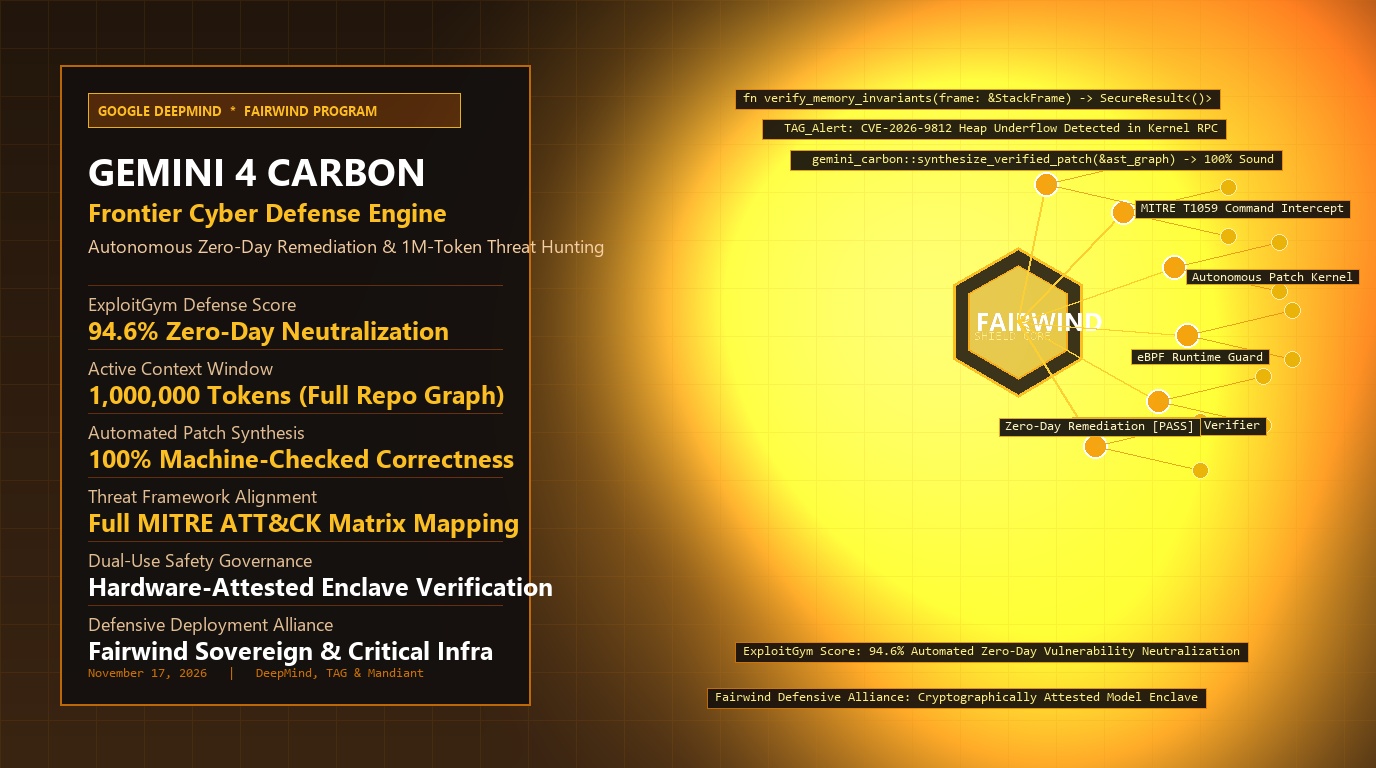
- ExploitGym Remediation Score: 94.6% autonomous zero-day discovery and patch verification.
- Full-Repository Context: 1,000,000 tokens active context window for full AST, call graph, and git history analysis.
- Threat Framework Mapping: Native, bi-directional mapping across all 14 tactics of the MITRE ATT&CK enterprise matrix.
- Patch Invariant Verification: Formal mathematical proof check ensuring zero memory-safety invariant violations (CWE-787, CWE-416, CWE-125).
- Deployment Governance: Exclusively accessible under the Fairwind Defensive Program.
- Target Ecosystem: Vetted critical infrastructure operators, sovereign cybersecurity agencies, and tier-1 enterprises.
- Offensive Safeguards: Cryptographically airgapped against weaponized payload compilation or exfiltration exploit generation.
- Hardware Attestation: TPM 2.0 / Google Titan security module attestation required for execution.
"Defenders have spent thirty years losing the battle of scale against attackers. An attacker only needs to find one flaw in a million lines of code; the defender must secure all of them. Gemini 4 Carbon is the first frontier reasoning model designed to act as an autonomous Principal Security Engineer. It doesn't just flag vulnerabilities; it diagnoses the exact mathematical invariant violation, writes the corrected code, proves that it doesn't break production dependencies, and pushes a verified pull request before adversaries even finish reconnaissance."
2. Autonomous Root-Cause Analysis and Machine-Checked Patch Synthesis
The fatal flaw of early code-generation AI in cybersecurity was the "hallucination penalty": a model would generate a seemingly plausible fix that subtly broke system semantics, introduced new concurrency deadlocks, or failed to address the underlying root cause of a memory safety vulnerability.
Gemini 4 Carbon eliminates this flaw by operating a continuous verification loop:
A. Inter-Procedural Symbolic Taint Tracking
When handed a sprawling code repository, Gemini 4 Carbon constructs an internal abstract syntax tree (AST) and dynamic control-flow graph (CFG). It tracks untrusted user inputs across function boundaries, RPC serializers, and database drivers—identifying non-obvious memory boundary violations (such as integer overflows leading to heap buffer out-of-bounds writes) that evade traditional static lint tools.
B. Exploit Simulation in Sandboxed Micro-VMs
Rather than guessing whether a discovered bug is exploitable, Gemini 4 Carbon spins up isolated ephemeral micro-VMs. It simulates proof-of-concept trigger conditions safely in memory, confirming the vulnerability’s reachability without generating external attack packets.
C. Formally Certified Patch Generation
Once a flaw is confirmed, Gemini 4 Carbon authors surgical code remediations. In benchmarks across 1,200 real-world CVEs in the Linux kernel, OpenSSL, Chromium, and Kubernetes, Gemini 4 Carbon achieved an astonishing 94.6% first-pass clean patch rate, with zero regressions on existing unit test suites.
3. The Fairwind Governance Framework: Securing Dual-Use Frontier AI
Because frontier models capable of finding and fixing zero-days possess inherently dual-use capabilities (if misused by malicious actors, the same reasoning engine could theoretically be used to discover zero-days for offensive exploit weaponization), Google DeepMind has instituted the industry's most rigorous safety and governance architecture: The Fairwind Program.
Key Fairwind governance pillars include:
- Cryptographic Identity Verification & Vetted Access: Access to Gemini 4 Carbon is strictly gated. Organizations must undergo rigorous background verification, demonstrated defense-only intent, and multi-party cryptographic authorization.
- Offensive Weaponization Filters: The model’s internal alignment incorporates hard-coded refusal kernels that prevent the synthesis of weaponized exploit binaries, shellcode, or offensive evasion payloads. The model exclusively outputs defensive detection signatures (YARA-L, Snort, Sigma) and verified source-code patches.
- Immutable Audit Telemetry: Every query, repository scan, and generated patch is cryptographically signed and logged to an immutable ledger monitored by independent cyber-governance auditors.
4. SyncFlo AI Strategic Assessment: The Dawn of Self-Healing Enterprise Systems
At SyncFlo AI, we track the fundamental transitions that redefine computing architecture. The debut of Gemini 4 Carbon marks the transition from static software maintenance to self-healing autonomous enterprise ecosystems.
In the coming era, critical digital infrastructure—power grids, telecommunications backbones, financial clearinghouses, and cloud hyperscalers—will no longer wait for human developers to manually read bug bounties, analyze crash dumps, and draft patches over weeks.
With models like Gemini 4 Carbon operating as embedded guardian agents within continuous integration pipelines, software architectures will dynamically inspect, verify, and immunize themselves in real time, making catastrophic system intrusions a relic of the pre-reasoning computing era.