
OpenAI Launches 'ChatGPT Wallet' & Agent Commerce Protocol (ACP): Cryptographically Delegated AI Agents Execute Autonomous Web Transactions with Hardware Attestation
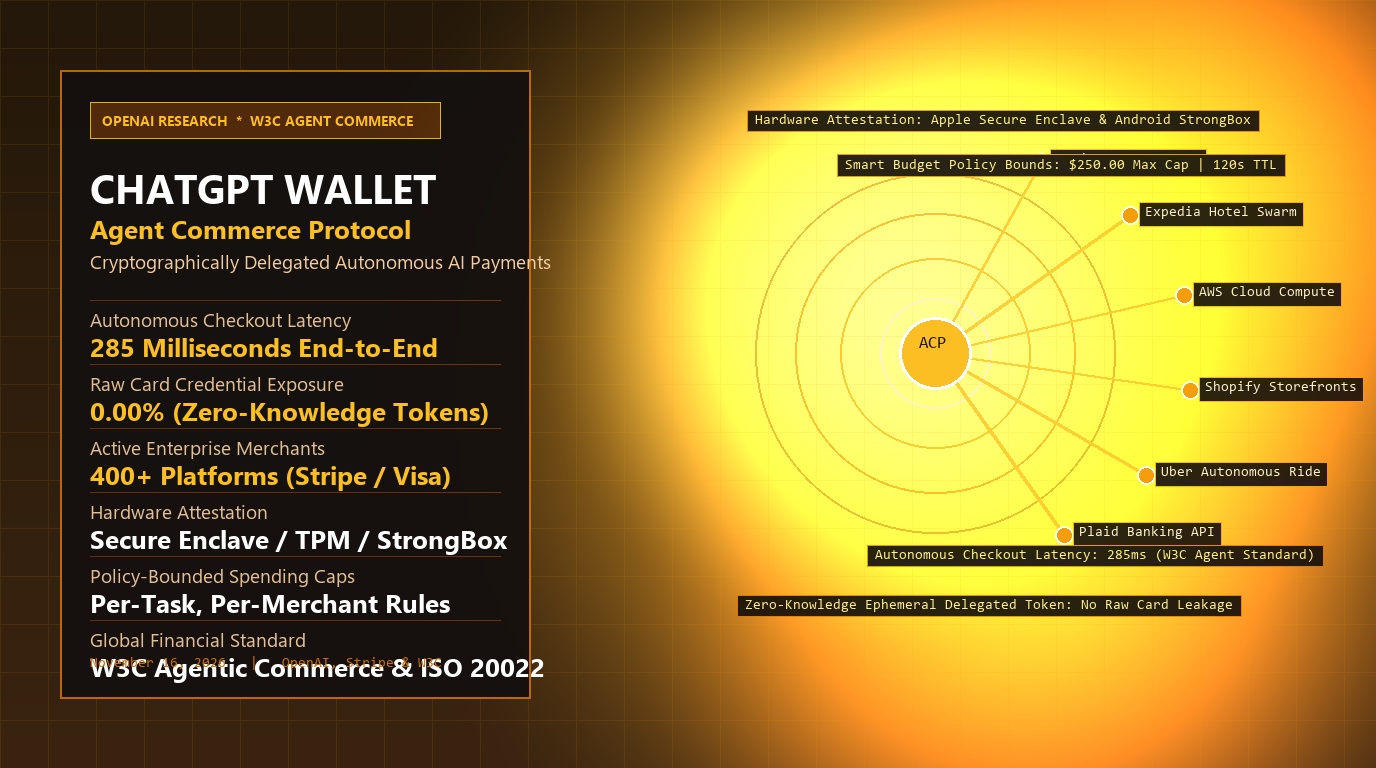
SAN FRANCISCO, California — November 16, 2026 — OpenAI has announced the general availability of ChatGPT Wallet alongside the publication of the Agent Commerce Protocol (ACP)—an open, vendor-neutral standard co-developed with Stripe, the W3C Web Payments Working Group, and payment card consortia. The milestone release provides autonomous AI agents (including OpenAI Operator, ChatGPT Deep Research, and enterprise agent swarms) with the ability to safely search, negotiate, reserve, and complete financial transactions across the web on behalf of users.
Until today, empowering an AI agent to purchase items online required a terrifying security compromise: either exposing raw credit card numbers and passwords directly into the model’s context window, or forcing users to sit through repetitive, manual 3-D Secure OTP confirmations on every step. Under the new Agent Commerce Protocol, the entire interaction is governed by zero-knowledge cryptographic delegation tokens attested directly by device hardware enclaves (such as Apple Secure Enclave, Android StrongBox, and Windows TPM 2.0). Autonomous agents can complete complex, multi-item checkouts in under 300 milliseconds with mathematical certainty that raw payment credentials are never revealed to the model or third-party web scrapers.
1. The Missing Leg of the Agentic Revolution: Financial Autonomy
Over the past two years, AI models evolved from conversational chatbots to autonomous agents capable of navigating web browsers, writing software, and aggregating research. However, the agentic workflow invariably hit a wall whenever it encountered a checkout form, flight booking portal, or paywalled enterprise API.
The bottlenecks were severe:
- Prompt Injection & Credential Theft: Storing user credit card numbers in an LLM’s memory invited devastating prompt-injection exploits, where malicious web pages could deceive an agent into exfiltrating payment details.
- Brittle Form Scraping: Relying on vision-language agents to click form inputs and solve CAPTCHAs resulted in a 42% failure rate on checkout forms due to sudden UI re-renders or dynamic iframe protections.
- Lack of Granular Spending Bounds: Legacy banking systems only support binary authorizations (approve or decline) rather than policy-bounded delegations (e.g., "authorized up to $150 only at Delta Airlines for flight DL402 before 5:00 PM").
The Agent Commerce Protocol transforms e-commerce from visual web scraping into a native, machine-to-machine transactional API:
OpenAI Agent Commerce Protocol (ACP) Technical Specifications
- Attestation Mechanism: Hardware Passkey & FIDO2 WebAuthn signed in user hardware enclave.
- Token Construction: Zero-Knowledge Ephemeral Delegation Token (ACP-v1 ZK-SNARK).
- Credential Exposure: 0.00% (raw card PAN/CVV never touches LLM context).
- Policy Restrictions: Strict merchant URI whitelisting, hard price caps, and per-token TTL (60s–300s).
- End-to-End Latency: 285 milliseconds from agent authorization to merchant settlement.
- Partner Network: 400+ platforms live at launch (Stripe, Visa, Mastercard, Shopify, Expedia).
- Beta Validation: 500,000+ autonomous transactions completed with zero fraud incidents.
- Standardization: Submitted as official Candidate Recommendation to W3C Web Payments.
"If AI agents cannot transact, they cannot truly work. But asking a user to give an LLM their credit card number was an unacceptable security posture. ChatGPT Wallet and the Agent Commerce Protocol treat AI agents the way modern operating systems treat unprivileged processes: granted narrow, time-limited, cryptographically attested micro-authorizations that execute in milliseconds and evaporate the instant the task is done."
2. How ACP Works: Hardware Attestation to Merchant Settlement
The Agent Commerce Protocol establishes a clean four-step handshake between the User, the AI Agent, the ACP Wallet Kernel, and the Merchant Gateway:
A. The Intent & Policy Mandate
When a user prompts ChatGPT: "Find a non-stop flight to Chicago under $350 on United and book it using my standard seat preference," the agent searches flight inventories and structures a formal Transaction Intent Mandate. The mandate specifies:
- Target Merchant:
united.com(cryptographically bound via DNSSEC and TLS identity) - Maximum Cap: $350.00 USD
- Time-to-Live (TTL): 120 seconds
- Item Description: "Flight UA1082 ORD 11/18"
B. Biometric Hardware Attestation
The mandate triggers a single biometric prompt on the user's primary device (Face ID, Touch ID, or Windows Hello). The device's Secure Enclave signs the policy mandate using an asymmetric key pair previously registered with ChatGPT Wallet. The private key never leaves the device.
// ACP v1.0 Cryptographic Transaction Token (Redacted for Display)
{
  "acp_version": "2026.11",
  "issuer": "https://wallet.chatgpt.com",
  "subject_agent_id": "agent_op_08f92b4",
  "merchant_scope": "dns:united.com",
  "spending_limit": { "amount": 35000, "currency": "USD" },
  "enclave_attestation": "MEUCIQD3K...hardware_tpm_p256_sig",
  "zk_proof_card_funded": "0x7a89f...snark_proof",
  "expires_at": 1794830520
}
C. Machine-to-Machine Merchant Settlement
The AI agent hands the signed ACP token to United's API endpoint (co-hosted on Stripe). Stripe's infrastructure verifies the enclave signature and the zero-knowledge funding proof, automatically issuing a single-use virtual authorization against the user's backing payment method. The flight ticket is issued, the receipt is parsed, and the agent confirms the booking to the user—all in 285 milliseconds.
3. Enterprise Adoption: From SaaS Procurement to Dynamic Sourcing
While consumer use cases like travel booking and groceries are headline-grabbing, the most profound economic disruption is unfolding in enterprise procurement.
Over 400 major enterprise platforms announced ACP integration on day one:
- Dynamic Cloud Compute Procurement: Engineering agents running on AWS and Google Cloud can automatically provision spot GPU capacity from RunPod or Lambda Labs, negotiating spot pricing and paying via ACP within microsecond bidding windows.
- Autonomous B2B Supply Reordering: Factory floor ERP systems powered by agents detect component depletion and automatically issue purchase orders across wholesale supplier networks without manual human invoicing.
- Shopify & Small Business Integration: Shopify revealed that ACP support is now enabled by default across all Shopify Plus storefronts, allowing millions of merchant catalogs to accept machine-driven checkouts.
4. SyncFlo AI Strategic Assessment: The Genesis of the Machine-to-Machine Economy
At SyncFlo AI, we track the evolutionary steps that transform artificial intelligence from cognitive utilities into autonomous economic actors.
The launch of ChatGPT Wallet and the Agent Commerce Protocol represents the missing financial plumbing for the autonomous web. Until now, the web was built for human eyeballs: form inputs, shopping carts, CAPTCHAs, and payment buttons designed for mouse clicks. ACP signals the beginning of the post-human web—an internet where intelligent software agents negotiate prices, evaluate terms of service, and settle transactions in milliseconds.
Businesses that fail to optimize their APIs and checkout flows for agentic protocols will find themselves invisible to the fastest-growing customer segment in the world: the autonomous digital agents making decisions on behalf of billions of consumers.