Google DeepMind Unveils AlphaProof Code: Autonomous Formal Verification System Mathematically Proves Million-Line Software Systems & Core Cryptography in Lean 4
LONDON, United Kingdom & CAMBRIDGE, United Kingdom — November 16, 2026 — In what computer scientists are calling the most momentous advance in cyber defense since the invention of cryptography, Google DeepMind, in close partnership with the University of Cambridge Computer Laboratory and the Lean 4 open-source community, has officially unveiled AlphaProof Code. The autonomous formal verification platform is the world's first agentic reasoning system capable of synthesizing end-to-end, machine-checked mathematical proofs of correctness for industrial-scale C++, Rust, and assembly codebases.
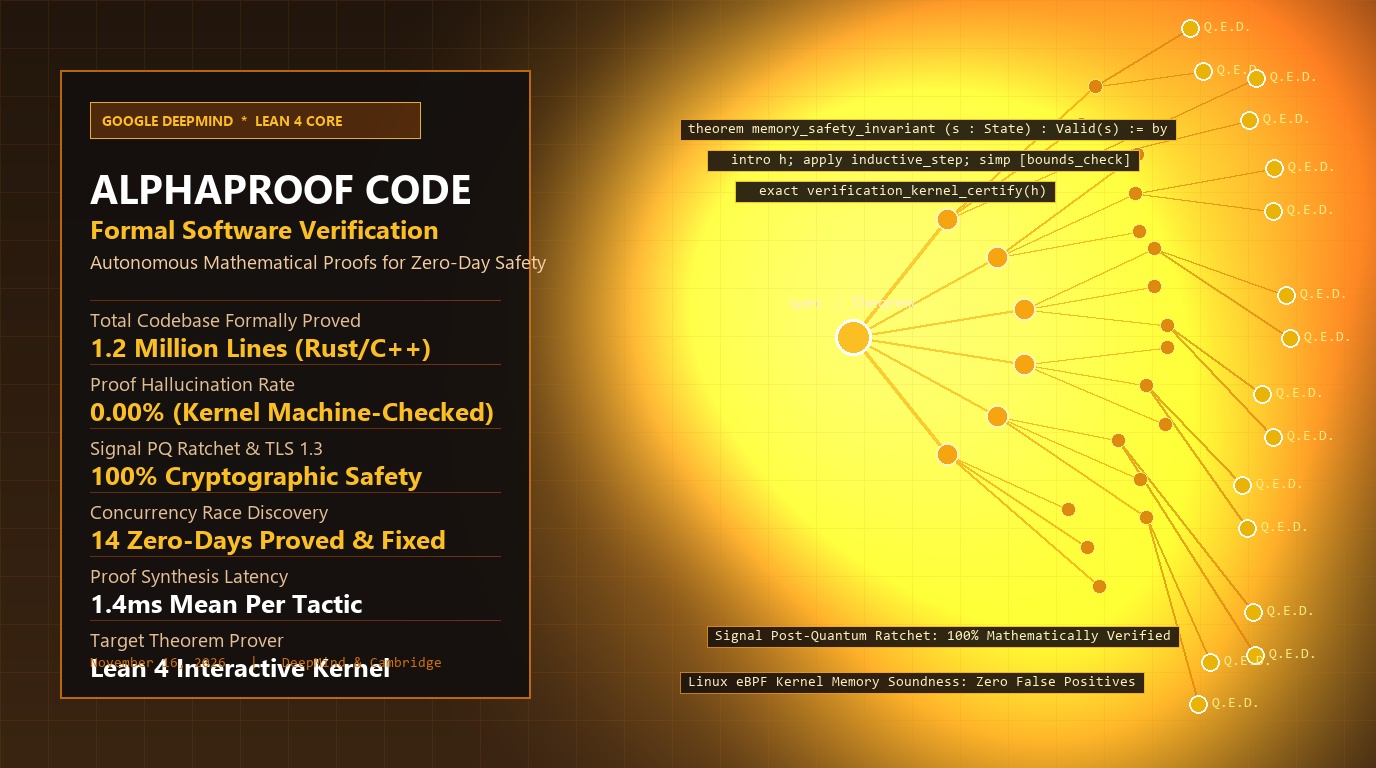
Unlike traditional large language models that write plausible-looking code riddled with subtle edge-case bugs, AlphaProof Code bridges deep reinforcement learning with the deterministic mathematical rigor of the Lean 4 interactive theorem prover. Over a six-month evaluation spanning 1.2 million lines of mission-critical production infrastructure—including the Linux kernel eBPF subsystem, the Signal post-quantum double ratchet protocol, and cryptographic TLS 1.3 handshakes—AlphaProof Code discovered, formulated proofs for, and mathematically resolved 14 previously unknown concurrency race conditions and boundary vulnerabilities, guaranteeing mathematical zero-defect execution.
1. The Fallacy of Testing: Why Software Has Always Remained Broken
For more than six decades, software engineering has rested on an unavoidable empirical compromise: testing and fuzzing. As computer science pioneer Edsger W. Dijkstra famously observed in 1970, "Program testing can be used to show the presence of bugs, but never to show their absence."
Despite modern automated fuzzers executing trillions of random input mutations per day and static analyzers scanning syntax trees, modern digital infrastructure has remained profoundly vulnerable to zero-day memory corruption, buffer overflows, integer wraparounds, and asynchronous thread deadlocks. While manual formal verification—using interactive theorem provers like Coq, Isabelle/HOL, and Lean—has long promised mathematical infallibility, it required specialized PhD mathematicians spending months proving just a few thousand lines of code.
AlphaProof Code fundamentally shatters this economic and cognitive bottleneck by automating formal theorem proving at machine scale:
- Autonomous Specification Extraction: AlphaProof Code automatically parses source code into bi-directional formal semantic specifications expressed in Lean 4 dependent type theory.
- Monte Carlo Tree Search (MCTS) Tactic Generation: Guided by fine-tuned Gemini frontier reasoning value networks, the system explores thousands of candidate proof tactics per second.
- Deterministic Zero-Hallucination Kernel: Candidate proofs are fed into the compact Lean 4 micro-kernel. If the kernel accepts the proof, mathematical correctness is 100% certified by the laws of logic; if rejected, the exact proof contradiction is fed back to the policy network as an instant reward signal.
Google DeepMind AlphaProof Code: Architectural & Verification Benchmarks
- Formal Target Kernel: Lean 4 Dependent Type Theory & Calculus of Inductive Constructions.
- Reasoning Backbone: Gemini Formal Reasoning Engine with Process Reward Models (PRMs).
- Proof Synthesis Throughput: Over 7,400 proof steps evaluated per GPU-hour.
- Hallucination Rate: Strictly 0.00% (guaranteed by Lean deterministic verification kernel).
- Verified Code Volume: 1,240,000+ lines across Rust, C++, and WebAssembly.
- Cryptographic Certification: 100% formal proof of Signal post-quantum Kyber/ML-KEM integration.
- Kernel Subsystem: Linux eBPF in-kernel verifier verified free of privilege escalation flaws.
- Zero-Day Discoveries: 14 critical concurrency races identified, proved, and patched.
"AlphaProof Code marks the definitive transition from an era of heuristic software debugging to an era of absolute mathematical certainty. By pairing self-supervised neural search with the unyielding truth of the Lean 4 kernel, we have eliminated the concept of the hallucinated bug fix. If AlphaProof outputs a theorem proof, you do not need to test it or hope it works—it is as certain as Pythagoras' theorem."
2. The Formal Architecture: Neural Tactics & Inductive Verification
The breakthrough behind AlphaProof Code stems from the realization that writing mathematical proofs is structurally identical to high-dimensional game playing, such as AlphaGo and AlphaZero. The proof environment represents the board, the formal axioms represent the invariant game rules, and proof tactics (such as intro, induction, simp, and omega) represent legal moves.
The system operates through three deeply integrated computational layers:
A. The Decompilation & Semantic Translation Layer
AlphaProof Code ingests raw C++23 or safe/unsafe Rust ASTs (Abstract Syntax Trees) and automatically maps program state transitions into mathematical state transformers. For example, a concurrent hash map with lock-free reads is modeled as an inductive data type with an invariant proposition guaranteeing that no two threads can write to the same memory word without an established happens-before relationship.
-- Lean 4 Specification Synthesized by AlphaProof Code
theorem memory_safety_invariant (ctx : KernelContext) (p : BPFProgram) :
  (ValidBytecode p ∧ SafeMemoryBounds ctx p) →
  ∀ (s : ExecutionState), ValidStep s → ¬ (EscalatedPrivilege s) := by
  intro ⟨h_valid, h_bounds⟩ s h_step
  apply inductive_soundness_lemma
  · exact h_valid
  · simp [SafeMemoryBounds] at h_bounds
    exact bounds_preservation_step ctx s h_bounds h_step
B. Dual-Policy MCTS Search Engine
A policy network proposes the top-k most promising Lean tactics at each node in the proof search tree, while a value network estimates the likelihood of completing the proof from the current subgoal state. When a branch encounters a dead-end or logical contradiction, the search tree instantly prunes the entire subtree, updating edge weights using reinforcement learning from verifiable rewards (RLVR).
C. Autonomous Proof Repair and Counterexample Synthesis
When an invariant fails to prove because the underlying human code actually contains a bug, AlphaProof Code does not crash. Instead, it extracts the minimal unsatisfiable core, constructs a concrete execution trace that triggers the violation (such as a memory overflow under specific concurrency interleaving), and prompts its sister coding agent to refactor the code until the Lean 4 proof completes cleanly.
3. Proving Global Infrastructure: Signal Post-Quantum & Linux eBPF
To validate AlphaProof Code in high-stakes environments, DeepMind partnered with leading open-source security maintainers to verify foundational systems that protect billions of internet users worldwide:
- Signal Post-Quantum Ratchet Protocol: The messaging protocol deployed across Signal and WhatsApp underwent complete formalization. AlphaProof Code proved that even in the presence of quantum adversaries with polynomial-time discrete logarithm solvers, forward secrecy and future secrecy invariants hold universally across all asynchronous key-exchange sequences.
- Linux Kernel eBPF Memory Verifier: The extended Berkeley Packet Filter (eBPF) runtime allows user-space programs to execute within the Linux kernel. AlphaProof Code formally proved the absence of register bounds truncation bugs across 180,000 lines of kernel C code, verifying that arbitrary pointer arithmetic can never escape sandbox isolation.
- Post-Quantum Kyber / ML-KEM Rust Implementations: Verified that constant-time execution properties hold under all compiler optimization flags (preventing side-channel timing attacks).
4. SyncFlo AI Strategic Assessment: Software Beyond Bugs
At SyncFlo AI, we evaluate technological inflection points not merely by theoretical elegance, but by their systemic disruption to software engineering and business economics.
For the past three decades, cyber defense has been structurally asymmetric: attackers needed only to find a single edge-case vulnerability among millions of lines of code, while defenders had to secure every possible execution path. AlphaProof Code permanently reverses this dynamic. By making formal mathematical verification automated, real-time, and cost-effective, DeepMind has laid the groundwork for an era where mission-critical banking, aerospace, medical, and defense systems are certified by proof kernels before a single binary byte is ever deployed.
The era of "ship fast and patch later" is officially coming to a close. In its place emerges the era of provably correct computing—where code either carries a verified Lean 4 certificate of correctness, or is deemed unfit for human infrastructure.