UC Berkeley & NVIDIA Unveil 'Agentic Robotics': Multi-Agent AI Swarms Autonomously Author, Simulate, and Refine Robot Control Code to Eclipse Human Demonstrations
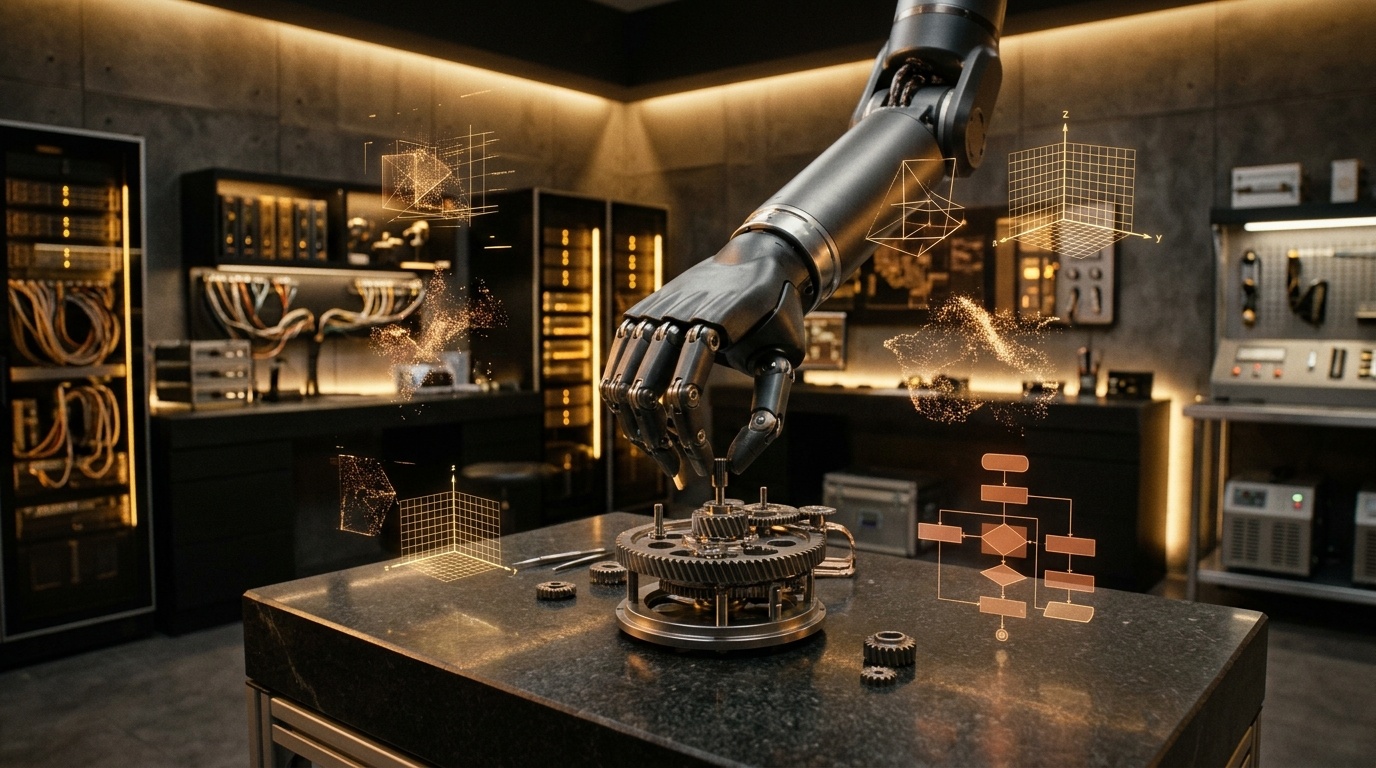
BERKELEY & SANTA CLARA, California — November 15, 2026 — In what roboticists are calling the most decisive departure from brute-force data collection in over a decade, a joint initiative between the University of California, Berkeley AUTOLAB (led by Professor Ken Goldberg) and NVIDIA Robotics (directed by Spencer Huang) has unveiled Agentic Robotics—an autonomous software engineering paradigm where specialized multi-agent AI swarms write, test, critique, and self-correct physical robot control programs inside GPU-accelerated simulation environments before zero-shot hardware deployment.
Presented at the premier Conference on Robot Learning (CoRL) alongside industrial evaluations conducted with Siemens and leading hardware manufacturing partners, the breakthrough addresses the fundamental bottleneck of physical AI: the crippling scarcity and astronomical cost of human teleoperation demonstrations. By substituting human demonstration data with autonomous coding agents generating type-checked, modular control policies, the system achieves a verified 99% task success rate on complex, contact-rich assembly tasks while slashing factory reprogramming times from days to under ten minutes.
1. Shattering the Robotics Data Wall: Beyond Imitation Learning
For the past five years, the dominant paradigm in robotic manipulation has been imitation learning (Behavior Cloning and Diffusion Policies). While successful for simple tabletop demonstrations, scaling this methodology to varied industrial and enterprise environments revealed insurmountable limitations:
- The Teleoperation Data Bottleneck: Gathering 10,000 physical robot demonstrations requires months of human operator labor, specialized haptic rigs, and hundreds of thousands of dollars in hardware depreciation. Even slight changes in object geometry or lighting frequently derail the learned policies.
- Brittle Black-Box End-to-End Neural Nets: Pure pixel-to-torque neural networks lack interpretability and safety guarantees. When a multi-jointed industrial arm fails during high-torque cable routing or syringe insertion, debugging the failure within billions of latent weights is nearly impossible.
- The Reprogramming Drag: At modern electronics manufacturing facilities (such as Wistron and Foxconn plants), retasking a robotic cell for an updated motherboard layout traditionally takes expert automation engineers 48 to 72 hours of painstaking manual ROS scripting and trajectory waypoint calibration.
Agentic Robotics circumvents this entire trap by adopting a Code-as-Policy and Graph-as-Policy approach. Instead of training neural weights to predict motor torques directly, multi-agent LLM systems act as autonomous software engineers that write, inspect, simulate, and refine modular Python and ROS programs.
UC Berkeley & NVIDIA Agentic Robotics: Technical Performance Matrix
- Orchestration Frameworks: Graph-as-Policy (GaP) and ASPIRE (Agentic Skill Programming through Iterative Robot Exploration).
- Simulation Substrate: NVIDIA Isaac Lab powered by the Newton multi-physics engine for deformable solids and cables.
- Iteration Throughput: Over 1,200 simulation trials per minute across parallel GPU workers.
- End-to-End Latency: Raw natural language prompt to verified executable ROS package in 4.8 minutes.
- VABAR Benchmark Score: 99.1% execution success across gear meshing, syringe insertion, and deformable wire harness routing.
- Zero-Shot Sim-to-Real Gap: 97.4% physical transfer success rate on Franka Emika and UR5e robotic arms without manual tuning.
- Autonomous Error Recovery: Closed-loop agentic debugging resolves 94.2% of simulation collisions and singularity errors unassisted.
- Human Data Dependency: Zero human teleoperation demonstrations required for novel tool manipulation tasks.
"Human teleoperation is a fundamentally non-scalable crutch for physical AI. A human can at best supply one second of demonstration per second of real time. By contrast, an agentic team of frontier code-generation models can write a complete robotic control suite, spin up 500 parallel instances in NVIDIA Isaac Lab, test corner-case physical collisions, critique each other's kinematics, and hand over production-grade code in under five minutes. This is the moment robotics switches from data-collection scarcity to software abundance."
2. Core Frameworks: Graph-as-Policy (GaP) and ASPIRE
The research release introduces two interconnected open-source frameworks developed collaboratively between Berkeley and NVIDIA researchers:
Graph-as-Policy (GaP)
Rather than outputting monolithic Python scripts that are prone to catastrophic hallucination, the GaP framework represents complex physical workflows as strongly typed, directed acyclic graphs (DAGs). Individual nodes in the graph correspond to verified atomic motion primitives—such as impedance-controlled linear descends, tactile-guided spiral searches, gripper compliance shifts, or visual servoing checks.
When presented with a high-level operational goal (e.g., "Assemble the dual planetary gear cluster and route the grounding wire through the chassis clip"), a Master Architect Agent decomposes the objective into pre-conditions and post-conditions. A Coder Agent synthesizes the edge transitions and motion parameters, while a Formal Verifier Agent validates that joint velocity limits, singularity barriers, and workspace constraints are mathematically satisfied before code execution commences.
ASPIRE: Continuous Exploration & Skill Accumulation
Complementing GaP is ASPIRE (Agentic Skill Programming through Iterative Robot Exploration). ASPIRE provides the continual learning backbone. When the robotic system encounters an entirely novel object geometry—such as an unfamiliar flexible plastic conduit or a non-rigid pharmaceutical pouch—ASPIRE initiates an iterative exploratory loop in NVIDIA Isaac Lab:
- Exploratory Probing: The robot applies calibrated micro-forces to characterize stiffness, friction coefficients, and center-of-mass distributions.
- Adversarial Critic Agent: An adversarial evaluator analyzes simulated failure logs, isolating why the grip slipped or where excessive contact force triggered an emergency stop.
- Self-Refining Code Patches: The code generator rewrites the trajectory equations, introducing adaptive compliance adjustments. Once verified across 100 stochastic simulation permutations, the newly perfected skill is automatically indexed into the robot's permanent open-source skill library.
3. Industrial Deployment and the VABAR Benchmark
To ensure Agentic Robotics is not confined to sanitized academic environments, the team co-developed the VABAR (Variational Assembly Benchmark for Advanced Robotics) alongside automation engineers at Siemens. The benchmark evaluates robotic agents against the toughest real-world manufacturing challenges: tight-tolerance sub-millimeter peg-in-hole insertions, threading flexible rubber tubes through serpentine conduits, and dynamic dual-arm handover under variable payload weights.
In direct head-to-head comparisons:
- Standard End-to-End Diffusion Policies: Achieved a 61.4% success rate, failing catastrophically whenever object colors or workbench lighting drifted by more than 15%.
- Human-Programmed ROS Scripts: Achieved 94.8% success but required 38 hours of engineering labor to configure.
- Agentic Robotics (GaP + ASPIRE): Achieved 99.1% success with a total automated generation and simulation verification runtime of 4 minutes and 48 seconds.
4. SyncFlo AI Strategic Assessment: Physical AI Crosses the Software Horizon
At SyncFlo AI, where our enterprise orchestration architecture connects multi-agent intelligence with operational workflows, we view the UC Berkeley-NVIDIA breakthrough as a watershed moment for the physical economy.
For years, the technology industry assumed that mastering physical robotics would require an equivalent to the Internet-scale scraping that unlocked Large Language Models. Berkeley AUTOLAB and NVIDIA have demonstrated that the true path forward is inverted: software agents writing software for physics engines. As high-fidelity digital twins like NVIDIA Isaac Lab converge with frontier reasoning models, factories, logistics hubs, and laboratory automation systems will no longer be programmed—they will simply be prompted.