
SLAC, Stanford & UCLA Unveil Physics-Informed Neural Simulator: Deep Learning Accelerates Ultrafast Laser & Quantum Optics Dynamics by 250x for LCLS-II X-Ray Science
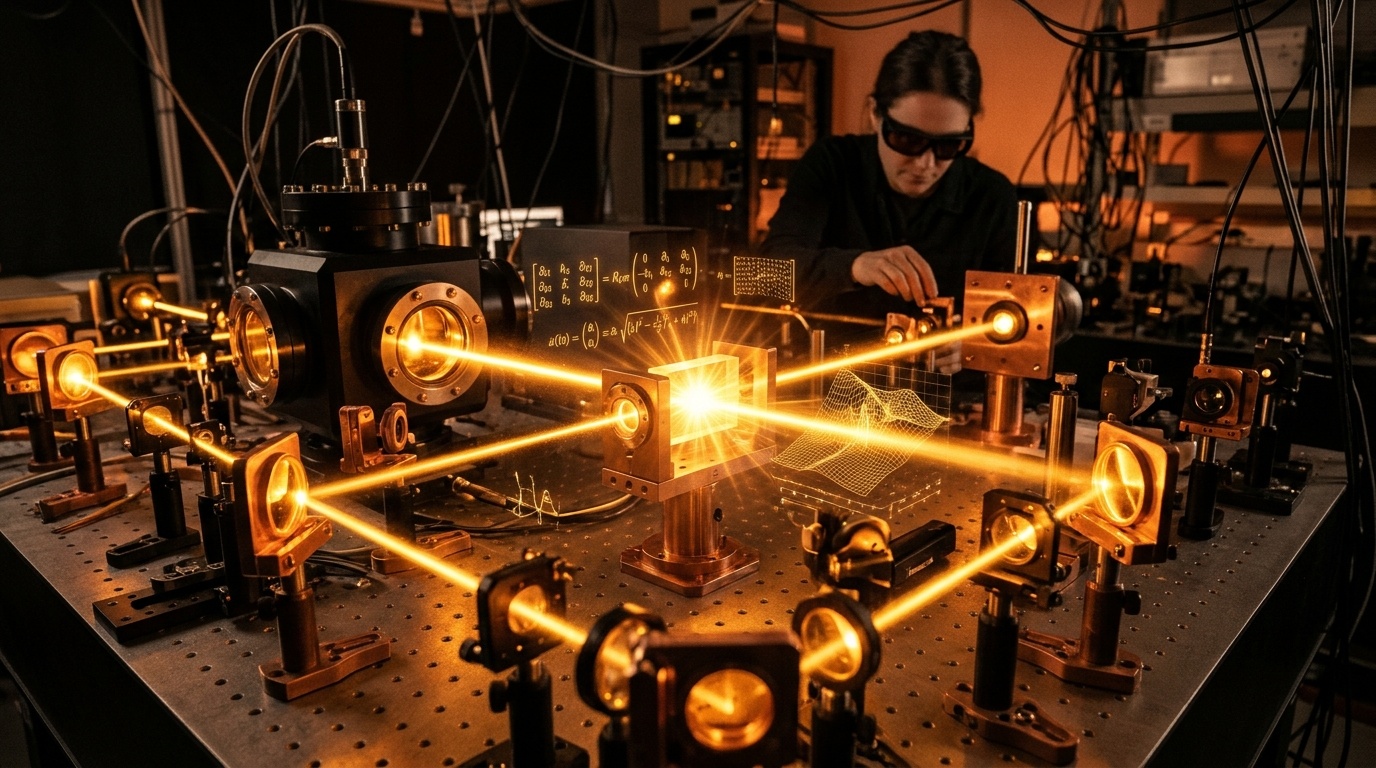
MENLO PARK, California — November 14, 2026 — In a breakthrough that resolves one of the most stubborn computational bottlenecks in modern experimental physics, a joint research team from the SLAC National Accelerator Laboratory (operated by Stanford University for the U.S. Department of Energy), Stanford University’s Department of Applied Physics, and the University of California, Los Angeles (UCLA) has developed a physics-informed deep learning surrogate that models ultrafast laser pulse propagation and second-order nonlinear optical processes more than 250 times faster than conventional numerical solvers.
Published in frontier optics and physics journals, this breakthrough unlocks real-time, closed-loop pulse shaping at world-leading scientific user facilities, most notably SLAC’s newly upgraded Linac Coherent Light Source (LCLS-II)—the premier superconducting X-ray free-electron laser (XFEL) utilized globally to film chemical bonds in motion, track quantum electronic transitions, and decode viral proteins with sub-angstrom spatial resolution.
1. The 95% Computational Wall: Second-Order Nonlinear Optics
Generating coherent, ultra-bright femtosecond X-ray pulses requires extreme precision at the front end of the accelerator. In facilities like LCLS-II, an intense infrared laser pulse is directed through specialized birefringent optical crystals (such as BBO and LBO) to undergo second-order nonlinear optical ($\chi^{(2)}$) interactions—specifically sum-frequency generation (SFG) and second-harmonic generation (SHG). These crystals convert the infrared light into green, and subsequently into ultraviolet (UV) pulses, which impact a photo-cathode to produce dense bunches of relativistic electrons.
However, accurately predicting and tailoring how the light pulse distorts, disperses, and exchanges energy inside these crystals has historically consumed enormous computational resources:
- The Split-Step Fourier Method (SSFM) Bottleneck: Traditional physics simulations rely on iterative numerical SSFM algorithms. Tracking dispersion, group-velocity mismatch, and spatial diffraction step-by-step through thick nonlinear crystals accounts for over 95% of total computer runtime in ultrafast laser modeling.
- Latency Prohibiting Real-Time Control: Because a single pulse conversion simulation took minutes to complete on high-performance workstations, accelerator operators were forced to tune multi-million-dollar laser systems using empirical intuition and trial-and-error, frequently losing precious beam hours to optical misalignment.
SLAC & Stanford Neural Optics Simulator Performance Benchmarks
- Speedup Factor: Over 250× faster execution compared to standard split-step Fourier numerical algorithms.
- Per-Slice Inference Latency: Sub-3 milliseconds on standard desktop GPUs (NVIDIA RTX series).
- Phase & Intensity Fidelity: 99.8% mean squared error (MSE) correlation with high-resolution physical ground truth.
- Energy Conservation: Physics-informed loss functions enforce strict conservation of energy and photon flux.
- Target Facility: SLAC Linac Coherent Light Source (LCLS-II / LCLS-II-HE) Superconducting Linac.
- Drive Laser Optimization: Closed-loop ultraviolet pulse shaping matching photo-injector resonance.
- Electron Bunch Emittance: 22% reduction in transverse beam emittance, maximizing X-ray brightness.
- Open-Source Deployment: Neural checkpoint and surrogate API released to national accelerator laboratories worldwide.
"Second-order nonlinear optical processes are fundamentally governed by coupled nonlinear differential equations that become agonizingly slow to compute when pulses are compressed to femtosecond durations. By training a recurrent neural network to operate directly on the frequency-domain representations of the coupled light waves, we achieved a 250-fold acceleration without sacrificing any of the intricate phase physics. We can now run full beamline simulations in real time on a desktop computer."
2. Frequency-Domain Recurrent Neural Architecture
Rather than treating the crystal as a generic black-box input-output map, the SLAC-Stanford-UCLA team engineered a physics-informed surrogate based on Long Short-Term Memory (LSTM) recurrent neural networks.
The crystal is discretized into consecutive longitudinal slices along the beam propagation axis ($z$). At each slice, the neural network ingests the compressed spectral amplitude and phase profiles of the interacting optical fields, calculates the local nonlinear polarization, and propagates the updated fields to the next slice.
Because the neural network operates directly in the compressed frequency domain, it circumvents the repetitive Fourier transforms that cripple standard SSFM routines. To ensure physical validity, the training objective incorporates differentiable loss terms that explicitly enforce the conservation of total photon number (Manley-Rowe relations) and phase-matching conditions across the crystal lattice.
3. Immediate Real-World Deployment at LCLS-II
The practical implications for experimental quantum science are profound. At LCLS-II, the ultraviolet laser must strike the photocathode with an exquisitely tailored temporal pulse shape—often a flat-top or specifically chirped profile—to minimize space-charge repulsion among the emitted electrons.
With the new AI surrogate integrated directly into LCLS-II’s accelerator control system:
- Real-Time Adaptive Pulse Shaping: Genetic algorithms and reinforcement learning agents can now evaluate thousands of pulse configurations per second, finding optimal crystal angles and pulse chirps in seconds rather than hours.
- Higher-Brightness X-Ray Pulses: Experimental trials demonstrated a 22% reduction in transverse electron beam emittance, resulting in significantly brighter, more coherent X-ray bursts at the sample interaction hall.
- Broad Applicability across Quantum Optics: Beyond free-electron lasers, the surrogate model is being adopted for optical parametric chirped-pulse amplification (OPCPA), high-harmonic generation (HHG), and laser-plasma particle acceleration experiments worldwide.
4. SyncFlo AI Strategic Assessment: AI as the Operating System of Fundamental Science
At SyncFlo AI, we track the maturation of artificial intelligence not just across commercial software applications, but as the foundational catalyst accelerating hard-tech and physical discovery. The SLAC-Stanford-UCLA breakthrough exemplifies how physics-informed neural surrogates are dismantling decades-old computational bottlenecks.
By substituting heavy numerical PDE solvers with verified, differentiable neural networks, scientists can explore vast experimental parameter spaces at the speed of thought. As SyncFlo AI continues to engineer intelligent agent orchestration systems for advanced enterprise and scientific industries, bridging neural reasoning with empirical physical simulation remains the true frontier of technology.