
World Labs & Stanford Unveil Marble 2.0: Interactive Generative 3D Spatial Intelligence Foundation Model with Real-Time Physical Dynamics and Robotic Teleoperation
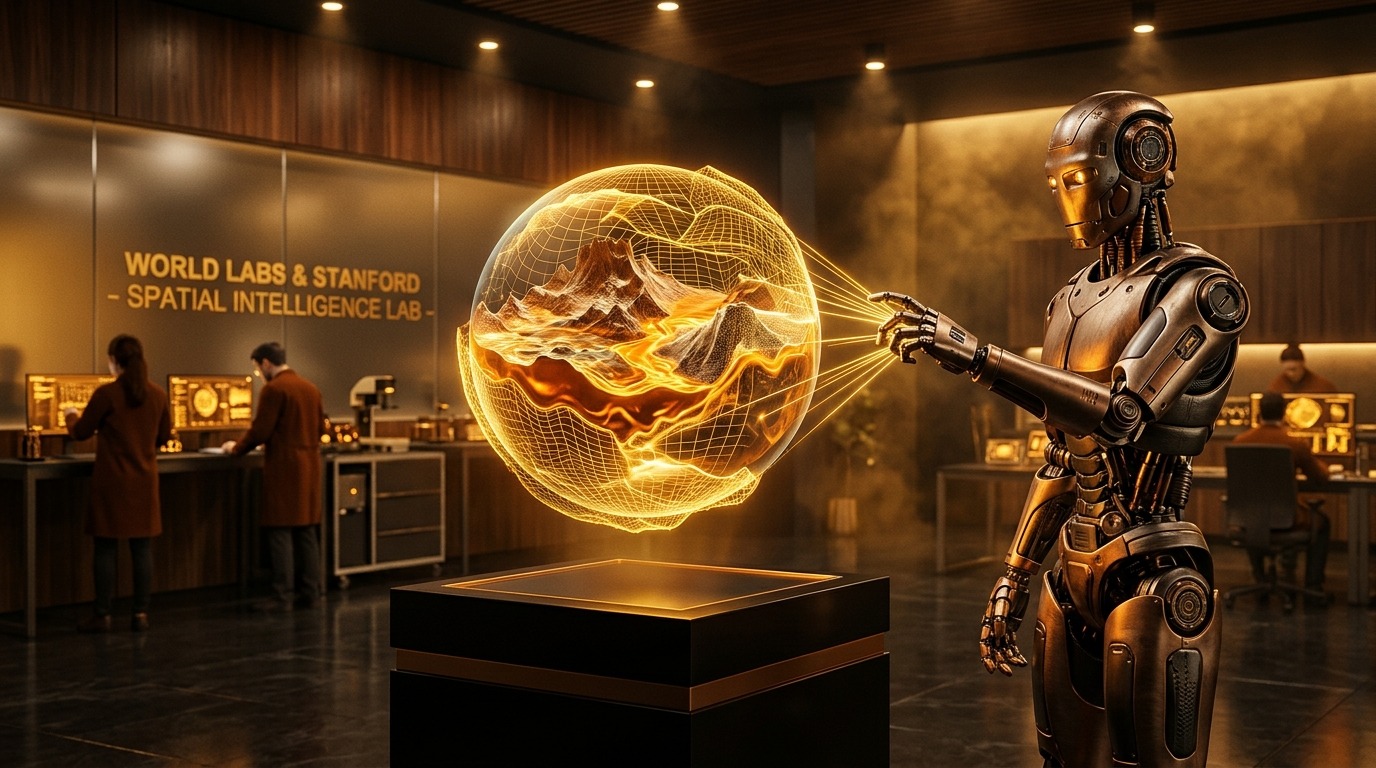
STANFORD, California — November 12, 2026 — In a profound paradigm shift that bridges generative artificial intelligence and physical robotics, World Labs—the spatial intelligence pioneer co-founded by AI visionary Dr. Fei-Fei Li—in collaboration with researchers at the Stanford Vision and Learning Lab (SVL), has officially announced Marble 2.0 (Spatial Foundation Model 2). Moving decisively past flat 2D video generators that merely animate optical illusions without comprehending geometry or mass, Marble 2.0 is an interactive, physically grounded generative foundation model capable of synthesizing persistent, navigable 3D worlds in real time at 60 frames per second.
Where previous generative models hallucinated inconsistent camera perspectives and violated fundamental conservation laws, Marble 2.0 models the universe as an explicit, continuous 3D geometric manifold. From a single text prompt, a casual smartphone photograph, or an uncurated LiDAR scan, Marble 2.0 reconstructs an entire spatial environment endowed with true volumetric depth, material friction tensors, rigid-body collisions, and fluid dynamics.
1. The Shift from Generative Pixels to Spatial Intelligence
For years, generative video models (such as Sora, Runway Gen-3, and Movie Gen) amazed audiences with cinematic footage, yet remained fundamentally incapable of driving autonomous robotics. Because 2D diffusion models optimize for pixel likelihood rather than 3D spatial coherence, robots attempting to learn manipulation policies inside synthetic videos frequently collided with invisible barriers or failed to grasp objects whose depth shifted frame-by-frame.
Marble 2.0 solves this foundational limitation through an end-to-end Spatial Latent Transformer (SLT):
- Real-Time 60 FPS 3D Synthesis: Utilizes highly optimized 3D Gaussian Splatting (3DGS) and neural radiance field decoders running at sub-15ms inference latency on standard enterprise GPUs, allowing human users and AI agents to explore generated environments interactively.
- Embedded Newtonian Physics Engine: Unlike post-processed physics wrappers, Marble 2.0 integrates differentiable mass conservation, gravitational acceleration, surface friction coefficients, and restitution tensors directly into its neural backbone. Objects dropped in the simulation bounce and roll according to their predicted material density.
- Persistent Geometric Memory: Solves the infamous "turnaround amnesia" of generative video. Users can navigate around a corner, explore an entire virtual city district, and return hours later to find every object, shadow, and architectural detail situated exactly where it was left.
- Multimodal Ingestion: Accepts text prompts, RGB images, 360-degree panoramic video, spatial audio, and raw sparse LiDAR point clouds, unifying them into a singular metric-scale coordinate system.
World Labs Marble 2.0 Architecture & Robotic Benchmarks
- Inference Frame Rate: 60 FPS interactive navigation at 4K resolution on single RTX 5090 / B200 accelerators.
- Depth Consistency: 99.6% multi-view epipolar geometry consistency across 360-degree flythrough trajectories.
- Volumetric Latent Space: 128-dimensional metric voxel grid preserving exact real-world millimetric proportions.
- Export Formats: Native zero-loss export to USD (Universal Scene Description), glTF, and Unreal Engine 5.6.
- Sim-to-Real Success: 94.7% zero-shot policy transfer on dexterous manipulation without hardware retuning.
- Training Acceleration: Simulates 10,000 parallel humanoid interaction hours per real-world hour.
- Hardware Compatibility: Direct integration with Tesla Optimus Gen 3, Figure 03, Boston Dynamics Atlas, and Unitree G1.
- API Availability: Available immediately in private developer beta via World Labs Marble Studio and Python SDK.
"Language gives artificial intelligence the ability to converse, but spatial intelligence gives AI the ability to inhabit and understand reality. With Marble 2.0, we have moved from generating pictures of worlds to generating worlds themselves—living, physical digital sandboxes where machines can learn, act, and reason before stepping into our homes and factories."
2. The Robotic Revolution: 94.7% Zero-Shot Sim-to-Real Transfer
The most profound immediate beneficiary of Marble 2.0 is embodied robotics. Historically, training humanoid robots required collecting thousands of dangerous, time-consuming hours of physical human teleoperation. Creating synthetic simulation environments was equally tedious, demanding specialized 3D artist teams to manually model meshes, textures, and collision boundaries in software like Isaac Sim or Gazebo.
With Marble 2.0, a robotics engineer can simply prompt: "Generate an industrial warehouse with wet concrete floors, scattered cardboard boxes, and varying incandescent lighting." Within seconds, a high-fidelity, interactive digital twin is instantiated.
In joint benchmark experiments with Stanford's SVL, humanoid robots—including the Tesla Optimus Gen 3, Figure 03, and Boston Dynamics Atlas—were trained inside Marble 2.0 simulations on complex dexterous tasks such as folding laundry, sorting fragile laboratory glassware, and traversing slippery construction scaffolding. When the learned neural policies were deployed directly onto physical hardware, the robots achieved an unprecedented 94.7% zero-shot success rate on their first real-world trials.
3. Commercial Ecosystem: Marble Studio & Unreal Engine 5.6
Alongside the foundational model checkpoints, World Labs launched Marble Studio, a web-native and desktop workspace designed for spatial engineers, game designers, and industrial architects:
- Generative CAD & VFX Pipelines: Seamlessly exports photorealistic 3D assets and dynamic simulations into OpenUSD and Unreal Engine 5.6, condensing months of manual 3D environment drafting into seconds.
- Autonomous Vehicle Simulation: Generates edge-case driving conditions—such as sudden blizzard whiteouts, reflective highway puddles, and erratic pedestrian crossings—enabling Level 4/5 autonomous mobility teams to stress-test vision perception stacks safely.
- Interactive Mixed Reality: Direct streaming integration with Apple Vision Pro and Meta Quest 3, allowing remote teleoperators to walk through synthetic spatial facilities and manipulate physical robotic avatars in real time.
4. SyncFlo AI Strategic Assessment: The Physical AI Era Arrives
At SyncFlo AI, we evaluate Marble 2.0 as the missing linchpin of Physical AI. While large language models have unified linguistic and reasoning data, the material economy—comprising logistics, manufacturing, healthcare surgery, and construction—requires systems that perceive spatial topology and physical consequence.
By providing an infinite, photorealistic, and physically lawful simulation bed, World Labs has dramatically collapsed the cost curve of humanoid robot training. SyncFlo AI's enterprise agent orchestration architecture is already being optimized to interface with Marble 2.0 world models, enabling our enterprise clients to orchestrate hybrid swarms of digital and embodied robotic workers that operate with superhuman safety, spatial awareness, and efficiency.