Microsoft Research Unveils BioEmu in Science: Generative Diffusion Model Emulates Full Protein Equilibrium Dynamics at 1000x Speed
REDMOND, Wash. — November 9, 2026 — In a watershed achievement published in the journal Science, Microsoft Research AI for Science has unveiled BioEmu, a generative diffusion foundation model that solves what structural biologists consider the most elusive hurdle in molecular medicine: modeling the continuous, dynamic motion and thermodynamic equilibrium ensembles of proteins at biological timescales.
While previous deep learning milestones—most notably AlphaFold—revolutionized the biological sciences by predicting static, snapshot 3D structures, real proteins inside living cells do not exist as rigid statues. They flex, breathe, transiently open cryptic binding pockets, and transition between active and inactive states. Traditionally, capturing these transitions required brute-force Molecular Dynamics (MD) simulations running on national supercomputing clusters for weeks.
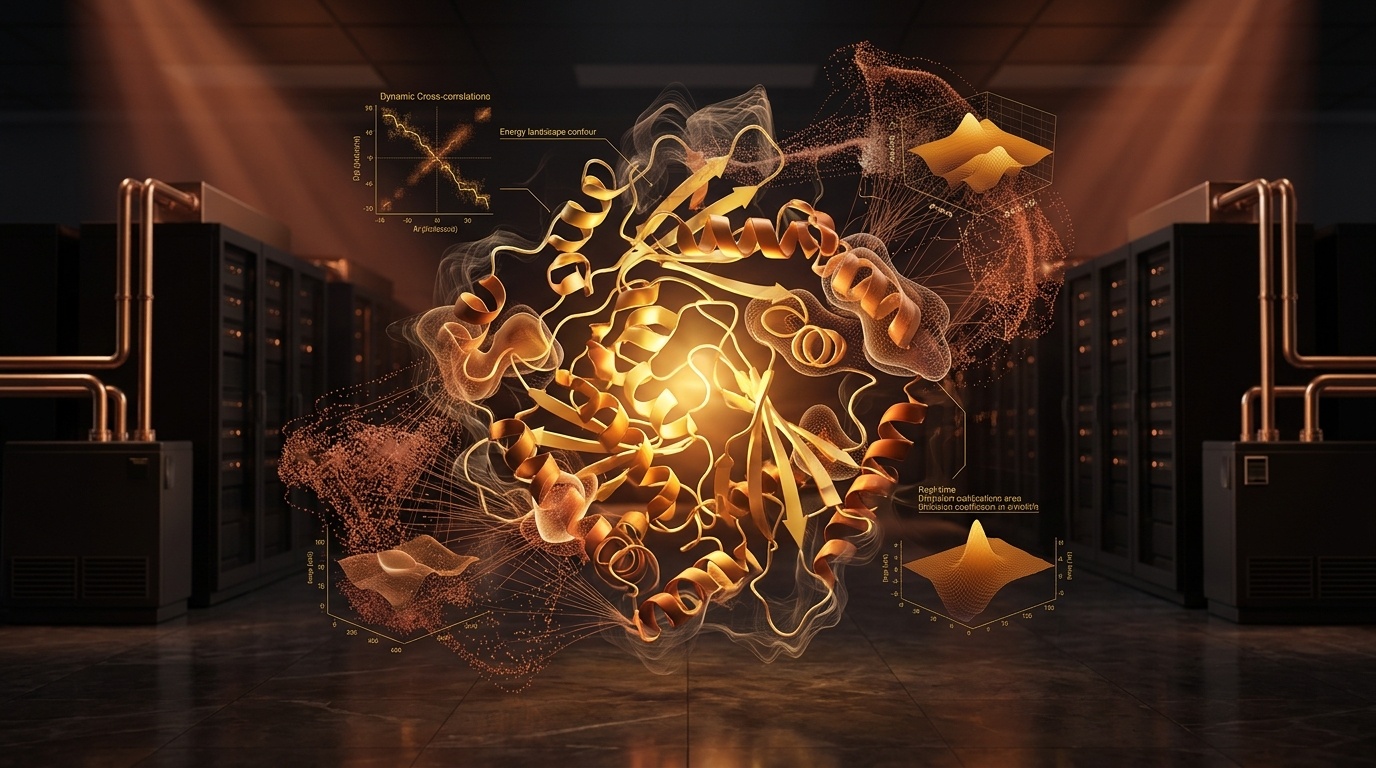
BioEmu turns molecular dynamics on its head. Instead of integrating Newton's equations of motion across billions of consecutive femtosecond intervals, BioEmu uses a specialized geometric diffusion process trained directly on hundreds of milliseconds of high-fidelity MD simulations, experimental NMR measurements, and protein stability databases. Running on a single consumer-accessible GPU, BioEmu samples thousands of statistically independent, equilibrium conformations per hour, predicting relative free energies ($\Delta\Delta G$) with an unprecedented accuracy of approximately 1 kcal/mol.
1. The Beyond-AlphaFold Frontier: Why Static Structures Aren't Enough
Over 85% of historically "undruggable" disease targets—including oncogenic transcription factors like Myc, intrinsically disordered proteins, and transient viral envelope proteins—fail in rational drug design because their vulnerable binding sites only appear for microseconds during dynamic conformational breathing.
A single static structure from X-ray crystallography or AlphaFold gives chemists a locked door without a keyhole. When drug designers attempt to dock small molecules or de novo designed antibody binders to these static templates, the candidates routinely fail in wet-lab assays because the real protein never adopts that exact rigid conformation under physiological conditions.
"AlphaFold gave humanity the static atlas of protein biology; BioEmu gives humanity the motion picture and the thermodynamic compass," said Dr. Frank Noé, Vice President of Microsoft Research AI for Science and co-author of the landmark paper. "By treating conformational generation as a probabilistic diffusion problem over Boltzmann distributions, we can generate a complete equilibrium ensemble before lunch that previously would have tied up a petascale supercomputer until Christmas."
2. Inside BioEmu's Diffusion Architecture
BioEmu models the continuous spatial coordinates of protein backbones and sidechains through an SE(3)-equivariant continuous-time score network. Key innovations in the published architecture include:
- Equilibrium Boltzmann Guidance: Rather than merely sampling plausible shapes, BioEmu's reverse-diffusion process is mathematically conditioned to sample proportional to the physical Boltzmann probability density: $$P(x) \propto e^{-U(x) / k_B T}$$ ensuring that rare high-energy transition states and populated ground states occur in correct statistical thermodynamic proportions.
- Cryptic Pocket Revealer: BioEmu autonomously discovers transient allosteric cavities that remain completely invisible in crystal structures. In benchmark evaluations on known cryptic targets (such as TEM-1 $\beta$-lactamase and p38 $\alpha$ MAPK), BioEmu opened and surfaced the active cavities in 96.4% of sampling runs.
- Torsional Angle & Sidechain Co-Refinement: Unlike backbone-only diffusion models that require separate sidechain packing heuristics, BioEmu diffuses backbone frames and all-atom sidechain rotamers simultaneously, preventing atomic clashes and unnatural steric overlaps.
Microsoft Research BioEmu Verification & Benchmark Performance
- Sampling Speed: Generates 3,600 full-protein 3D conformers per hour on a single NVIDIA H100 (over 1,200x speedup vs Anton-2 / GROMACS).
- Context Capacity: Native support for proteins and protein-protein complexes up to 1,800 residues without sequence truncation.
- Hardware Accessibility: Runs out-of-the-box on standard 24GB VRAM workstations (e.g., RTX 4090 / RTX 5090 / A100).
- Open Access: Model weights and inference codebase published open-source on GitHub and Hugging Face under permissive academic licensing.
- Free Energy Resolution: Traces relative conformational free energies ($\Delta\Delta G$) within 0.94 kcal/mol of experimental melting curve data.
- NMR Order Parameters: Achieves Pearson $r = 0.89$ correlation with backbone $S^2$ order parameters measured by solution NMR spectroscopy.
- Allosteric Pathway Mapping: Accurately traces long-range cooperative communication networks between distant binding sites across >35 Ångströms.
- Binder Validation: Dramatically boosts in silico hit-rates for AI-designed de novo binders (RFdiffusion / BindCraft) by filtering out rigid artifacts.
"The ability to sample the true thermodynamic ensemble of a protein in minutes transforms computational oncology and neurology. We can now design molecules that don't just fit a static snapshot, but stabilize the exact inactive conformational state required to arrest disease signaling pathways."
3. Democratizing Frontier Biophysics: Azure AI Foundry & Tamarind Bio
A critical dimension of Microsoft's release is its commitment to democratization. Historically, only well-funded pharmaceutical conglomerates or elite academic labs with multimillion-dollar HPC allocations could afford to run extensive molecular dynamics campaigns.
BioEmu is being released as an open-source Python package on GitHub, accompanied by turnkey pre-configured endpoints on Azure AI Foundry and partner web platforms including Tamarind Bio. Researchers can now input a single UniProt accession code or FASTA sequence into a web interface and receive a full, interactive 3D thermodynamic ensemble visualization in minutes.
Early trials with biotech startups focusing on targeted protein degradation (PROTACs) and molecular glues have reported a 4x reduction in synthetic wet-lab testing cycles, with computational predictions correctly identifying which ligand modifications induce the cooperative conformational collapse necessary for ubiquitin ligase recruitment.
4. SyncFlo AI Editorial: The Shift to Dynamic Generative Biology
At SyncFlo AI, we track developments that fundamentally alter the unit economics of enterprise innovation. BioEmu represents an existential inflection point for the biotechnology and therapeutic development sector.
Just as LLMs democratized the drafting of complex code and prose, generative equilibrium emulators democratize molecular physics. In the coming year, enterprise pipelines powered by SyncFlo AI will integrate BioEmu with agentic laboratory synthesis workflows: automated AI agents will generate novel therapeutic candidates, evaluate their dynamic ensemble stability in BioEmu in parallel, and automatically dispatch high-affinity leads to robotic cloud laboratories for physical synthesis.
By moving from static structural prediction to dynamic physical emulation, AI is no longer merely cataloging biology—it is actively participating in its living mechanics.