Tesla Deploys FSD V13 & Unified End-to-End Neural Robotics Architecture: One Foundation Model Powering Autonomous Cars and Optimus Gen 3
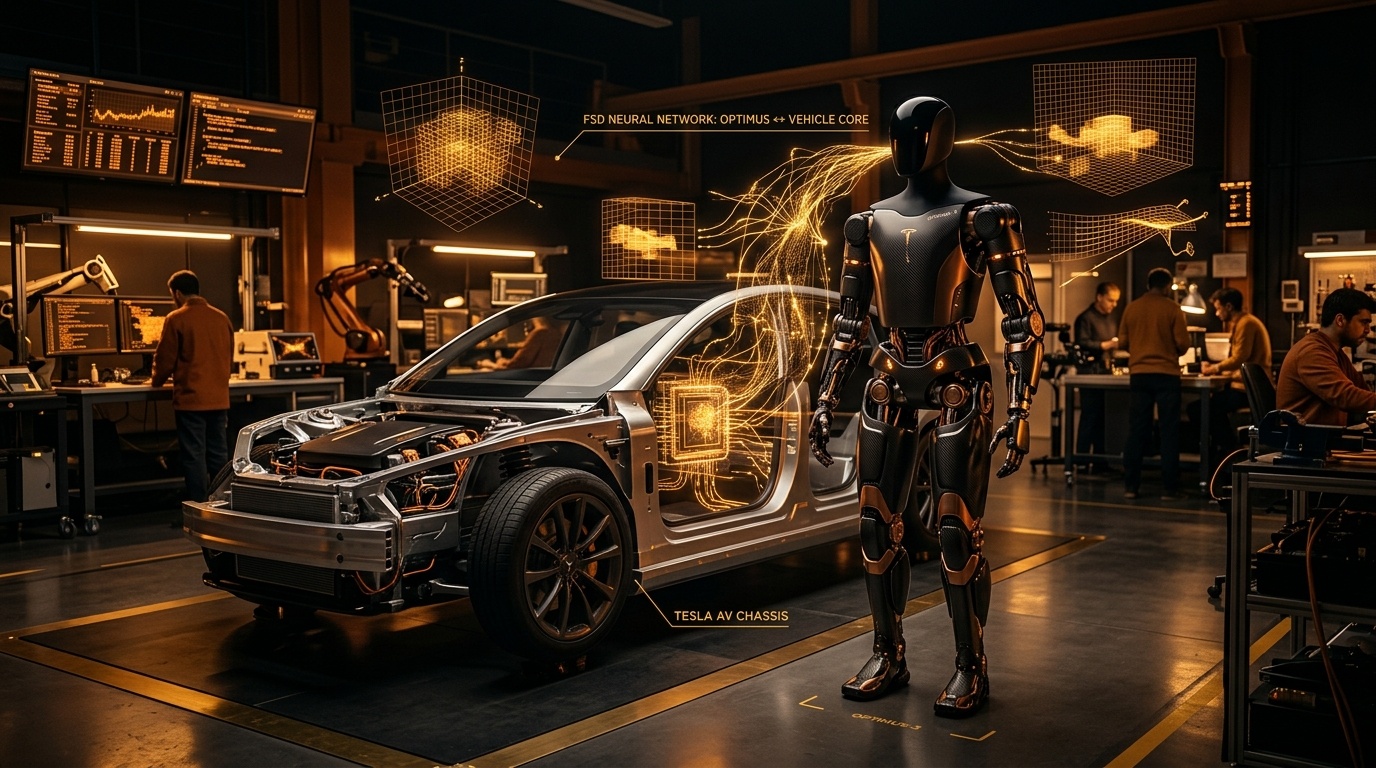
AUSTIN, Texas — November 8, 2026 — In what engineers and robotics researchers describe as a monumental milestone in physical artificial intelligence, Tesla, Inc. has officially deployed Full Self-Driving (FSD) Version 13 alongside an architectural revelation: the complete unification of its vehicle driving intelligence with its Optimus Gen 3 humanoid robotics platform under a single, shared end-to-end neural network backbone.
By transitioning entirely away from modular robotics pipelines—which historically separated object recognition, geometric depth estimation, heuristic path planning, and trajectory control into disjoint codebases—Tesla has achieved a monolithic vision-to-action (VLA) foundation model. Raw multi-camera photon streams enter the neural network, and continuous physical actuator commands (steering torque, braking, bipedal leg placement, and 36-degree-of-freedom hand manipulation) emerge directly from the weights.
1. The Death of Heuristic Code in Physical Robotics
For decades, the robotics industry was dominated by classical control theory: engineers wrote hundreds of thousands of lines of C++ code defining explicit rules for collision avoidance, kinematic inverse equations, and finite-state machines. Even modern self-driving systems often relied on C++ glue code to negotiate edge-case intersections or interpret ambiguous pedestrian hand gestures.
FSD V13 marks the final removal of legacy heuristic rules. Everything from highway high-speed merging and unpaved rural navigation to navigating multi-level subterranean parking structures is now handled entirely within a massive transformer-based neural network.
Crucially, Tesla's AI division proved that an autonomous car is simply a "robot on four wheels," while Optimus is a "robot on two legs." By sharing more than 90% of the foundational vision-encoder weights, temporal world-model transformers, and 3D occupancy forecasting layers, advancements in autonomous driving now immediately benefit humanoid manipulation, and vice versa.
2. Inside the Cortex Supercluster: 100,000 GPUs at Giga Texas
Training a unified physical AI foundation model requires astronomical compute. At the heart of this deployment is Cortex, Tesla's newly expanded 100,000-GPU supercomputing cluster situated at Gigafactory Texas in Austin.
Cortex processes petabytes of video data collected daily from Tesla's global fleet of millions of vehicles, as well as thousands of hours of high-precision teleoperated demonstration data recorded from Optimus robots operating inside Tesla's battery, stamping, and vehicle final-assembly lines.
The Cortex training pipeline leverages a specialized Neural World Simulator. By generating photorealistic synthetic variations of physical anomalies—such as severe flash floods, blinding snow squalls, structural collapse debris, and fragile industrial part drops—the network learns robust real-world physical dynamics without risking physical hardware.
Tesla FSD V13 & Optimus Gen 3 Architecture Metrics
- Intervention-Free Scaling: 4.2x increase in miles between critical disengagements over FSD V12 (exceeding 50,000 urban miles).
- Full End-to-End Speed: Ingestion of 8 camera streams at 36 FPS directly outputs continuous 6-DoF vehicle trajectory.
- Unpaved & Parking Autonomy: Seamless end-to-end navigation from home garage to remote unmapped rural destinations.
- Reverse Trajectory Autonomy: Fully autonomous tight-quarter multi-point turns and reverse backing maneuvers.
- Hand Dexterity (36 DoF): Integrated tactile-sensor fingertips with milligram-sensitive grip calibration for delicate assembly.
- Cross-Embodiment Transfer: 92% parameter sharing between vehicle vision-world-model and humanoid motor cortex.
- Autonomous Assembly Rate: 99.4% task completion rate on battery pack cell insertion without human intervention.
- Inference Hardware: Dual custom Tesla HW4/AI5 inference silicon consuming under 120W during full-body dynamic balance.
"The breakthrough of FSD V13 is not merely that cars drive themselves better than humans—it is that we have solved the foundational problem of generalized vision-to-action intelligence in the physical universe. The exact same neural networks that guide a car through a chaotic construction zone now enable Optimus to thread a needle, balance on slippery terrain, and assemble battery cells on our factory floor."
3. Optimus Gen 3: Factory Deployment and Dexterous Manipulation
Alongside the FSD V13 rollout, Tesla provided extensive production footage of Optimus Gen 3 operating autonomously inside Gigafactory Texas and the Fremont manufacturing facility.
Featuring redesigned high-torque planetary actuators in the hips and knees, as well as a 36-degree-of-freedom hand equipped with high-speed tactile sensors and tendon-driven actuation, Optimus Gen 3 demonstrated tasks previously thought to require years of further research:
- Dynamic Perturbation Recovery: When physically pushed or jostled by human workers or factory machinery, Optimus utilizes its end-to-end whole-body momentum network to instantly adjust foot placement and center of mass without pausing.
- Autonomous Wiring Harness Installation: Using visual feedback alone, Optimus routes flexible, non-rigid wiring harnesses through tight automotive chassis compartments—a task that historically defeated automated robotic arms.
- Continuous Battery Cell Sorting: Operating 16-hour autonomous shifts on the 4680 cell manufacturing line, achieving sub-second cycle times with zero mechanical failures.
4. The Scale Advantage: Data Flywheel and Hardware Margins
Tesla's primary moat in physical AI lies in its data flywheel. While competing humanoid robotics startups must rely on manual teleoperation with a few dozen prototype robots, Tesla leverages data collected from over 6 million customer vehicles driving tens of millions of miles every single day.
Every time a vehicle navigates a strange intersection, avoids an unexpected obstacle, or negotiates an unusual pedestrian behavior, that compressed video clip is indexed and uploaded to the Cortex cluster. This vast spatial library provides Optimus with common-sense physics, spatial persistence, and 3D object dynamics that cannot be replicated in isolated laboratory settings.
5. SyncFlo AI Perspective: The Industrial Horizon of Embodied Workflows
At SyncFlo AI, the unification of autonomous vehicle software and humanoid robotics represents the culmination of Embodied AI.
Until now, enterprise AI automation existed purely in the digital domain: optimizing code, processing financial documents, managing customer engagement, and generating digital media. The breakthrough of unified physical foundation models like FSD V13 and Optimus Gen 3 bridges digital workflows with the physical world.
In the coming years, SyncFlo AI's agentic orchestration frameworks will not only direct cloud software agents, but coordinate physical robotics swarms—enabling an enterprise to automatically schedule raw material procurement, dispatch autonomous delivery vehicles, and orchestrate humanoid factory workers with end-to-end, zero-latency visibility.