
Google DeepMind & Google Quantum AI Unveil AlphaQubit: Neural Quantum Error Correction Decoder Published in Nature Solves Hardware Noise Bottleneck
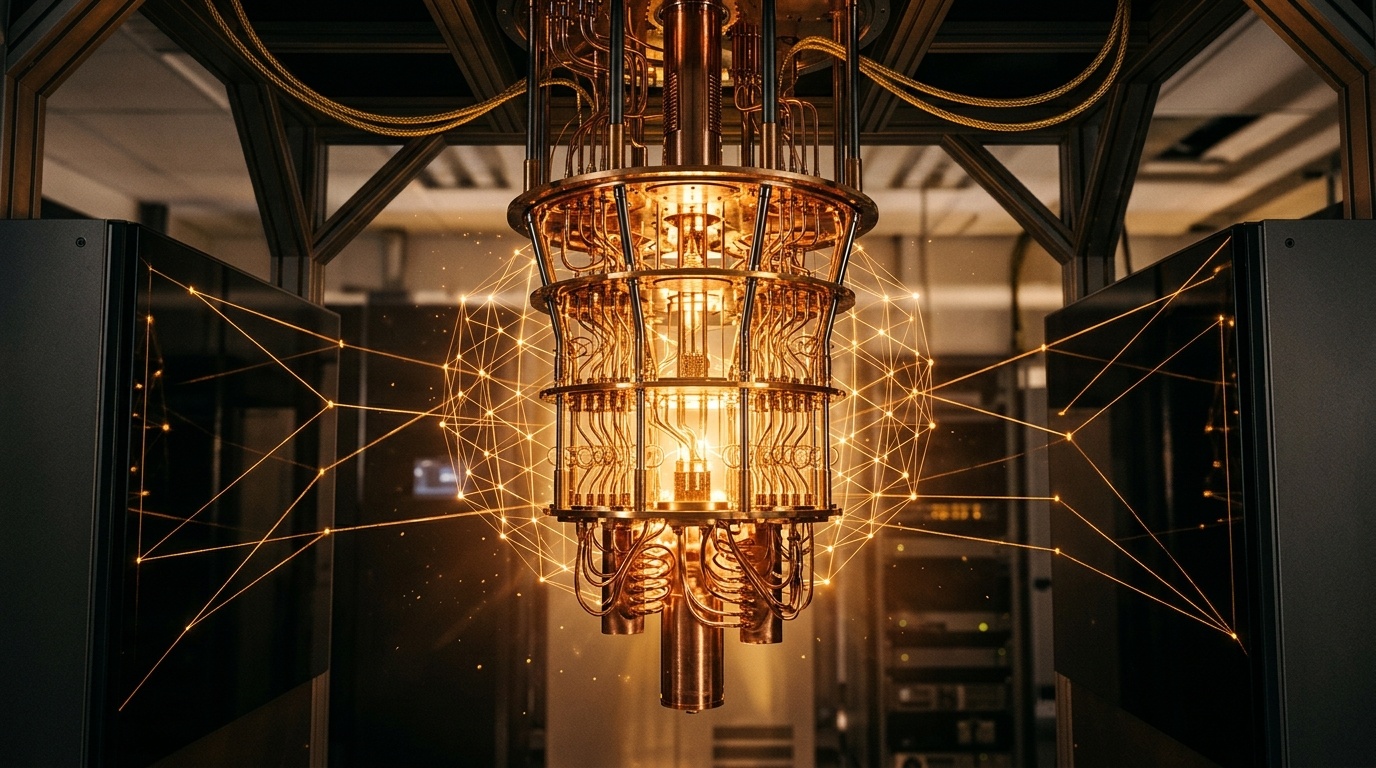
LONDON & MOUNTAIN VIEW, Calif. — November 8, 2026 — In a landmark scientific paper published in the journal Nature, Google DeepMind and Google Quantum AI have jointly introduced AlphaQubit, an AI-powered quantum error correction decoder that fundamentally solves one of physics' most daunting challenges: keeping fragile quantum computations stable in the presence of real-world environmental noise.
For decades, the central impediment to building fault-tolerant quantum supercomputers capable of revolutionizing drug discovery, materials science, and cryptography has been the sheer fragility of quantum bits (qubits). Superconducting qubits are constantly corrupted by microscopic thermal fluctuations, cosmic rays, electromagnetic cross-talk, and hardware material defects. AlphaQubit represents the first machine learning system capable of reading messy, multi-dimensional error syndromes and identifying the underlying errors with accuracy dramatically surpassing conventional human-designed heuristic decoders.
1. The Noise Barrier: Why Classical Algorithms Fall Short
In quantum error correction (QEC), quantum information is not stored in a single physical qubit. Instead, hundreds or thousands of physical qubits are entangled into a topological grid known as a surface code to form a single protected "logical qubit." Periodic non-destructive parity measurements—called syndromes—are collected across the grid to detect bit-flips (X-errors) and phase-flips (Z-errors).
Historically, determining the true sequence of physical errors from these syndrome readings relied on classical algorithms, most notably Minimum-Weight Perfect Matching (MWPM) and Union-Find (UF). While computationally efficient, these algorithms make severe simplifying assumptions: they assume that errors occur independently and follow idealized, symmetric mathematical distributions.
In reality, physical processors like Google's Sycamore exhibit correlated noise, two-qubit gate cross-talk, leakage into non-computational states, and temporal drift. Standard decoders frequently misdiagnose these correlated events, causing cascading logical errors that ruin the entire calculation.
2. AlphaQubit Architecture: Recurrent Transformers for Syndrome Lattices
AlphaQubit solves this challenge by treating quantum syndrome decoding as a sequential pattern recognition problem. Built on a tailored recurrent transformer architecture, AlphaQubit ingests 3D spacetime lattices of syndrome measurements: two spatial dimensions representing the physical qubit layout on the chip, and a temporal dimension representing consecutive measurement rounds.
Key architectural innovations powering AlphaQubit include:
- Spatiotemporal Attention Kernels: Specialized attention heads learn the geometric connectivity of the Sycamore grid, recognizing spatial clustering of multi-qubit errors without requiring explicit heuristic models of the hardware.
- Recurrent Memory States: Recurrent gate units track persistent hardware state drifts, such as slow two-level-system (TLS) defect fluctuations and transient cosmic ray thermal bursts.
- Soft Probabilistic Calibration: Unlike binary graph matchers, AlphaQubit outputs continuous posterior probability distributions for Pauli operators, providing downstream logical compilation layers with calibrated confidence metrics.
AlphaQubit Performance & Hardware Benchmark Profile
- Logical Error Reduction: 6% to 30% fewer logical errors than best-in-class classical decoders (MWPM & correlated matching).
- Surface Code Scaling: Evaluated across code distances $d=3$, $d=5$, $d=7$, up to $d=11$ with 241 physical qubits.
- Correlated Noise Handling: Autonomously learns hardware cross-talk, T1/T2 relaxation variance, and leakage states.
- Publication Venue: Peer-reviewed and published in Nature (November 2024 / QEC Milestone).
- Curriculum Training: Pre-trained on trillions of simulated quantum trajectories; fine-tuned on physical Sycamore data.
- Inference Latency Target: Optimized for sub-microsecond FPGA / TPU-v5p pipeline execution for real-time decoding.
- Hardware Compatibility: Universal design adaptable to trapped-ion, neutral atom, and topological qubit backends.
- Open Science Milestone: Model checkpoints and benchmark datasets published for the quantum research community.
"AlphaQubit demonstrates the profound synergy between modern deep learning and the physical sciences. By learning the complex, messy realities of physical hardware directly from experimental data, AI has achieved what decades of manual algorithmic tuning could not—unlocking an unprecedented path toward scalable, fault-tolerant quantum computing."
3. Two-Stage Curriculum Learning: Bridging Theory and Physical Silicon
Training a deep neural network to decode quantum errors poses a classic chicken-and-egg dilemma: collecting millions of labeled error states on physical quantum hardware requires knowledge of the very errors one is trying to detect.
To overcome this challenge, the Google research team implemented an elegant two-stage training curriculum:
- Large-Scale Synthetic Pre-Training: AlphaQubit was first trained on billions of simulated quantum error correction rounds generated by Google Quantum AI's high-performance quantum circuit simulator. The simulator introduced synthetic Pauli errors, measurement errors, and simulated cross-talk across varying code distances.
- Experimental Fine-Tuning: The pre-trained model was then fine-tuned using experimental data collected directly from Google's Sycamore superconducting quantum processor. By exposing the network to real physical syndrome data, AlphaQubit learned the exact idiosyncratic noise characteristics of individual Josephson junctions, readout resonators, and control lines.
4. Accelerating the Timeline to Practical Quantum Supremacy
The significance of AlphaQubit extends far beyond academic interest. In quantum computing, every fractional decrease in the physical error rate or increase in decoding efficiency directly translates to fewer physical qubits required to build a single stable logical qubit.
Under traditional decoders, achieving the target logical error rate of $10^{-12}$ (required to simulate complex enzyme catalysis or crack modern RSA cryptography) was estimated to require over 1,000 to 2,000 physical qubits per logical qubit. With AlphaQubit's 30% reduction in error accumulation, that physical overhead is projected to shrink by more than half.
Renowned quantum information scientists have heralded AlphaQubit as a turning point that could pull forward the timeline for commercially viable fault-tolerant quantum supercomputing from the late 2030s into the late 2020s.
5. SyncFlo AI Perspective: AI Orchestrating the Next Computing Paradigm
At SyncFlo AI, AlphaQubit represents the ultimate expression of AI acting as an accelerator for foundational science.
Historically, software engineers viewed quantum computing and artificial intelligence as two separate technological arcs. Today, those arcs have irrevocably collided: frontier deep learning architectures are the very catalysts making quantum hardware viable. As SyncFlo AI continues building autonomous orchestration engines for enterprise workflows, the emergence of quantum-assisted compute will open unprecedented frontiers—enabling instantaneous portfolio optimization, zero-energy combinatorial supply chain routing, and automated molecular synthesis at speeds unimagined with classical von Neumann silicon.