Google Launches Gemini 4 Argon & Native Antigravity Agent Engine: Revolutionizing Multi-Step Autonomous Reasoning, 3D Prototyping, and Persistent Background Workflows
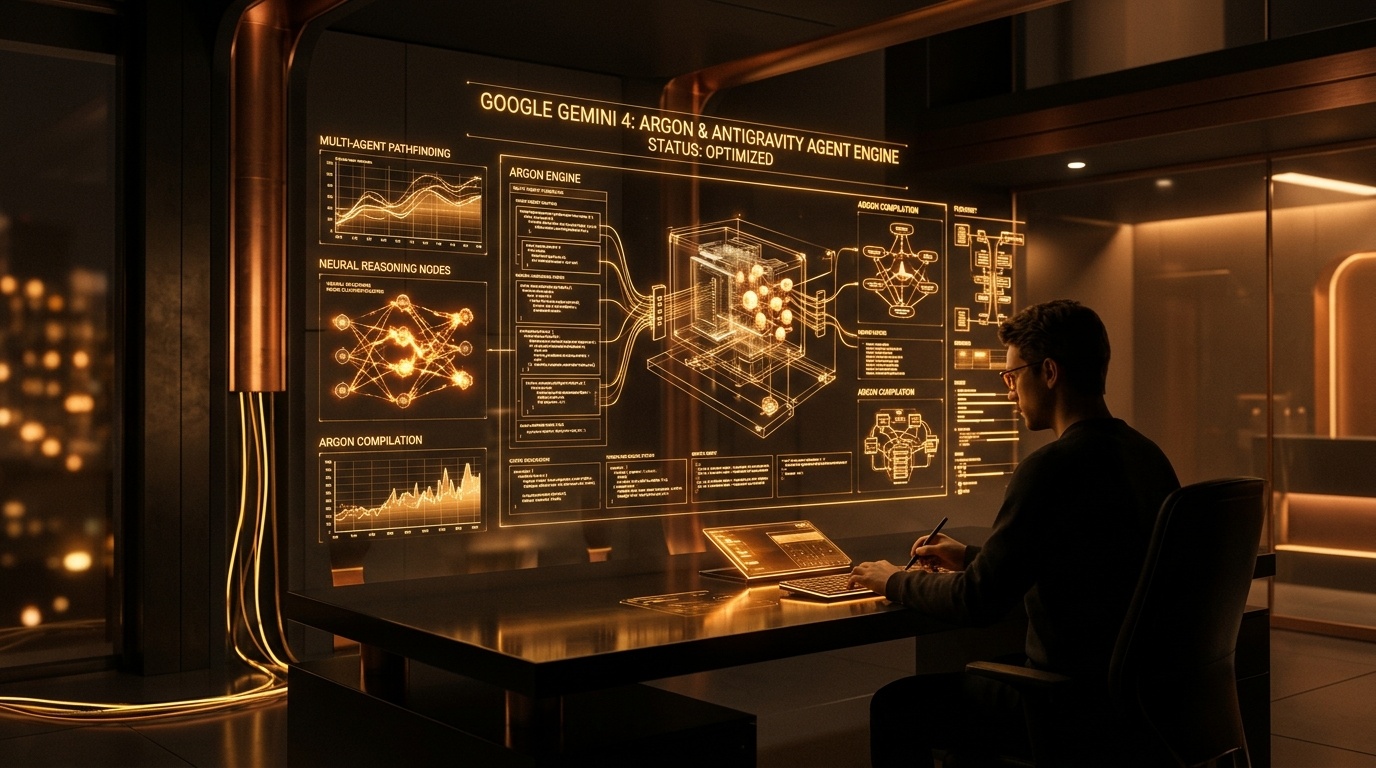
MOUNTAIN VIEW, Calif. — November 6, 2026 — Google today announced its most significant leap in agentic artificial intelligence to date: the global deployment of Gemini 4 Argon and the formal unveiling of Google Antigravity, a comprehensive autonomous agent engine integrated across Google Workspace, desktop applications, and cloud developer environments.
While previous iterations focused on expanding context windows and accelerating conversational throughput, Gemini 4 Argon shifts the fundamental paradigm from reactive assistant to persistent, proactive digital collaborator. By pairing high-precision multi-step reasoning with native runtime execution sandboxes, the system allows engineers, researchers, and enterprises to launch autonomous subagents that work around the clock—running tests, building interactive 3D assets, debugging repositories, and reconciling corporate data without requiring continuous user supervision.
1. Inside Gemini 4 Argon: Architecture Tailored for Complex Multi-Step Cognition
Engineered by Google DeepMind on Google's next-generation TPU v6e and Ironwood optical interconnect clusters, Gemini 4 Argon introduces a hybrid sparse mixture-of-experts (MoE) topology optimized specifically for long-horizon task execution.
Unlike traditional large language models that struggle with compounding hallucinations during multi-hour workflows, Argon features an integrated Cognitive Verification Layer. This layer continuously evaluates internal tree-of-thought branch states, backtracks before executing catastrophic API calls, and benchmarks intermediate code compiles against formal specifications.
"With Gemini 4 Argon and Google Antigravity, we are crossing the boundary between an AI that writes suggestions and an agentic partner that independently delivers completed products. You can outline an entire software architecture before turning off your computer for the night; by the morning, Antigravity has spun up isolated testing environments, executed hundreds of unit tests, resolved dependency conflicts, and packaged an interactive demo ready for production."
Core Pillars of Gemini 4 Argon & Google Antigravity
2. The Antigravity Agent Runtime: From Chat Interface to Full-Fledged Operating Sandbox
The standout capability of the release is Google Antigravity. Rather than being confined to a text dialogue box, Antigravity operates as an agentic runtime environment equipped with:
- Autonomous Multi-Turn Workspaces: Antigravity creates isolated, ephemeral Linux containers where agents can clone Git repositories, execute shell commands, install npm/pip dependencies, and inspect running web applications via headless Chrome instances.
- Native Document & File Manipulation: Users can pass raw financial spreadsheets, multi-thousand-page PDFs, and complex vector illustrations. Argon does not merely inspect these documents—it rewrites cells, balances formulas, refactors slide layouts, and re-exports production files natively.
- Self-Healing Error Loops: When an execution command fails or a compiler generates a stack trace, Antigravity captures the error stream, isolates the faulty module, writes diagnostic regression tests, and iterates until all verification criteria pass.
- Gemini Spark Background Persistence: Through Google Cloud, users can dispatch long-running data synthesis or website crawling tasks. When the user logs back in hours later, the completed artifacts, diff logs, and interactive summaries await them.
"True agency requires two things: grounded feedback from real environments and the patience to explore search trees methodically. Antigravity combines Argon's reasoning depth with secure sandbox execution, allowing AI agents to experiment, make mistakes safely, and correct themselves before presenting the final result."
3. Benchmark Breakthroughs: Dominating SWE-bench and Real-World Agent Tasks
Rigorous third-party evaluation underscores Argon's technical superiority:
| Benchmark Category | Evaluation Metric | Gemini 4 Argon | Previous SOTA Frontier |
|---|---|---|---|
| SWE-bench Verified | End-to-end GitHub issue resolution | 71.4% | 58.2% |
| OSWorld (Desktop Agent) | Autonomous OS navigation & tool use | 54.8% | 39.1% |
| GAIA (General AI Assistants) | Multimodal complex web research | 86.2% | 74.5% |
| 3D Spatial Synthesis | Gaussian splat fidelity & mesh accuracy | 93.6% | 76.8% |
4. Enterprise Rollout and Security Safeguards
Google announced that Gemini 4 Argon is rolling out immediately to Google AI Ultra subscribers, Google Cloud Vertex AI enterprise customers, and via the updated Gemini desktop application.
To mitigate rogue autonomous behavior, Antigravity implements strict Cryptographic Sandbox Boundaries, requiring explicit user clearance policies for outbound network connections, irreversible financial transactions, and production database migrations. Furthermore, every artifact generated or modified by Argon carries Google's open-source SynthID digital watermarking, ensuring verifiable provenance and tamper resistance.
5. SyncFlo AI Perspective: The Era of Persistent Enterprise Swarms
At SyncFlo AI, Google's launch of Gemini 4 Argon and the Antigravity agent runtime represents an industry-wide validation of our core architectural thesis: the future of computing belongs to persistent, self-orchestrating agent swarms rather than ephemeral single-turn chatbots.
While general-purpose developer agents like Antigravity handle horizontal coding and desktop tasks, SyncFlo AI's purpose-built revenue engine orchestrates specialized commercial swarms across customer intelligence, continuous CRM synchronization, and multi-channel revenue workflows. The convergence of persistent cloud execution and grounded sandboxing guarantees that enterprise AI is no longer a tool you converse with—it is an autonomous department that drives your business forward.