Google Achieves First Orbital AI Inference via Project Suncatcher TPU Satellite: A Historic Milestone for Spaceborne Autonomous Machine Learning
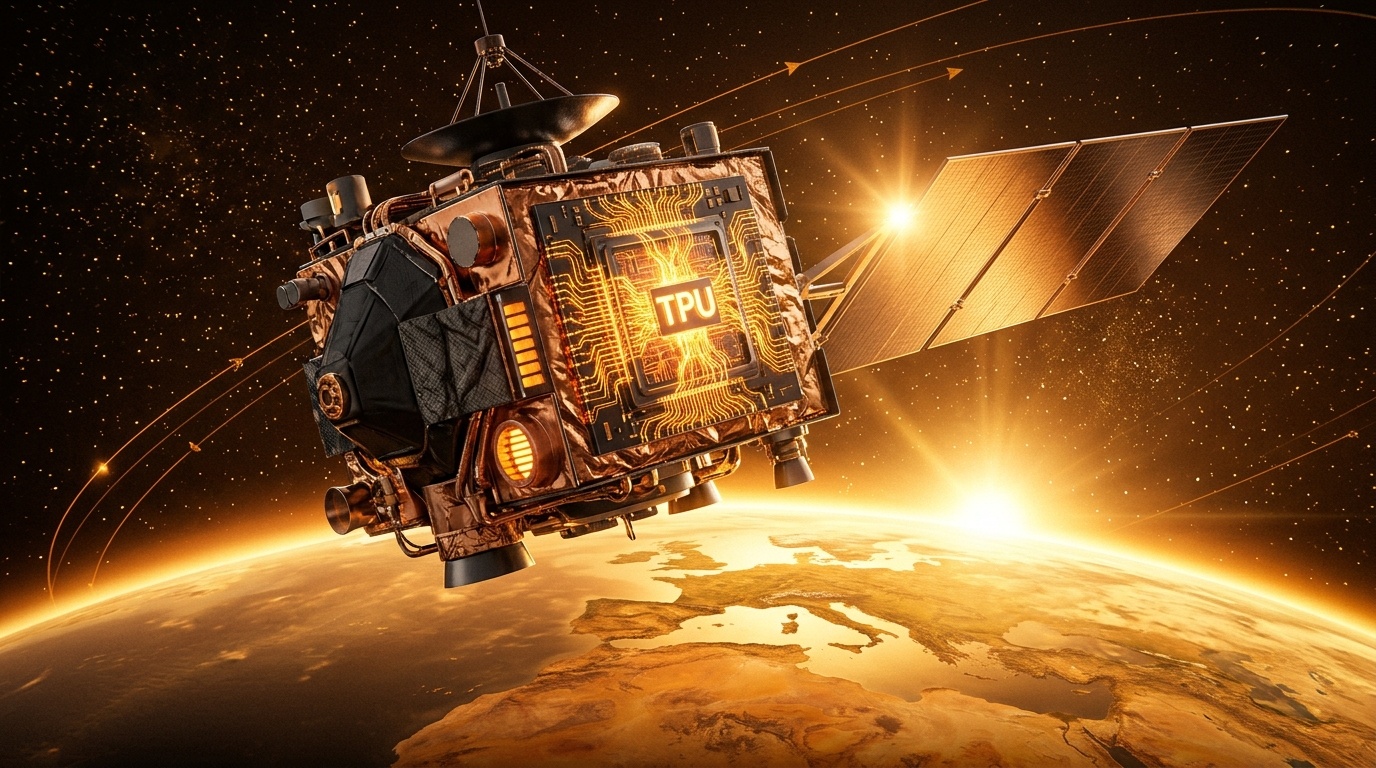
MOUNTAIN VIEW, CALIFORNIA — November 2, 2026 — In what engineers are hailing as a defining milestone for humanity's computational frontier, Google has officially confirmed the successful execution of the world's first orbital artificial intelligence inference aboard a spaceborne satellite. Under the codename Project Suncatcher, a demonstration satellite launched in October completed commissioning maneuvers and generated direct neural model inferences in low Earth orbit (LEO), transmitting verified synthetic outputs during a high-speed pass over a terrestrial ground station.
The achievement bridges terrestrial cloud supercomputing and deep space mechanics. Historically, space-based observation systems were strictly restricted to gathering raw telemetry, multispectral imagery, and radar passes before queuing massive gigabyte payloads for delayed downlink to Earth-based data centers. With Project Suncatcher, Google has proven that advanced machine learning models can run directly on satellite payloads in real time, filtering billions of data points on-orbit before transmitting only critical intelligence.
1. Overcoming the Hostile Physics of Space: The Radiation-Hardened TPU
Deploying state-of-the-art AI accelerators in outer space presents extreme physical challenges that standard terrestrial silicon cannot survive. In low Earth orbit, semiconductors are bombarded continuously by cosmic rays, solar energetic particles (SEPs), and high-energy protons capable of triggering Single Event Upsets (SEUs)—bit flips that instantly crash transformer attention matrices and corrupt weights.
To resolve this, Google DeepMind and Google Cloud Space Systems engineered a custom space-hardened packaging architecture for Google's proprietary Tensor Processing Unit (TPU):
- Triple Modular Redundancy (TMR) at the Matrix Level: Mathematical systolic arrays in the space TPU feature real-time parity checking and voting logic, scrubbing cosmic ray bit-flips without stalling inference cycles.
- Silicon Carbide & Beryllium Heat Sinks: Without an atmosphere to enable convective fan cooling, the TPU relies on passive conductive pathways that route thermal dissipation directly to radiator panels radiating into deep space.
- Dynamic Power Budgeting: The satellite's onboard energy controller modulates clock frequencies between 45W during solar panel exposure and ultra-low power 8W states during planetary eclipse orbits.
"Project Suncatcher proves that the boundary between ground-based AI infrastructure and spaceborne exploration has dissolved. Running frontier neural inference directly in orbit allows satellites to understand what they see instantly—from tracking wildfire spread in seconds to detecting orbital debris trajectories without waiting for round-trip latency to Earth."
Key Technical Pillars of Project Suncatcher Orbital AI
2. Immediate Applications: Planetary Defense, Climate, and Swarm Autonomy
The successful deployment of orbital inference unlocks dramatic improvements across global industrial, scientific, and geopolitical domains:
Wildfire and Natural Disaster Triage: Traditional satellites must wait for their scheduled orbital pass over an authorized ground station to dump raw thermal imagery. By the time emergency personnel receive the processed map, hours have passed. Project Suncatcher executes onboard thermal segmentation models, instantly identifying new fire ignitions and blasting SMS-equivalent alert vectors directly to local first responders via emergency transponders in under 30 seconds.
Orbital Debris Navigation and Collision Avoidance: As low Earth orbit grows increasingly crowded with megaconstellations, the risk of Kessler Syndrome cascade collisions escalates. In-orbit neural inference enables satellites to track non-cooperative space debris using onboard optical sensors and calculate optimal orbital adjustment burns autonomously, eliminating delays caused by orbital blackout zones.
3. The Broader Trend: Space as the Next Hyperscale AI Platform
Google's breakthrough reflects a larger race among tech giants to extend compute beyond Earth's biosphere. With terrestrial data centers facing power grid bottlenecks and regulatory constraints, spaceborne orbital compute—fueled by uninterrupted 24/7 direct solar irradiation—is increasingly seen as a viable long-term frontier for autonomous computing nodes.
Following the milestone, Google engineers revealed plans to expand Project Suncatcher into a multi-node constellation testbed throughout 2027, evaluating inter-satellite laser communications and distributed federated learning across orbital clusters.
4. SyncFlo AI Perspective: Extending Autonomous Agents Beyond Terrestrial Boundaries
At SyncFlo AI, we view Google's Project Suncatcher as validation of the ubiquitous agentic paradigm. True workflow autonomy cannot remain tethered to stationary desktop environments or centralized server halls; it must operate at the physical edge where decisions dictate real-world outcomes.
Whether coordinating supply chains across maritime vessels, balancing decentralized industrial energy grids, or routing critical telemetry through satellite constellations, SyncFlo AI's architecture is built to orchestrate autonomous workflows across hybrid edge-to-cloud environments—bridging terrestrial operational systems with the emergent spaceborne computational tier.