OpenAI & Simons Foundation Partner on AI Mathematics: Open-Sourcing Lean-Verified Formal Proofs and Autonomous Theorem Provers
NEW YORK & SAN FRANCISCO — October 30, 2026 — In a watershed moment for the mathematical sciences, OpenAI and the Simons Foundation have announced a joint multi-million dollar initiative to bridge frontier artificial intelligence with formal mathematical verification, releasing a sprawling open-source repository of machine-checked research proofs written in Lean 4.
As part of the initiative, OpenAI has contributed a $5 million direct grant alongside dedicated frontier computing allocations to a newly formed research endowment administered by the Simons Foundation. The program is designed to empower mathematicians globally to scrutinize, reproduce, and build upon thousands of novel mathematical conjectures, combinatorial bounds, and theoretical physics theorems generated by OpenAI's frontier reasoning models.
1. Overcoming the "Trust Bottleneck" in Machine Science
For years, the application of large language models to pure mathematics and theoretical physics was severely constrained by the problem of plausible hallucination. While models could propose intuitive mathematical leaps and mimic the rhetorical style of professional research papers, verifying whether a 50-page natural language proof contained subtle logical fallacies required months of painstaking labor by human reviewers.
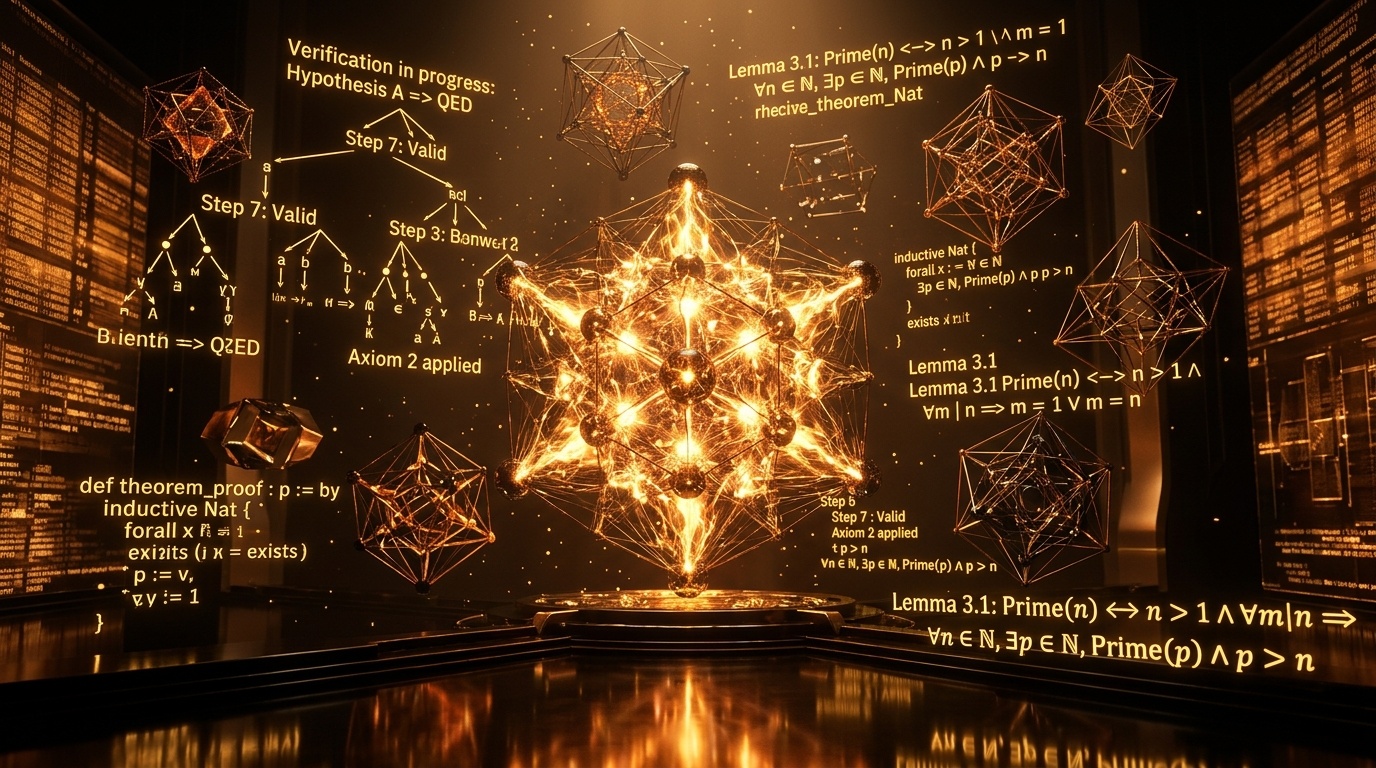
The collaboration solves this trust bottleneck by requiring all AI-generated research outputs to be delivered as Lean 4 certificates—interactive computer code that is compiled and cryptographically verified by the Lean proof assistant kernel:
- Zero-Hallucination Guarantees: In Lean 4, a proof cannot pass compilation if a single axiom, lemma, or logical deduction step is invalid. The kernel acts as an incorruptible arbiter of truth, eliminating the risk of undetected mathematical errors.
- Massive Research Corpus: Rather than issuing solitary demonstration theorems, OpenAI has open-sourced an indexed database containing hundreds of complete formalized proofs spanning algebraic geometry, extremal combinatorics, number theory, and quantum field theory topologies.
- Test-Time Search Integration: The proofs were constructed utilizing advanced reinforcement learning search loops and Monte Carlo tree search algorithms, allowing the model to explore millions of prospective proof pathways before formalizing the optimal deductive branch in Lean syntax.
"Mathematics has always progressed through rigorous proof, but human capacity to formalize modern knowledge has reached its physical limits. By combining frontier AI reasoning models with computer-verified proof assistants like Lean, we are witnessing the dawn of a symbiotic era where AI generates conjectures and verifies proofs at scale, while human mathematicians steer the deep conceptual frontiers."
Core Pillars of the OpenAI & Simons Foundation Mathematics Partnership
2. Community Oversight & Academic Governance
Recognizing the cultural sensitivities within pure mathematics regarding authorship and attribution, the initiative is being closely guided by the Advisory Group on Mathematics and Artificial Intelligence (AGMAI), anchored at the prestigious Institute for Advanced Study (IAS) in Princeton.
Renowned mathematicians—including Fields Medalists who have championed formalization—will oversee the curation of open challenges, establish citation norms for AI-synthesized proofs, and design educational curriculum to train the next generation of graduate students in automated reasoning languages.
3. From Pure Mathematics to Mission-Critical Software Safety
While pure mathematics represents the immediate proving ground, computer scientists emphasize that the implications of formal verification extend far beyond theoretical academia.
The same Lean 4 verification pipelines used to guarantee mathematical truth are already being adapted to audit mission-critical aerospace flight control systems, smart contracts managing billions in digital assets, and cybersecurity cryptographic kernels. When an AI agent writes software that must never fail, mathematical theorem proving transforms from an academic pursuit into an imperative engineering safeguard.
4. SyncFlo AI Perspective: Verified Reasoning for Enterprise Autonomy
At SyncFlo AI, we view formal verification as the definitive foundation for the next stage of enterprise automation. As autonomous AI agents take control of complex corporate supply chains, payroll systems, and legal compliance contracts, businesses cannot tolerate stochastic errors or ungrounded generative speculation.
By embracing the formal logic and deterministic constraint architectures pioneered by Lean 4 and verified theorem provers, SyncFlo AI is building operational workflows where every AI-driven transaction, contract clause, and financial reallocation is backed by verifiable, provable logic. The future of AI belongs to verifiable certainty.