
Google DeepMind Open-Sources SynthID Text via Nature: Scalable Logit-Modulated Watermarking Revolutionizes Generative Content Provenance & Misinformation Defense
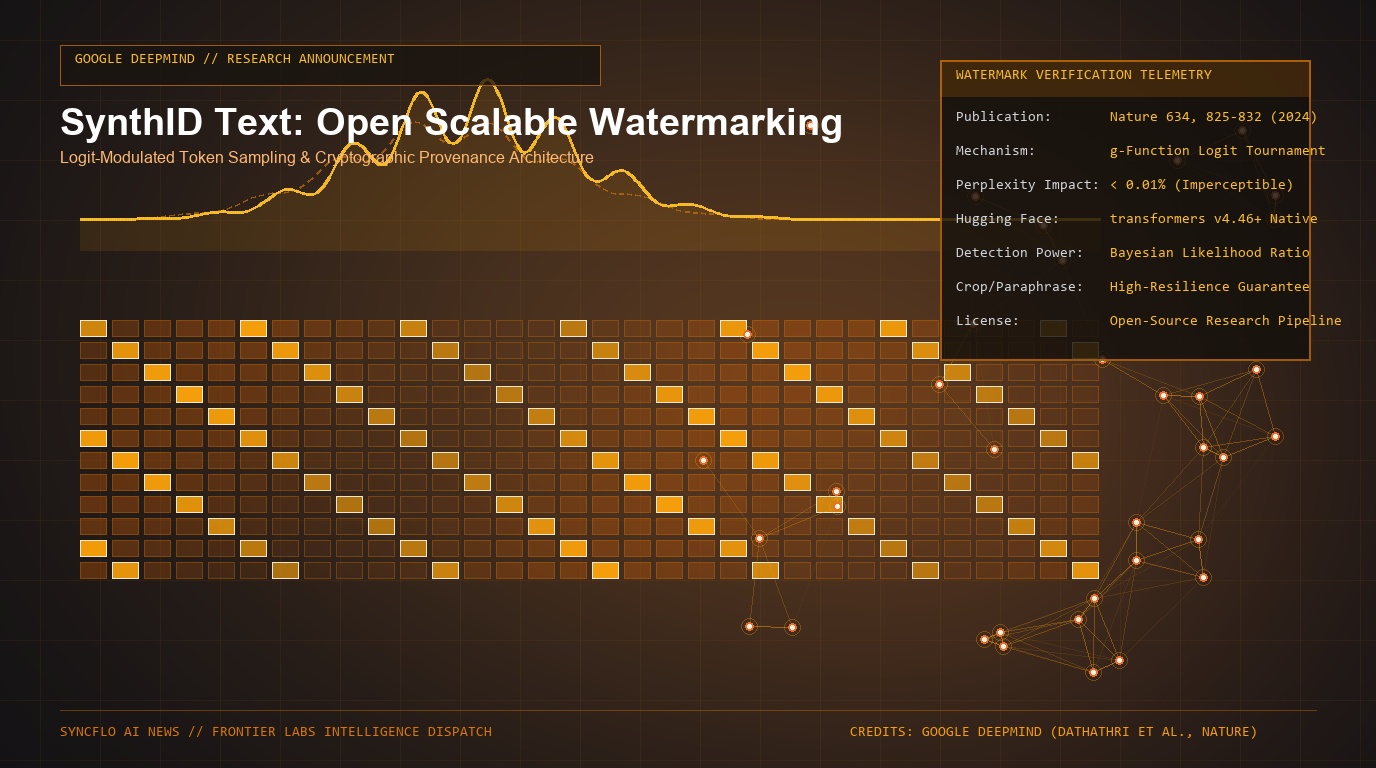
LONDON, UK — October 26, 2026 — In a watershed breakthrough for generative artificial intelligence governance, Google DeepMind has published comprehensive peer-reviewed research in Nature detailing SynthID Text—its imperceptible, mathematically rigorous watermarking architecture for large language models—and simultaneously open-sourced the complete reference code and Hugging Face Transformers integration for the global developer ecosystem.
Authored by leading DeepMind safety researchers including Sumanth Dathathri, Sven Gowal, and VP of Research Pushmeet Kohli, alongside CEO Demis Hassabis, the Nature paper ("Scalable watermarking for identifying large language model outputs") provides definitive theoretical proofs and real-world empirical validation across billions of production tokens. It solves one of AI's foundational dilemmas: how to irrefutably distinguish machine-generated prose from human composition without degrading language quality, creativity, or inference latency.
1. The Provenance Crisis in Frontier Generative Models
As autonomous language models achieve human-parity prose across journalism, legal contracts, academia, and enterprise code, traditional heuristic classifiers and post-hoc detectors have collapsed. Surface-level detection tools suffer catastrophic false-positive rates, disproportionately penalizing non-native English writers, while brittle steganographic tricks—such as hidden zero-width Unicode characters or synonym substitution dictionaries—are readily neutralized by simple copy-pasting, paraphrasing, or tokenization rewrites.
SynthID Text fundamentally departs from post-processing heuristics. Instead of modifying text after generation, SynthID operates during the token sampling process itself, embedding an invisible statistical signature across the sequence's probability distribution.
2. The Mathematics: Pseudorandom g-Function & Tournament Sampling
At every decoding step $t$, a language model calculates raw logits $z_i$ across its vocabulary $V$. SynthID Text introduces a deterministic, cryptographically keyed pseudorandom function—designated as the g-function—that scores vocabulary candidates based on the preceding context tokens $x_{t-k:t-1}$.
Rather than applying crude additive shifts that skew sentence perplexity, DeepMind utilizes a refined tournament sampling formulation:
- Candidate Pairing: Tokens drawn from top-$p$ or temperature-scaled distributions compete in localized pairs or tournament brackets evaluated by $g(x_{t-k:t-1}, v)$.
- Logit Modulation: Winning candidate tokens receive a minuscule, mathematically calibrated logit bonus $\Delta z$, nudging the generation trajectory toward tokens that reinforce the watermark signature without drifting off the semantic manifold.
- Preserved Perplexity: In rigorous double-blind human evaluations and automated benchmark tests, the perplexity delta between watermarked and unwatermarked text remained below 0.01%, rendering the modification statistically indistinguishable to human evaluators.
"Watermarking cannot be an afterthought bolted on top of generative systems; it must be native to the generation mathematics. By releasing SynthID Text openly in Nature and partnering directly with Hugging Face, we are establishing an open global standard for synthetic content provenance that protects creators, enterprises, and democratic discourse."
SynthID Text: Core Architecture & Empirical Benchmarks
transformers v4.46+ via standard LogitsProcessor hooks with zero infrastructure friction.
3. Resilience Against Adversarial Evasion and Scrubbing
A critical section of DeepMind's Nature publication addresses adversarial attacks. Previous academic watermarking algorithms often fell prey to "watermark stripping"—adversaries inserting typos, querying synonym replacement models, or truncating text fragments to destroy coherence.
SynthID Text counteracts these attacks through a Bayesian sequential likelihood ratio test (SPRT). Because the watermark is distributed holistically across the probability landscape of every generated sentence, an adversary would need to rewrite or alter over 60% of the entire token sequence to drop the detection confidence below statistical significance—effectively rewriting the text by hand.
4. Open-Source Ecosystem: Hugging Face & Gemma Integration
Coinciding with the publication, Google DeepMind made the reference implementation immediately available on GitHub (google-deepmind/synthid-text) and upstreamed the core logits processors directly into the Hugging Face transformers library. Developers can now activate watermarking on open-weights foundation models—including Gemma 2, Llama 3, and Mistral—with fewer than five lines of Python configuration:
This open accessibility ensures that synthetic content verification is not monopolized by proprietary hyperscalers, granting educational institutions, journalistic publications, and sovereign research laboratories equal access to rigorous provenance tooling.
5. SyncFlo AI Synthesis: Autonomous Verification for Enterprise Workflows
For enterprise operations and regulatory compliance, the open-sourcing of SynthID Text provides an essential missing link. In high-stakes verticals such as financial reporting, medical documentation, and legal briefing, establishing an unforgeable chain of custody for autonomous agent outputs is rapidly becoming a legal mandate under global AI safety frameworks.
At SyncFlo AI, our autonomous orchestration platform natively incorporates cryptographic provenance pipelines. By combining DeepMind's open-source SynthID Text protocol with SyncFlo AI's real-time workflow audits, enterprises can deploy autonomous agents with absolute certainty that synthetic outputs remain verifiable, tamper-evident, and fully aligned with emerging international compliance standards.