MIT CSAIL & Harvard Unveil Recursive Language Models (RLMs): Self-Decomposing Agent Trees Eliminate Monolithic Context Degradation
CAMBRIDGE, MA — October 24, 2026 — In what computer scientists are calling the most important architectural breakthrough since the transformer attention mechanism, researchers from MIT CSAIL and the Harvard John A. Paulson School of Engineering and Applied Sciences (SEAS) have unveiled Recursive Language Models (RLMs).
For years, the artificial intelligence industry engaged in a brute-force context window race—pushing context sizes from 32,000 to 1 million and even 10 million tokens. However, production deployments encountered severe mathematical physics limitations: quadratic Key-Value (KV) cache bloat, catastrophic latency spikes, and the infamous "lost-in-the-middle" attention degradation phenomenon, where models fail to retrieve subtle logical dependencies buried within massive textual corpuses.
1. The Paradigm Shift: Prompts as Topological Environments
Rather than forcing a single monolithic neural network to attend globally across millions of tokens simultaneously, RLMs re-conceptualize prompts as explorable topological environments.
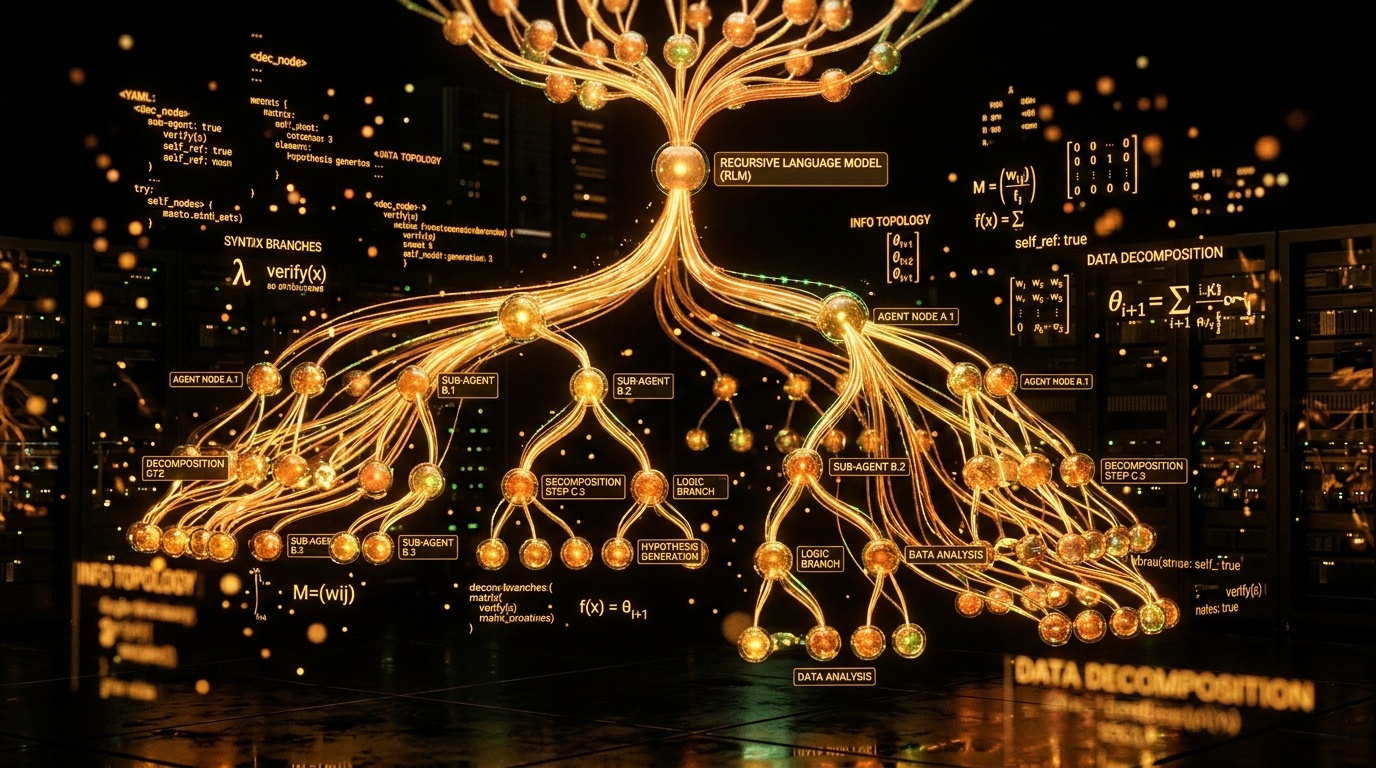
When presented with a complex, multi-million-token task—such as synthesizing a 500-page corporate litigation archive, refactoring an entire monorepo, or verifying an intricate mathematical proof—the root RLM evaluates the scope and dynamically decomposes the problem into an asynchronous tree of recursive micro-agents:
- Dynamic Branch Spawning: The root model spawns lightweight, specialized sub-agent instances tasked with specific sub-regions of the problem space, passing bounded sub-contexts (typically 4,000 to 16,000 tokens) with localized high-resolution attention.
- Recursive Reduction & Verification: Child agents run in parallel, performing semantic extraction, intermediate verification, and symbolic theorem proving. Instead of dumping raw text back up the hierarchy, each node generates formal verified synthesis proofs and confidence bounds.
- Collapsing KV-Cache Bloat: As each child branch finishes execution, its raw token context is discarded while retaining only the mathematically condensed proof artifact. This prevents memory leaks and ensures active KV-cache footprints remain constant regardless of document length.
"Human beings do not read a thousand-page legal dossier by keeping every single word actively illuminated in working memory simultaneously. We skim, we index, we delegate chapters, we take notes, and we synthesize. Recursive Language Models bring this exact hierarchical cognition to neural architectures."
MIT-Harvard RLM Benchmark Comparison
2. Solving the Hallucination Cascades in Enterprise Workflows
A critical hazard of traditional multi-agent systems was error propagation: if agent A hallucinated a fact, agent B and C accepted it uncritically, cascading into catastrophic errors.
RLMs integrate a novel Contractual Constraint Protocol (CCP). Every message passed between parent and child agents must satisfy formal typed contracts. If a child agent fails to ground its response in the provided document chunk with strict cryptographic proof anchors, the parent node rejects the branch and re-routes the task with modified search constraints.
3. SyncFlo AI Synthesis: Powering Scalable Autonomous Knowledge Swarms
The validation of Recursive Language Models provides mathematical and systems validation for the modular architecture behind modern agentic workflows. Monolithic context scaling has reached its economic and thermodynamic limits; the future belongs to recursive, self-orchestrating agent collectives.
At SyncFlo AI, our autonomous enterprise systems embody this exact design philosophy. By leveraging deterministic task decomposition, persistent memory trees, and recursive verification loops, SyncFlo AI enables organizations to deploy high-throughput, low-latency agentic workflows across millions of unstructured documents, ERP databases, and customer operations—delivering flawless reliability at a fraction of legacy inference costs.