Anthropic & Waters Corporation Launch Waters AI Link with Model Hardware Standard (MHS): Autonomous AI Agents Take Control of Physical Scientific Laboratories
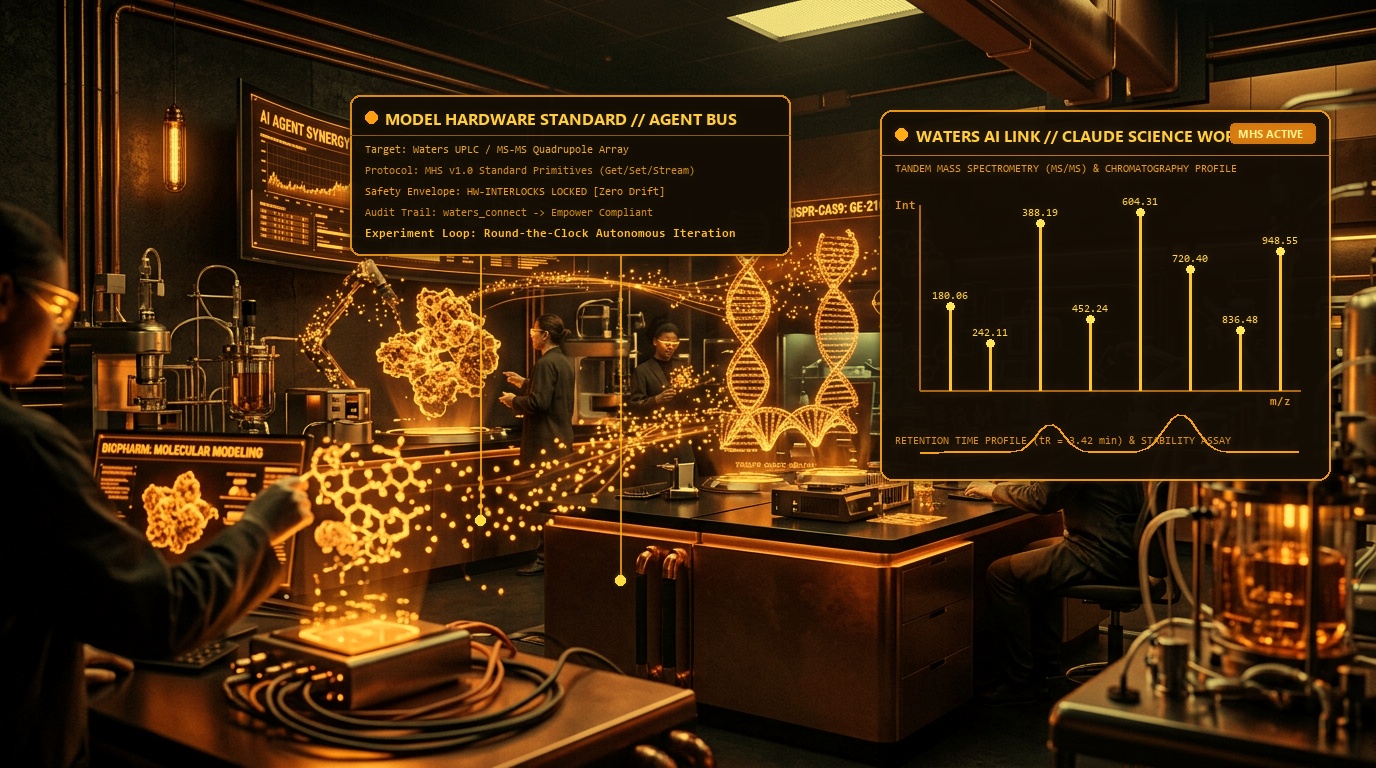
MILFORD, MA & SAN FRANCISCO — October 20, 2026 — In a landmark transition from in-silico hypothesis generation to physical real-world execution, Waters Corporation and Anthropic have officially launched Waters AI Link, powered by Anthropic's breakthrough Model Hardware Standard (MHS).
The deployment bridges Anthropic's Claude Science workbench directly with Waters' industry-standard waters_connect informatics platform. For the first time, autonomous AI agents are equipped to configure, calibrate, execute, and analyze physical liquid chromatography (LC) and mass spectrometry (MS) assays around the clock—radically collapsing drug discovery, biopharma quality control, and advanced materials characterization timelines from months to hours.
1. Breaking the Firmware Barrier: What is the Model Hardware Standard (MHS)?
While autonomous AI models have achieved superhuman performance in coding and theoretical data analysis, their deployment into physical scientific laboratories has historically hit a brick wall: incompatible, proprietary hardware drivers. Integrating a new liquid handler, autosampler, or spectrometer into an automated cycle previously required teams of embedded engineers spending weeks writing brittle custom APIs.
Developed by Anthropic in collaboration with the HHMI Janelia Research Campus, Genentech, and Carnegie Mellon University, the Model Hardware Standard (MHS) serves as a universal, open device abstraction layer. MHS reduces complex lab machinery to simple, standardized primitives:
- Universal Read/Write Primitives: Standardized calls to read sensor state, set thermal or pressure parameters, execute sample injections, and query optical/spectrometric data streams.
- Hardware-Enforced Safety Envelopes: Machine-level interlocks ensure that AI agent requests cannot exceed physical thermal thresholds, trigger mechanical arm collisions, or cross-contaminate reagent lines.
- Self-Describing Hardware Schemas: When an instrument joins an MHS bus, it advertises its capabilities, precision bounds, and tolerances dynamically, enabling AI models to generate valid experimental sequences instantly.
"AI has rewritten how we formulate scientific hypotheses. With Waters AI Link and the Model Hardware Standard, agents are now physically closing the loop: preparing runs, acquiring mass spectra, diagnosing chromatographic anomalies, and recalibrating the next test within minutes."
Waters AI Link & MHS: Core Capabilities
2. Native Integration with waters_connect and Empower Informatics
A critical hurdle in laboratory AI has been strict regulatory compliance in pharmaceutical and clinical development. Uncontrolled agentic scripts that cannot guarantee reproducible audit trails are prohibited in regulated manufacturing and discovery pipelines.
Waters solved this by integrating AI Link directly into waters_connect and linking back into the gold-standard Empower Chromatography Data System (CDS). Every instruction generated by Claude Science—from solvent gradient curves to quadrupole collision energies—is authenticated against user privileges, validated by physical hardware safety envelopes, and recorded with immutable timestamped signatures.
3. Real-World Impact: Biopharma and Materials Acceleration
Early deployments at leading biopharmaceutical research centers highlight the dramatic impact of autonomous lab-in-the-loop workflows:
- Accelerated Monoclonal Antibody (mAb) Characterization: An oncology research team completed an exhaustive 96-sample intact mass and peptide mapping campaign in 14 hours—a process that normally consumed 11 working days of senior analytical chemist time.
- Autonomous Chromatographic Peak Deconvolution: Waters AI Link detected an unforeseen co-eluting impurity peak in real time, automatically modified the mobile phase gradient, and rerun the extraction without human intervention, preserving precious clinical sample batches.
4. SyncFlo AI Synthesis: The Physical Dimension of Autonomous Orchestration
The launch of Waters AI Link and the Model Hardware Standard signals the undeniable dawn of Physical AI. Autonomous agents are no longer confined to desktop browsers, text chats, or software repositories; they are stepping into the physical realm of high-precision chemistry, robotics, and hardware fabrication.
At SyncFlo AI, our mission is to build the enterprise backbone for the autonomous age. By interfacing high-level reasoning frameworks with physical protocol standards like Anthropic's MCP and MHS, SyncFlo AI enables enterprises to build unified orchestrations that seamlessly span cloud reasoning models, high-speed decision engines, and physical robotic laboratory equipment.