Google DeepMind Unveils Genie 3 & Gemini Robotics ER 2: Real-Time Interactive World Models Power Embodied Humanoid Intelligence
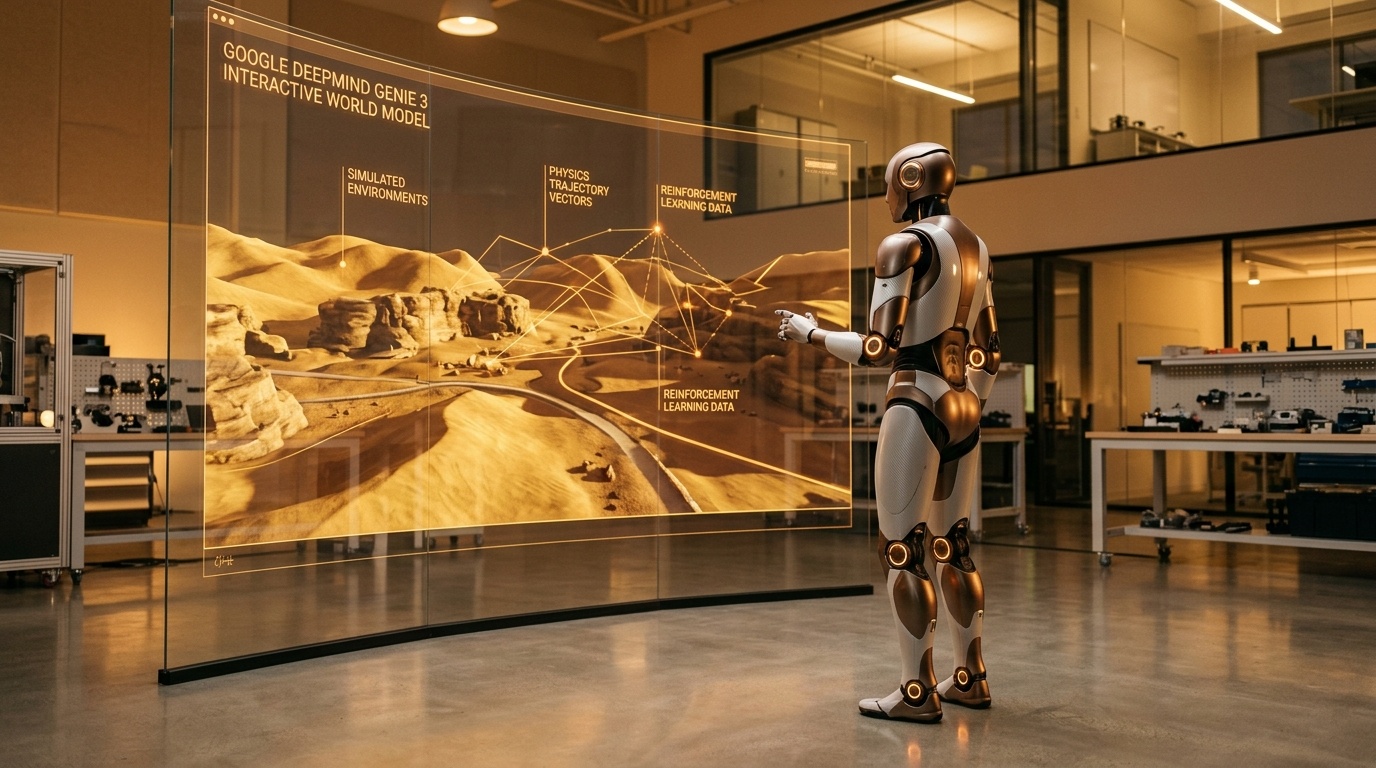
LONDON & MOUNTAIN VIEW — October 13, 2026 — In a monumental leap bridging digital intelligence with physical reality, Google DeepMind has officially unveiled Genie 3 and Gemini Robotics ER 2 (Embodied Reasoning 2).
Presented by Google DeepMind CEO Demis Hassabis alongside Robotics Lead Carolina Parada, the joint breakthrough represents the culmination of a multi-year effort to give artificial intelligence a comprehensive, intuitive understanding of 3D physical dynamics. By coupling Genie 3—a real-time, interactive 3D generative world model—with Gemini Robotics ER 2, robots can now imagine thousands of counter-factual physical interactions inside high-speed simulation before executing them in the physical world with millimeter precision.
1. Genie 3: Playable, Physics-Consistent Reality on Demand
While previous video generation models generated passive video clips from text prompts, Genie 3 functions as a general-purpose, playable world simulator.
Given a single text description, sketch, or photograph, Genie 3 generates a fully interactive 3D environment in real-time at 720p resolution and 24 frames per second. Unlike passive video generators, Genie 3 responds instantaneously to dynamic control inputs—such as joystick steering, camera panning, or robotic joint actuations:
- Continuous Physics Memory: Genie 3 maintains persistent environmental state across a sustained multi-minute memory window. Objects placed on a shelf remain precisely where left when the camera returns.
- Latent Force and Collision Modeling: The simulator natively models friction, mass, gravitational torque, liquid viscosity, and deformation without requiring rigid hand-coded physics engines.
- Accelerated Policy Pre-Training: AI agents can train at 100x real-world speed inside Genie 3 synthetic environments, experiencing rare corner cases (such as slippery spills or collapsing stacks) safely in digital space.
"True general intelligence cannot exist solely in language; it must comprehend cause and effect in space and time. Genie 3 gives AI an interactive world model where it can imagine, test, and refine physical actions before a robotic actuator ever makes contact with physical reality."
Google DeepMind Physical AI Core Architecture
2. Gemini Robotics ER 2: Whole-Body Dexterity and Multi-Step Planning
Complementing the virtual world engine is Gemini Robotics ER 2 (Embodied Reasoning 2). Where earlier robotic policies were restricted to static tabletop arms or basic pick-and-place routines, ER 2 governs whole-body kinematic coordination across bipedal humanoids, wheeled quadrupeds, and multi-axis industrial gantries.
ER 2 bridges high-level semantic intent with low-level torque control:
- Long-Horizon Multi-Minute Chores: The model plans and executes complex tasks exceeding 100 sequential sub-actions—such as clearing a dining table, sorting recyclables, wiping counter surfaces, and loading appliances.
- Multi-Robot Fleet Collaboration: In demonstration trials, three autonomous robots running ER 2 communicated over local peer-to-peer mesh to lift and maneuver heavy, irregularly shaped objects through narrow doorways without human orchestration.
- Visual Error Self-Recovery: If a grasped glass slips or an obstacle blocks a planned walking route, ER 2 detects the anomaly through RGB-D camera feeds, stops immediately, queries Google Search or local Genie simulations for guidance, and recovers deterministically.
3. Industrial Deployments: From Waymo to Advanced Manufacturing
The commercial ramifications of this release are immediate. Variants of the Genie 3 architecture are already powering Waymo's next-generation autonomous driving simulator, allowing robotaxis to navigate millions of hallucination-free extreme weather scenarios and aggressive driver cut-ins.
Simultaneously, Google DeepMind announced pilot partnerships with leading global manufacturers, including Fanuc and Intrinsic, deploying Gemini Robotics ER 2 into flexible electronics assembly lines where robots adapt to changing component dimensions on the fly without reprogramming.
4. SyncFlo AI Perspective: The Convergence of Software and Physical Autonomy
Google DeepMind's breakthrough underscores the overarching trajectory of artificial intelligence: intelligence is migrating from isolated chat windows into the operational, physical fabric of the world.
At SyncFlo AI, we believe the future of enterprise productivity lies in the harmonious synthesis of digital agent workflows and physical execution. By building deterministic coordination layers, real-time telemetry pipelines, and intelligent routing systems, SyncFlo AI enables businesses to bridge their software platforms, supply chains, and automated fulfillment networks into unified, autonomous operations that operate at peak efficiency around the clock.