Meta Launches Muse Wonder & Wonder Full: Frontier Autonomous Agents with Active Memory and Multi-Day Active Focus
MENLO PARK & SAN FRANCISCO — October 12, 2026 — In a breakthrough demonstration of persistent digital co-workers, Meta Platforms has officially launched Muse Wonder and Muse Wonder Full, its most capable agentic frontier intelligence models to date.
Engineered inside Meta Superintelligence Labs under the direction of CEO Mark Zuckerberg, Chief AI Scientist Joelle Pineau, and Chief Product Officer Alexandr Wang, the Muse Wonder series marks a definitive departure from transient, single-turn conversational chatbots. Instead, Wonder models function as persistent, proactive autonomous agents capable of retaining lifelong episodic context, maintaining project awareness across weeks, and orchestrating complex multi-day workflows end-to-end.
1. Active Memory: Overcoming the Context Horizon Bottleneck
Historically, large language models have been bounded by ephemeral context windows. Even with theoretical multi-million-token contexts, real-world models suffered from attention degradation, expensive re-computation, and total amnesia the moment an inference session closed.
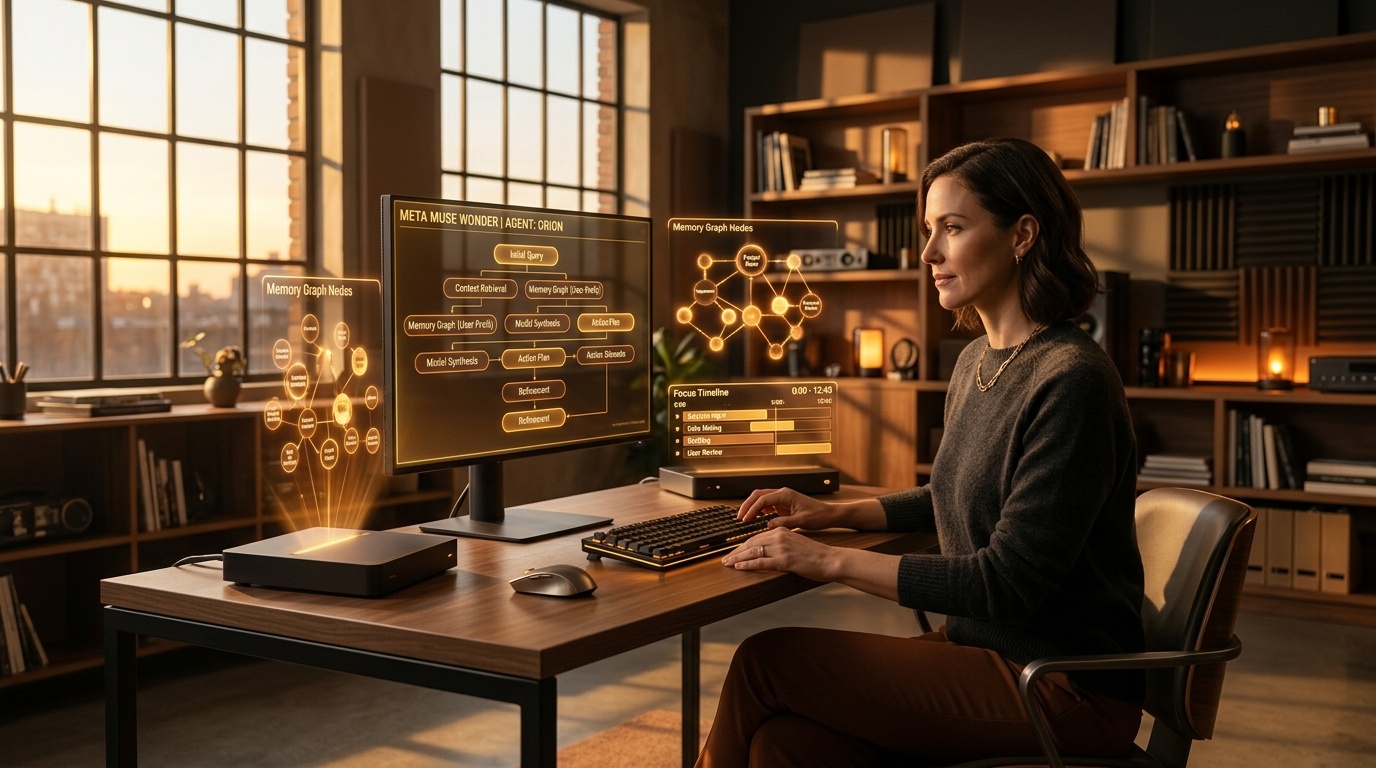
Muse Wonder solves this fundamental limitation with Active Memory, a continuously evolving, graph-indexed episodic memory engine:
- Episodic Knowledge Graphs: Every user instruction, code change, document review, and preference is indexed into a persistent semantic graph that persists across months.
- Proactive Relevance Routing: When given a new objective, Muse Wonder automatically queries its internal graph to recall prior decisions, company conventions, and team stakeholder roles without requiring prompt engineering.
- Differential Consolidation: During idle compute windows, background agents prune stale references, reconcile contradictions, and consolidate high-frequency working knowledge into ultra-compact, high-density latent representations.
"The shift from passive chat to proactive agency requires memory that doesn't evaporate when you close your browser tab. With Muse Wonder and Active Memory, your agent remembers your architecture decisions from three weeks ago, checks your calendar, and finishes multi-step tasks while you sleep."
Meta Muse Wonder Series Specifications
- • Architecture: Sparse Mixture-of-Experts (64B active / 420B total)
- • Context Window: 2 Million tokens native with Active Memory
- • Target Deployment: Ray-Ban Meta glasses, WhatsApp Business, Local Server clusters
- • Latency: Optimized for real-time tool calling and sub-second agent routing
- • Architecture: Hyper-dense MoE (120B active / 1.25T total)
- • Capabilities: Deep multi-day task planning, counterfactual branching, formal verification
- • Benchmarks: 88.4% on SWE-bench Verified, 91.2% on Agentic Complex QA
- • Integrations: Enterprise ERP, GitHub, Slack, AWS, and Cloudflare Workers
2. Active Focus: Self-Correcting Execution Loops
The second foundational innovation in the Wonder architecture is Active Focus. In traditional agent implementations, if a subagent encounters a 404 API error, a broken unit test, or an unexpected data payload, the execution chain frequently loops indefinitely or collapses into hallucination.
Active Focus introduces an integrated meta-cognitive supervisor that runs asynchronously alongside the primary execution stream:
- Heuristic Roadblock Detection: If an agentic sub-task fails to yield progress within three consecutive actions, Active Focus pauses the active branch.
- Counterfactual Branching: The model forks its internal state, generates three divergent architectural hypotheses, and tests them in lightweight virtual sandboxes before committing changes.
- State Reversion & Self-Correction: If simulated outcomes fail compliance benchmarks, the agent rewinds to the last known healthy state, logs the anomaly to Active Memory, and pursues the verified alternative pathway.
3. Omnipresent Consumer and Enterprise Integration
Meta is deploying the Wonder engine across its entire hardware and software matrix. In consumer hardware, lightweight distilled variants of Muse Wonder are shipping directly into next-generation Ray-Ban Meta Smart Glasses, allowing the wearable to track visual task continuity—such as reminding a homeowner where they placed a tool thirty minutes earlier or guiding a technician through a complex hardware repair step-by-step.
In enterprise environments, Muse Wonder Full is integrated into Meta Workplace and WhatsApp Business APIs, enabling automated customer dispute resolution, claims processing, and software bug triage that operate 24/7 without human intervention.
4. SyncFlo AI Perspective: The Era of True Autonomous Operations
The release of Meta Muse Wonder validates the core architecture championed by SyncFlo AI: point solutions and stateless bots are obsolete; scalable enterprise transformation requires persistent, context-aware operational agents.
At SyncFlo AI, we architect enterprise automation engines that leverage persistent knowledge graphs, deterministic routing, and proactive multi-agent coordination. By integrating frontier capabilities like Active Memory and self-healing focus pipelines into day-to-day sales, marketing, and operational workflows, SyncFlo AI empowers modern organizations to run resilient, fully autonomous business operations that scale without friction.