Google DeepMind, Meta, & Chan Zuckerberg Biohub Launch $1.8 Billion "Virtual Cell" AI Initiative: Simulating Human Biology at Planetary Scale
SAN FRANCISCO — October 8, 2026 — In an unprecedented convergence of Silicon Valley technology titans, philanthropic research institutes, and federal scientific agencies, the Chan Zuckerberg Biohub has announced a momentous expansion of its Virtual Biology Initiative. Backed by a coordinated $1.8 billion commitment, the consortium aims to construct the world's first comprehensive foundation AI models of the living human cell.
The initiative unites Google DeepMind, Meta AI, and Isomorphic Labs alongside the U.S. Department of Energy (DOE) and the National Institutes of Health (NIH). Supported by advanced high-performance compute clusters engineered with NVIDIA, the coalition seeks to move medicine from wet-lab trial-and-error to high-fidelity, in-silico biological simulation.
1. The Consortium Breakdown: $1.8 Billion in Capital and Compute
The $1.8 billion capital deployment represents one of the largest coordinated investments in computational biology in human history:
- Google DeepMind, Isomorphic Labs & Meta: Contributing $300 million in direct funding, algorithmic frameworks, multimodal biological transformers, and proprietary training datasets.
- U.S. Department of Energy (Genesis Mission): Investing over $500 million across five years to provide supercomputing time across national laboratories and automated measurement pipelines.
- National Institutes of Health (NIH): Standardizing and federating repositories representing over $500 million in existing biomedical investments to feed training pipelines.
- Chan Zuckerberg Biohub: Injecting an additional $500 million committed to cutting-edge imaging infrastructure, including automated cryo-electron tomography and single-cell RNA perturbation pipelines.
"If AlphaFold decoded the static shapes of individual proteins, the Virtual Cell initiative solves the dynamic movie of life itself. We are training models that understand how trillions of molecular components communicate inside a living cell, enabling us to simulate therapies before synthesizing a single molecule."
Virtual Cell Initiative: Strategic Architecture
2. Beyond Protein Folding: Simulating Living Cellular Dynamics
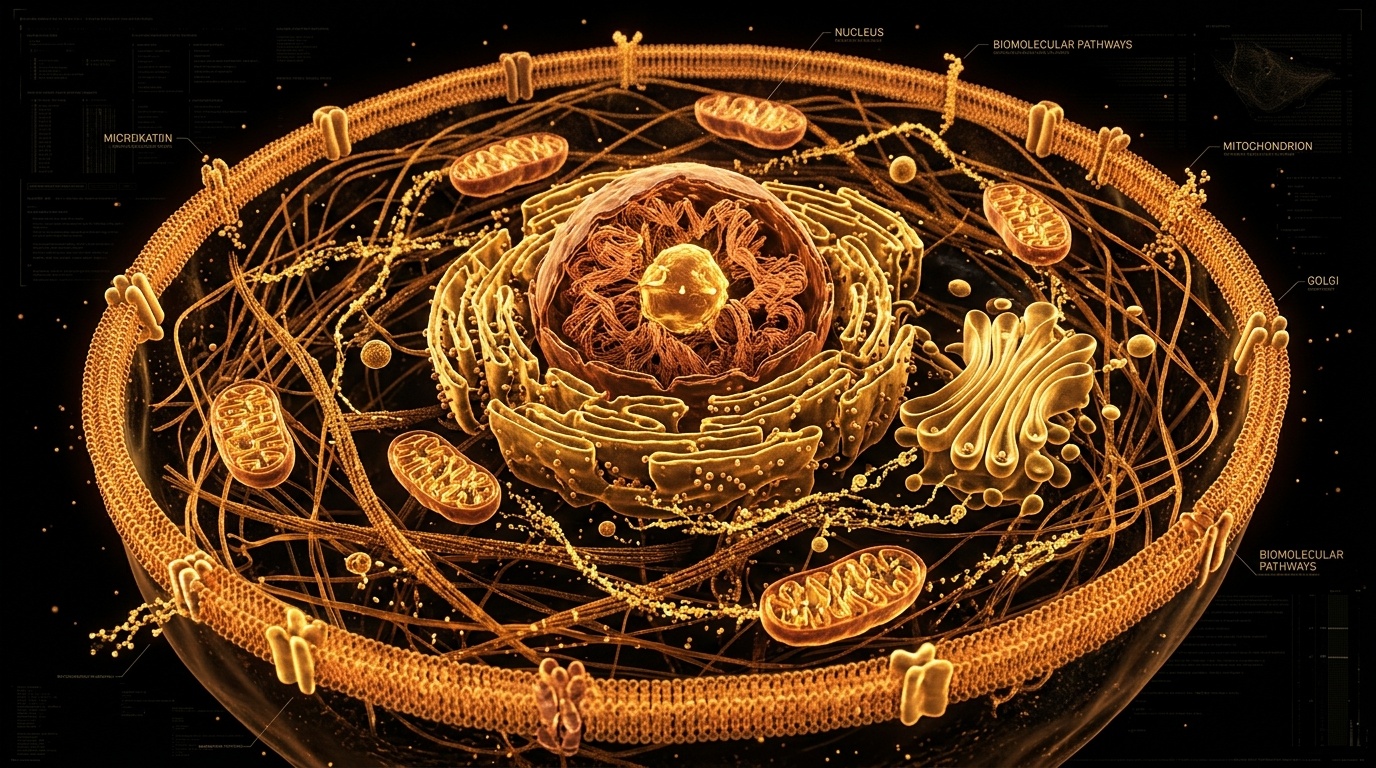
While structural biology AI has solved the static 3D structures of hundreds of millions of proteins, understanding how proteins fold within the chaotic, crowded cytoplasm of a living cell remains biology's grandest challenge.
The Virtual Cell models integrate cryo-electron tomography (cryo-ET)—which takes nanometer-scale three-dimensional snapshots of intact cells—with spatial transcriptomics and metabolomics. The result is a generative foundation model capable of predicting how a diseased cell responds to candidate drug molecules, toxicities, or genetic therapies without requiring months of animal models.
3. Data Access Governance & Timeline
The project aims to release its initial milestone dataset within 12 months, with fully functional predictive virtual cell models targeted within five years.
Under the consortium agreement, commercial partners (Google, Meta, and Isomorphic Labs) receive a one-year exclusive exploration window for datasets they co-fund, after which all biological matrices are released into public scientific repositories. All research funded directly by U.S. federal dollars via the DOE and NIH will enter the public domain immediately upon validation.
4. SyncFlo AI Perspective: Deterministic Reliability in Scientific AI
The creation of virtual cell foundation models demonstrates the necessity of high-assurance data orchestration, a core competency of SyncFlo AI.
In biotechnology, an ungrounded hallucination or unaccounted covariance in training data can mislead laboratory scientists for years. By applying deterministic verification frameworks, immutable telemetry logging, and cryptographic data lineage—principles that SyncFlo implements across mission-critical enterprise workflows—scientific enterprises can ensure that every prediction made by foundation models is auditable, reproducible, and grounded in verifiable empirical reality.