
OpenAI & Broadcom Tape Out "Jalapeño": Custom 2nm Inference Processor Delivers 4.2x Latency Lead Over GPUs for Autonomous Agent Swarms
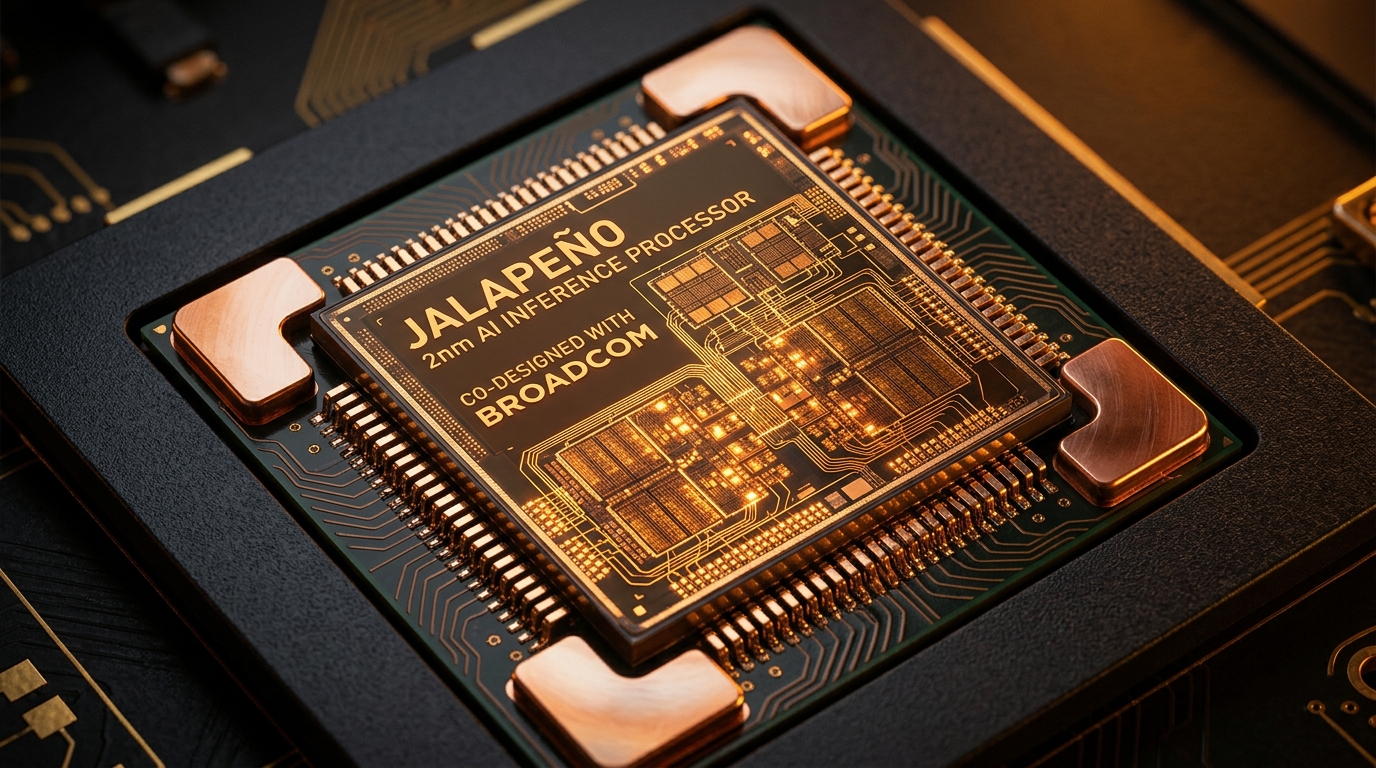
SAN JOSE & SAN FRANCISCO — October 4, 2026 — In a watershed moment for artificial intelligence infrastructure, OpenAI and Broadcom have officially completed the production tape-out of "Jalapeño," their bespoke 2-nanometer application-specific integrated circuit (ASIC) engineered exclusively for large-scale AI inference. Co-designed with Broadcom's world-class custom silicon division and fabricated on TSMC's cutting-edge N2P process node, Jalapeño is purpose-built to break the memory bandwidth chokeholds that hinder autonomous agent swarms running on general-purpose GPUs.
While general-purpose GPUs like NVIDIA's Grace Blackwell and AMD's MI450 dominate foundation model training, long-horizon agentic workloads—where thousands of AI agents maintain continuous context windows, query external tools, and verify intermediate code loops—are fundamentally constrained by memory latency, KV-cache thrashing, and inter-node optical routing overhead. Jalapeño eliminates these bottlenecks with an architecture dedicated to low-batch, high-frequency token generation.
1. The Architecture of Dedicated Agentic Inference
Unlike traditional graphics processors burdened with legacy rasterization pipelines, FP64 scientific units, and deep tensor memory hierarchies designed for massive matrix multiplications, Jalapeño is stripped to the bare essentials of autoregressive generation:
- Integrated Hardware KV-Cache Compression Engine: Dedicated silicon decompression logic allows multi-megatoken context retention with near-zero latency impact, reducing off-chip memory transactions by 68%.
- SRAM-Dominant Die Topology: Features 1.4 GB of ultra-fast on-die SRAM operating at over 32 Terabytes per second, enabling single-digit microsecond prompt prefill for continuous agent loops.
- Custom 2nm Matrix Cores: Optimized specifically for FP4, FP6, and FP8 quantized attention heads, delivering unprecedented throughput per watt for models in the 8B to 120B active parameter regime.
"When thousands of agents are running simultaneously in a workflow loop, latency is not just a user experience detail—it is the difference between a system that converges in seconds or one that stalls for minutes. Jalapeño gives our models the instant reflexes needed for true autonomous collaboration."
Architectural Comparison: Jalapeño ASIC vs. Frontier GPUs
2. Co-Packaged Optics & Broadcom's Optical Interconnect Fabric
A standout engineering breakthrough of Jalapeño is its native integration of Broadcom's next-generation Co-Packaged Optics (CPO). Instead of routing signals through high-loss copper PCB traces to external transceivers, light engines are integrated directly onto the chip substrate.
By embedding 1.6 Tbps optical links directly into the multi-chip module, Jalapeño pods communicate over optical fibers with less than 25 nanoseconds of switching overhead. This allows an entire rack of 128 Jalapeño processors to function as a unified virtual accelerator with a shared memory space of over 24 Terabytes of ultra-low latency HBM4 memory.
3. Gigawatt Datacenter Economics & Hardware Independence
With frontier labs facing ballooning energy bills in hyperscale datacenters, inference efficiency has become the primary operational metric. Industry estimates indicate that autonomous agent swarms consume up to 12 times more inference compute than traditional single-turn chatbots.
Broadcom CEO Hock Tan highlighted that Jalapeño's tailored ASIC approach achieves a 3.8x reduction in power consumption per generated token compared to running equivalent workloads on leading general-purpose GPU clusters. In a planned 1-gigawatt AI facility, this energy efficiency translates into hundreds of millions of dollars in annual power savings while enabling 4x greater concurrent agent capacity.
4. SyncFlo AI Integration: High-Frequency Agent Execution
SyncFlo AI is slated as an early enterprise pilot partner for the Jalapeño inference infrastructure.
In SyncFlo's autonomous sales orchestration and document reconciliation engines, multi-agent teams continuously debate verification steps, evaluate code diffs, and inspect structured data streams. Transitioning backend inference nodes to Jalapeño-accelerated clusters reduces multi-agent consensus latency from 3.2 seconds down to under 750 milliseconds, providing enterprise customers with fluid, near-instantaneous business automation.