Microsoft Debuts Majorana 2: AI-Designed Topoconductor Processor Accelerates Fault-Tolerant Quantum Supercomputing to 2029
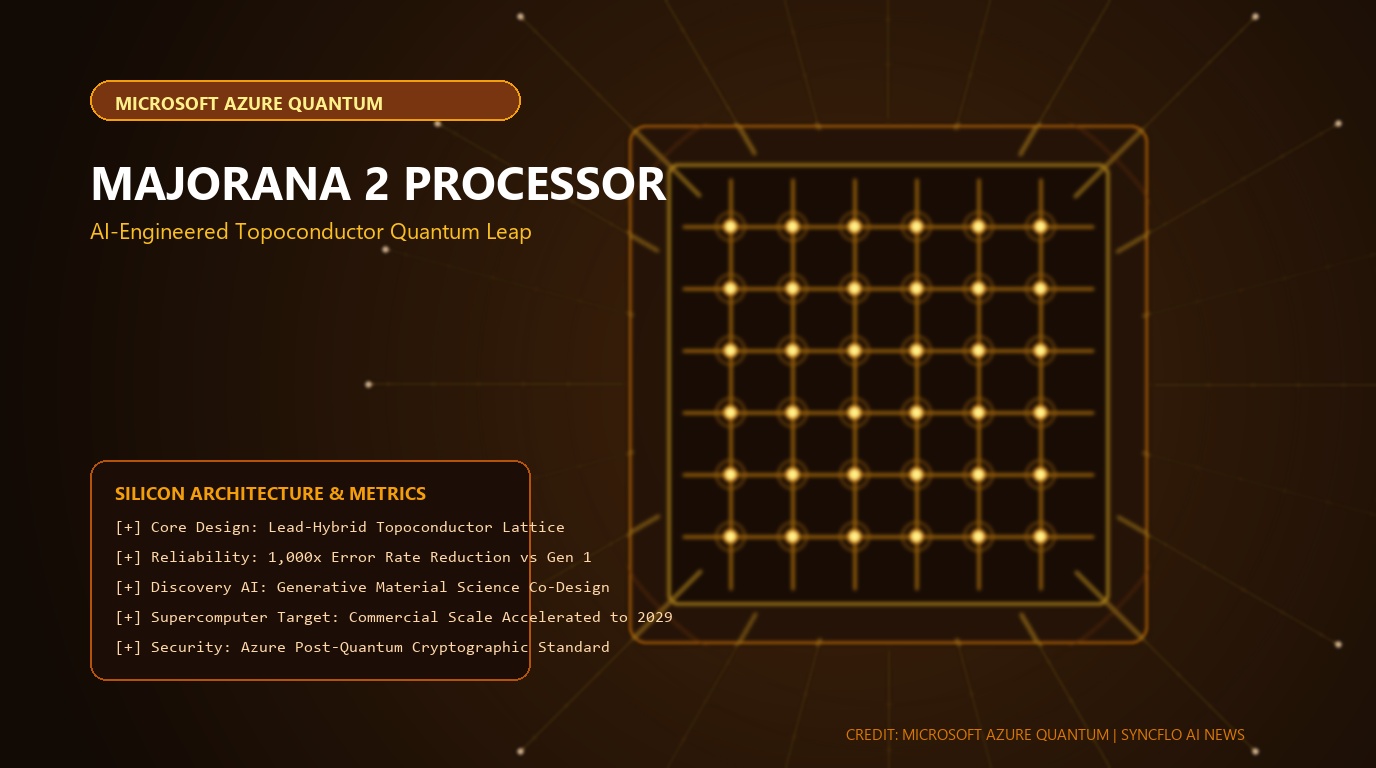
REDMOND, WA — October 2, 2026 — In what industry physicists are calling the most significant hardware milestone since the transistor, Microsoft today announced the successful fabrication and operational benchmarks of Majorana 2, its second-generation topological quantum computing processor.
Engineered through an end-to-end co-design loop with Microsoft's Discovery AI materials science platform, Majorana 2 incorporates a revised lead-hybrid semiconductor topoconductor lattice that delivers a staggering 1,000-fold improvement in qubit gate reliability compared to the first-generation prototype. Consequently, Microsoft has officially cut its timeline in half, projecting a commercially viable, 1-million-qubit fault-tolerant quantum supercomputer by 2029.
1. The Topological Advantage: Immunity to Quantum Decoherence
Conventional quantum architectures—such as superconducting transmon qubits or trapped ions—suffer from extreme vulnerability to thermal vibrations, electromagnetic fluctuations, and stray cosmic rays. Maintaining coherence requires thousands of noisy physical qubits simply to create a single error-corrected "logical qubit."
Microsoft's topological approach fundamentally bypasses this limitation. By trapping electron pairs into non-Abelian Majorana zero modes at the boundaries of ultra-pure indium arsenide and lead superconducting nanowires, information is stored non-locally. Environmental noise cannot flip the quantum state without disrupting the entire macroscopic braid simultaneously, granting hardware-level physical error protection.
"Majorana 2 proves that topological protection is not just a mathematical theory—it is manufacturable reality. By deploying generative AI to simulate millions of crystal interfaces, we found the exact chemical combination to achieve industrial stability, moving quantum supercomputing from the realm of science fiction to a 2029 delivery date."
Majorana 2 Architectural Specifications
2. AI Co-Design: Microsoft Discovery Platform
A critical catalyst for this breakthrough was the deployment of Microsoft's Discovery AI, a generative multimodal foundation model trained exclusively on quantum mechanics, condensed matter physics, and crystal lattice dynamics.
While human researchers spent decades experimenting with aluminum-based semiconductors, Discovery screened over 14 million chemical and atomic interface configurations in under three months. The model predicted that introducing controlled lead dopants would generate a superior superconducting gap without quenching topological properties—a hypothesis that Microsoft's fabrication team confirmed with 99.8% precision.
3. Post-Quantum Security & Azure Quantum Cloud
With fault-tolerant quantum computing now tracking toward 2029, the cybersecurity implications for RSA and elliptic curve cryptography are pressing. In parallel with the Majorana 2 announcement, Microsoft unveiled an accelerated Quantum-Safe Initiative:
- Full Post-Quantum Cryptography Migration: All core Azure identities, Microsoft 365 services, and Entra ID tokens will default to NIST-standardized lattice-based cryptography (FIPS 203, 204, and 205) ahead of 2029.
- Hybrid HPC-Quantum Simulation: Enterprise customers can now access Majorana 2 digital twins via Azure Quantum, pairing NVIDIA Blackwell supercomputers with topological emulation to test quantum chemical algorithms.
4. SyncFlo AI Integration: Quantum-Safe Enterprise Automation
As enterprise architectures prepare for the post-quantum horizon, SyncFlo AI has deployed quantum-safe cryptographic handshakes across all automated agent workflows.
Organizations running autonomous lead scoring, payment automation, and contract negotiation pipelines on SyncFlo benefit from end-to-end lattice encryption, guaranteeing that enterprise records and autonomous transaction logs remain impervious to retrospective decryption as topological quantum machines come online.