Google DeepMind Launches Gemini 4 Argon: 1M Token Output Limit, CodeMender Autonomous Vulnerability Defense, and Fairwind Cyber Deployment
LONDON & MOUNTAIN VIEW — October 2, 2026 — In an architectural leap for generative reasoning and digital infrastructure defense, Google DeepMind today announced Gemini 4 Argon, a state-of-the-art foundation model specifically engineered to break output generation barriers and autonomously secure mission-critical software systems.
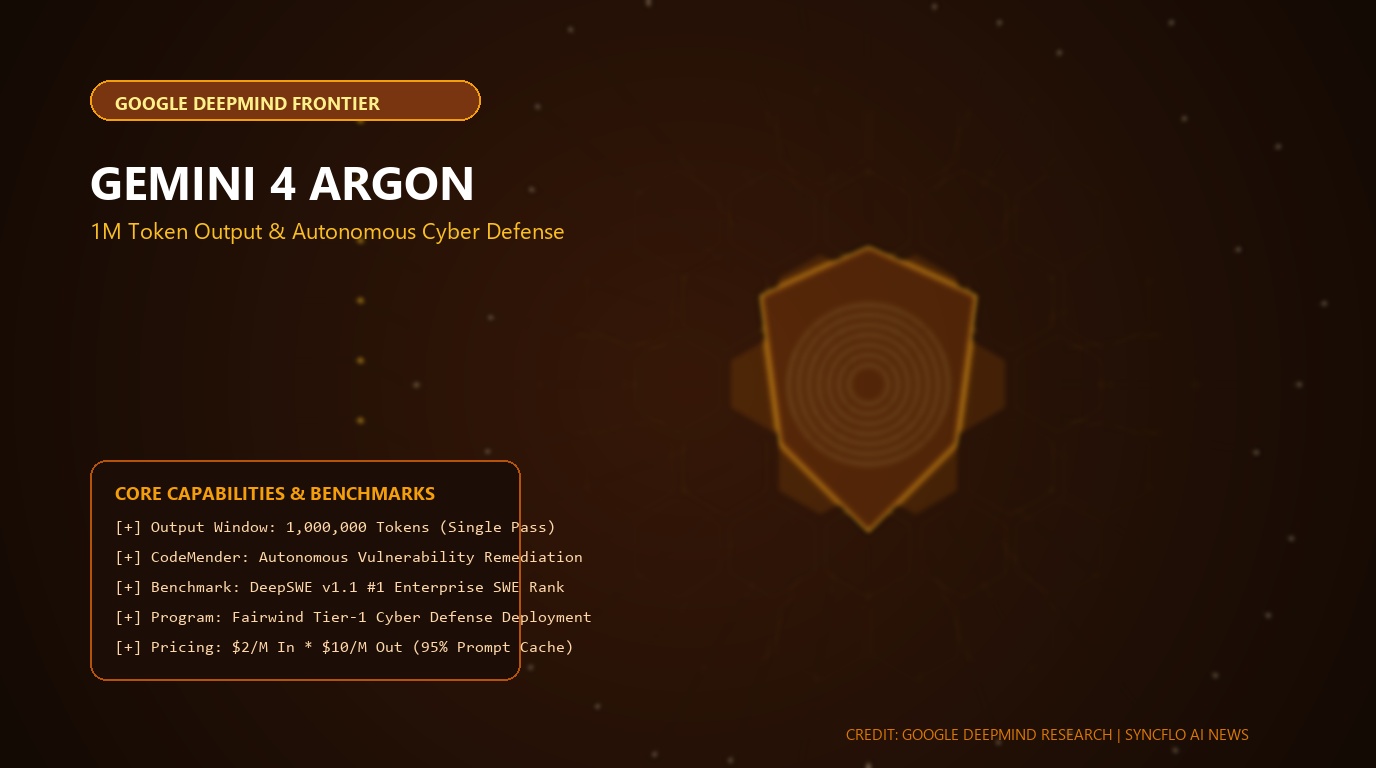
While previous frontier models focused heavily on expanding input context windows, Gemini 4 Argon tackles the historically bottlenecked generation phase. With the capability to produce up to 1,000,000 output tokens in a single sustained inference pass, Argon can synthesize entire enterprise repositories, generate comprehensive formal verification mathematical proofs, and execute end-to-end multi-week cybersecurity mitigation playbooks without chunking or conversational state loss.
1. Unprecedented Generation Depth: The 1 Million Output Token Frontier
Traditional Large Language Models encounter severe degradation in coherence, attention drift, and exponential quadratic latency when generating responses past tens of thousands of tokens. Google DeepMind resolved this through a novel sparse-attention recurring state memory mechanism paired with hardware-native linear memory compression on Google's TPU v6e and Ironwood clusters.
This breakthrough enables Gemini 4 Argon to generate fully realized multi-file software projects, complete architectural audits, and exhaustive mathematical proofs in a continuous generation stream. Rather than waiting for conversational agent loops to assemble disparate modules piece-by-piece, developers receive self-consistent, production-grade applications in one unified compilation pass.
"With Gemini 4 Argon, we have dissolved the distinction between thinking and doing. Generating a million tokens with zero semantic hallucination means an AI model can conceive, draft, formally verify, and deliver entire complex systems in a single cohesive breath."
Gemini 4 Argon Technical Specifications & Benchmarks
2. CodeMender: Autonomous Vulnerability Remediation
Built natively on top of Gemini 4 Argon's million-token reasoning engine is CodeMender, Google's autonomous cyber defense platform. Unlike legacy static analysis tools that flood engineers with noisy alerts, CodeMender operates as an active software security engineer:
- Autonomous Vulnerability Discovery: Recursively audits billions of lines of legacy code, identifying subtle concurrency race conditions, memory leaks, and logical privilege escalations.
- Zero-Day Patch Synthesis: Automatically crafts precise, minimally invasive pull requests that resolve identified CVEs while generating comprehensive unit tests to prevent regressions.
- Internal Production Deployment: Google confirmed that CodeMender has already migrated critical C/C++ core networking stacks into memory-safe Rust across its global datacenter fleet, slashing memory-related vulnerabilities by over 80%.
3. Project Fairwind: Phased Controlled Defense Deployment
Recognizing the dual-use potential of a model capable of finding and rewriting software vulnerabilities at automated speed, Google DeepMind is debuting Gemini 4 Argon through Project Fairwind.
Initially restricted to vetted global cybersecurity defenders, critical infrastructure operators, and enterprise defense partners, Fairwind ensures that defensive cyber teams gain the asymmetric advantage before broader general API availability. Introductory enterprise pricing is set at $2.00 per million input tokens and $10.00 per million output tokens, with cached prompts receiving an aggressive 95% discount. General enterprise and Google AI Ultra availability will roll out in subsequent stages.
4. SyncFlo AI Integration: Enterprise Security and Pipeline Governance
As autonomous agent swarms take over revenue and software pipelines, security boundaries are paramount. SyncFlo AI has integrated the Gemini 4 Argon verification endpoints into its agent orchestration framework.
Through SyncFlo's native Fairwind integration, enterprises deploying autonomous sales agents and operational workflows can continuously audit customer data connections, verify zero third-party data leakage, and ensure that automated outbound communication channels maintain complete cryptographic and regulatory integrity.