
OpenAI Launches Decisions API: Sub-15ms 'System 1' Luna Engine Delivers Deterministic Decision Trees for Autonomous Agent Swarms
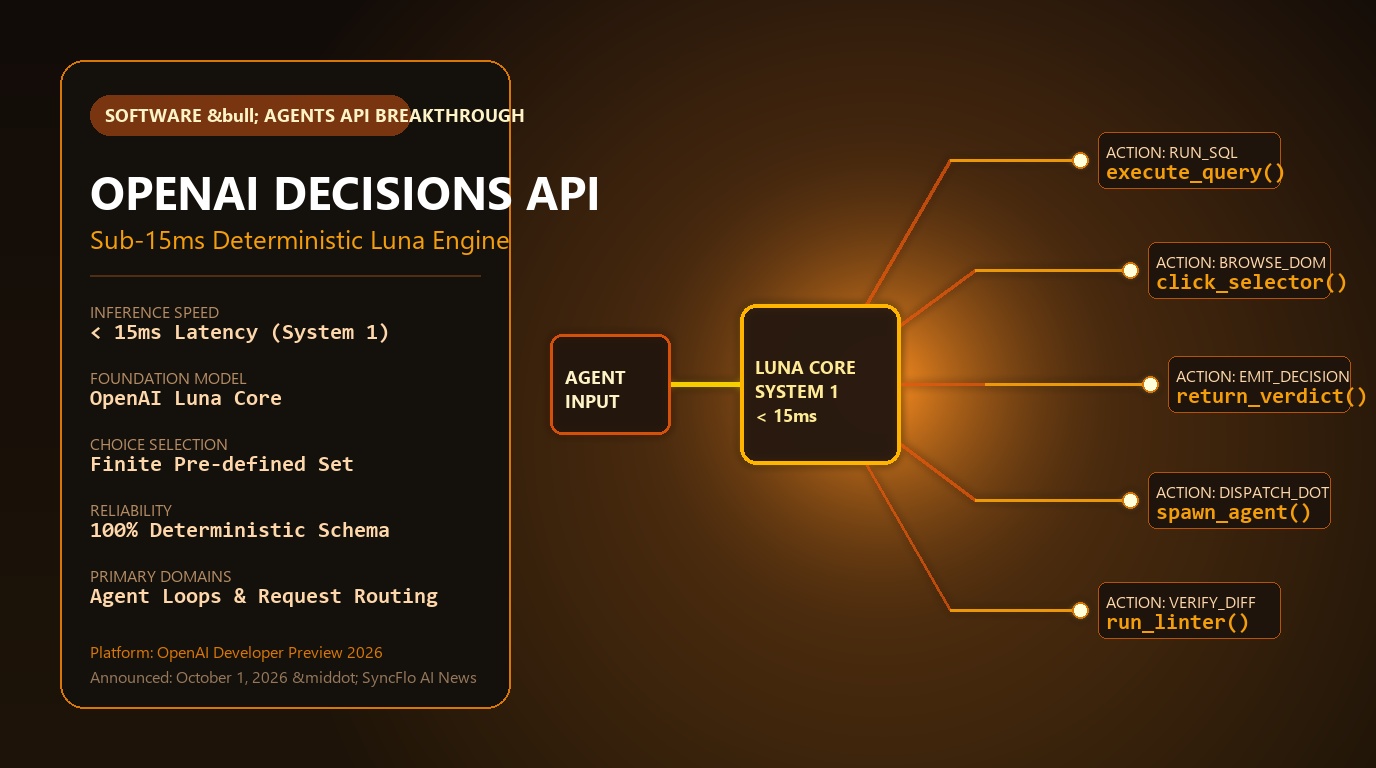
SAN FRANCISCO, CA — October 1, 2026 — Following the unveiling of its persistent agent framework at DevDay, OpenAI today formally launched the Decisions API, an architectural departure from conversational language models that delivers sub-15-millisecond deterministic classification and action selection powered by a specialized "System 1" model named Luna.
Rather than forcing agent developers to parse verbose Markdown strings or wrestle with JSON extraction failures during mission-critical automation loops, the Decisions API allows engineers to pass complex multimodal contexts alongside a strictly defined, finite set of choices. In a fraction of the time required to generate a single sentence of text, the Luna engine evaluates the state and returns a guaranteed, deterministic branch selection.
1. Solving the Agent Latency & Hallucination Tax
In modern multi-agent systems—where agents invoke bash terminals, navigate web DOM trees, query SQL databases, and pass state to subagents—over 70% of model calls do not require creative prose. Instead, they require fast binary or categorical decisions: "Should I click the submit button or paginate?", "Did the unit test pass or fail?", "Does this inbound email warrant a live sales transfer?"
Until now, developers had to use large reasoning models like GPT-6 or Claude Opus for these routing forks, paying hundreds of milliseconds in time-to-first-token (TTFT) and risking nondeterministic tool-call formatting errors. The Decisions API eliminates this computational overhead entirely.
"When building complex autonomous workflows, 90 percent of execution is fast, instinctual steering—what Daniel Kahneman termed System 1 thinking. The Decisions API gives agents instantaneous reflexive decision-making, reserving frontier reasoning models for the hard reflective problems."
Decisions API Core Architectural Advantages
2. Anatomy of the Call: Code Example & Flow
The Decisions API interface provides an ergonomic, type-safe schema designed for high-concurrency event loops. Developers specify the input context (text, screenshot, or structured JSON) and an explicit array of permitted choice keys:
client.decisions.create(
    model="luna-system1",
    context={
        "task": "Triage inbound customer demo request",
        "lead_revenue": "$45,000,000 ARR",
        "lead_tier": "Enterprise VIP"
    },
    choices=[
        {"key": "DISPATCH_AE_PHONE", "desc": "Trigger immediate executive AE ring"},
        {"key": "SEND_CALENDAR_LINK", "desc": "Send asynchronous booking calendar"},
        {"key": "FLAG_FRAUD", "desc": "Quarantine domain for verification"}
    ]
)
# Returns: {"choice": "DISPATCH_AE_PHONE", "confidence": 0.998, "latency_ms": 11.4}
3. Powering OpenAI 'Dots' and Autonomous Swarms
The launch of the Decisions API is the technical engine behind OpenAI's newly announced Dots—the persistent cloud-hosted workcells capable of executing background enterprise tasks.
Rather than burning expensive GPU cycles generating conversational apologies or verbose explanations, a Dot running in headless Linux containers uses the Decisions API to cycle through interface navigation, form field inputs, and git conflict reconciliations with industrial speed.
4. Enterprise Orchestration with SyncFlo AI
With thousands of enterprises transitioning toward agent-driven revenue pipelines, SyncFlo AI has integrated the Decisions API directly into its workflow automation engine.
SyncFlo AI users can now execute real-time intent classification, lead scoring, and automated SDR handoffs at sub-15-millisecond speeds. By pairing the speed of the Decisions API with SyncFlo's native governance and CRM synchronization, revenue operations teams achieve instantaneous pipeline progression while slashing cloud token expenditure by up to 88%.