
Japan's JERA, Dell Technologies, and RHAELM Form $15B Alliance to Construct Multi-Gigawatt Green AI Hyperscale Campus in Chiba
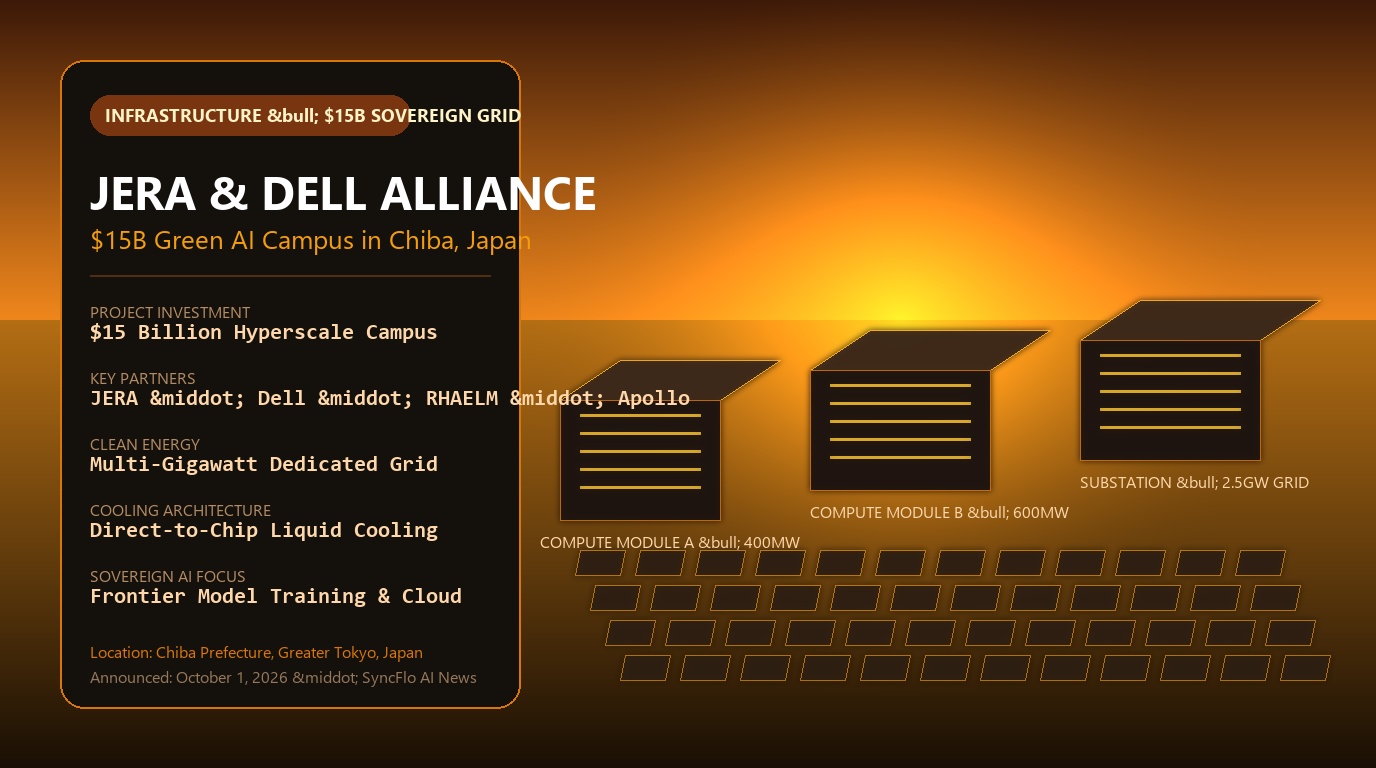
TOKYO & ROUND ROCK, TX — October 1, 2026 — In one of the largest infrastructure agreements in Asian computing history, JERA Co., Inc., Japan's largest power generator, alongside global technology leader Dell Technologies and UK-based AI datacenter developer RHAELM, today announced a landmark $15 billion strategic partnership to construct a standardized, multi-gigawatt AI hyperscale campus in Chiba Prefecture.
Backed by strategic financing from global asset manager Apollo Global Management, the project directly addresses the most pressing bottleneck facing frontier AI labs and national governments: the severe shortage of dedicated grid power and water-efficient cooling capacity required to train next-generation foundation models.
1. Solving the AI Power Wall: Dedicated Green Generation
As frontier models scale into clusters exceeding 100,000 accelerators, traditional electrical grids in North America and Western Europe have reached maximum substation transmission thresholds. Datacenter lead times in Northern Virginia and Frankfurt now stretch beyond five years due to utility interconnection delays.
By partnering directly with JERA—which produces approximately 30% of Japan's electricity—the Chiba campus circumvents grid congestion through on-site zero-emission power delivery. The facility integrates offshore wind farms, hydrogen-ready co-generation, and large-scale battery energy storage systems (BESS) directly into high-voltage private substations.
"AI infrastructure is fundamentally an energy and thermodynamic engineering challenge. You cannot build artificial general intelligence on a fragile electrical grid. By coupling Japan's premier energy utility with Dell's liquid-cooled compute architecture, we are delivering an uncompromised, clean-energy foundation for sovereign AI across the Asia-Pacific."
Chiba AI Hyperscale Campus Architectural Pillars
2. High-Density Compute Architecture: Dell PowerEdge & Liquid Cooling
The compute fabric deployed inside the Chiba pavilions will be built upon standardized Dell PowerEdge XE9680 and next-generation liquid-cooled modular server blocks.
Engineered to handle thermal loads exceeding 120kW per rack, the campus employs direct-to-chip warm-water cooling manifolds that eliminate traditional evaporative water consumption. Waste heat from the accelerator clusters will be captured and repurposed to support regional agricultural greenhouses and district heating initiatives across Chiba Bay.
3. Anchoring Japan's Sovereign AI Mandate
Japan's Ministry of Economy, Trade and Industry (METI) has identified compute sovereignty as a core economic security priority. By establishing a world-class hyperscale compute sanctuary on Japanese soil, domestic research institutions, financial conglomerates, and automotive giants can train Japanese-first frontier foundation models without exporting sensitive enterprise data to foreign jurisdictions.
RHAELM will oversee turnkey datacenter construction and modular campus expansion, with Phase 1 expected to energize initial 400-megawatt compute halls by late 2027.
4. SyncFlo AI Enterprise Resilience: Multi-Region High Availability
As enterprise AI adoption surges across Tokyo, Singapore, and Asia-Pacific financial centers, SyncFlo AI has announced planned availability on the JERA-Dell sovereign compute grid.
SyncFlo's global orchestration network allows multi-national enterprises to maintain real-time sales agent instances, customer intent intelligence, and automated revenue workflows with ultra-low latency while complying with strict cross-border data protection acts. The Chiba campus will serve as a primary Asia-Pacific regional compute anchor for SyncFlo AI's enterprise customers.