Google Unveils Project Suncatcher: Space-Hardened TPUs Launching on SpaceX Transporter-18 for Orbital AI Datacenters
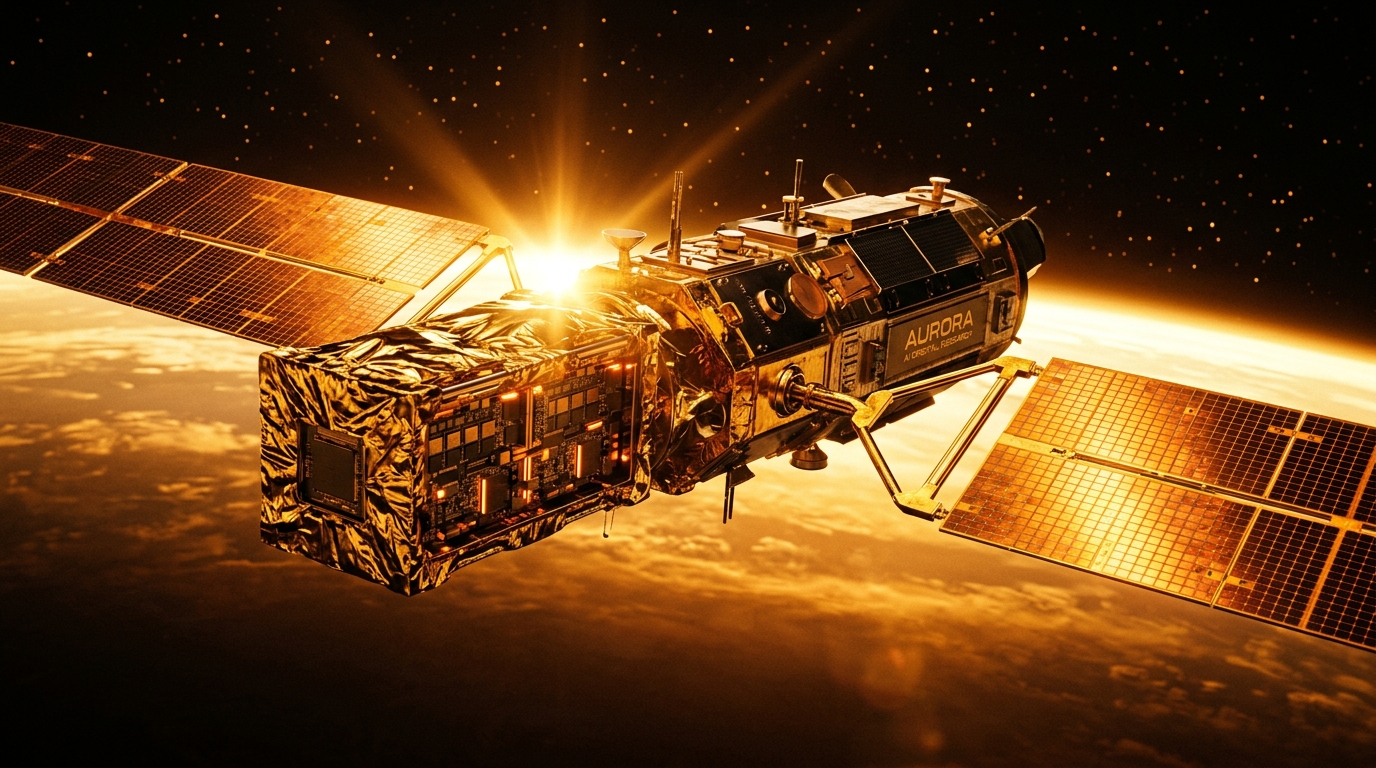
MOUNTAIN VIEW, CA — September 28, 2026 — In what may be the definitive technological solution to the terrestrial energy crisis threatening the expansion of artificial intelligence, Google has officially unveiled Project Suncatcher—an audacious moonshot to relocate large-scale frontier AI supercomputing clusters into low Earth orbit. Developed in strategic collaboration with aerospace imaging leader Planet Labs, the first operational prototype satellite is scheduled for launch on October 1, 2026, aboard SpaceX’s Transporter-18 rideshare flight from Vandenberg Space Force Base.
Packed with four specially engineered, radiation-shielded Google Tensor Processing Units (TPUs), the satellite platform delivers the compute density of a terrestrial datacenter server rack directly into orbit. By tapping into nearly 24/7 unfiltered solar irradiance and shedding heat through radiative dissipation into the absolute cold of deep space, Google aims to prove that the future of clean, unlimited AI intelligence lies beyond the atmospheric envelope of Earth.
1. The Energy Imperative: Why Orbit is the Ultimate AI Datacenter
Terrestrial AI datacenters currently confront insurmountable physical bottlenecks: strained municipal power grids, cooling water consumption in arid zones, and zoning restrictions. In sun-synchronous orbit, however, solar radiation is roughly 30% to 40% more intense than at sea level, entirely unimpeded by clouds, atmospheric scattering, or diurnal night cycles.
By coupling high-efficiency multi-junction gallium arsenide photovoltaic arrays directly to onboard TPU power distribution networks, Project Suncatcher achieves near-unity power usage effectiveness (PUE), eliminating terrestrial transformer substations, diesel backup generators, and millions of gallons of evaporative cooling water.
"We have reached a juncture where Earth's electrical grids are becoming the primary throttle on human scientific progress. Project Suncatcher is about looking upward: harnessing the infinite, unfiltered nuclear furnace of our Sun to compute the next era of frontier intelligence without leaving an ecological footprint on our planet."
Project Suncatcher Orbital Platform Specifications
2. Overcoming Cosmic Hardships: Radiation & Thermal Dissipation
Deploying cutting-edge 3nm-class accelerators into space presents immense physics hurdles. Unshielded cosmic rays and solar proton events can cause single-event upsets (bit flips) or permanent latch-up damage. To counteract this, Google’s hardware team implemented architectural triple-modular redundancy (TMR) and radiation-hardened memory substrates that can autonomously detect and correct transient memory anomalies in real-time.
Furthermore, with no air in the vacuum of space, traditional heatsinks and fans are useless. Partnering with Planet Labs, Google designed an innovative closed-loop capillary radiator manifold wrapped in multilayer gold thermal insulation. Heat generated by the TPUs is pumped directly toward deployable radiator wings oriented permanently toward the deep-space thermal sink (approaching 3 Kelvin), radiating hundreds of thermal watts purely through infrared emission.
3. Autonomous Orbital Inference: Real-Time Planetary Sensing
Beyond proving long-term hardware reliability, the October 1 mission will perform real-time autonomous machine learning directly on raw geospatial sensor streams captured by Planet Labs’ imaging payloads.
Instead of downlinking gigabytes of uncompressed raw spectral telemetry to ground stations, the onboard TPUs will run edge computer vision models (including specialized Gemini vision checkpoints), autonomously identifying wildfire ignitions, illegal oceanic vessel movements, and glacial retreat in sub-second timelines before transmitting targeted alert tokens back to Earth.
4. Off-Planet Data Orchestration with SyncFlo AI
As orbital AI nodes establish the vanguard of distributed extraterrestrial infrastructure, coordinating data synchronization between orbital laser constellations and terrestrial enterprise repositories requires intelligent protocol adapters.
SyncFlo AI has launched experimental support for Delay-Tolerant Space Networking (DTSN) connectors. Enterprise developers leveraging SyncFlo can now queue asynchronous inference tasks for orbital execution, automatically buffering requests during satellite ground-pass blindspots and synchronizing validated results straight into core enterprise workflows upon optical downlink acquisition.