Meta Connect 2026: Zuckerberg Unveils Muse on AI Glasses, Muse Charm Hardware, and Autonomous Agentic Commerce Powered by Muse Spark 1.3
MENLO PARK, CA — September 27, 2026 — In what industry watchers are describing as Mark Zuckerberg's boldest consumer computing gambit since the founding of Reality Labs, Meta Connect 2026 concluded with a historic unveiling centered on "Personal Superintelligence". Announcing the deep physical integration of Meta's flagship autonomous agent Muse into next-generation AI glasses, Zuckerberg revealed the all-new Muse Charm standalone hardware wearable, ultra-slim VR glasses, and a game-changing partnership with Stripe and Shopify enabling autonomous agentic commerce.
Rather than limiting artificial intelligence to chat windows and web browsers, Meta's strategy puts multimodal agent intelligence directly into the physical world. Under the hood, these devices are driven by Muse Spark 1.3—Meta's frontier reasoning and agentic foundation model that has now superseded the legacy Llama series as Meta's primary consumer AI engine.
1. Muse on AI Glasses: See, Hear, and Act in the Physical World
The centerpiece of Meta's hardware showcase is the expanded smart eyewear lineup. Partnering with EssilorLuxottica, Meta introduced over 100 frame styles across Ray-Ban and Oakley brands, alongside a breakthrough set of ultralight, all-day wearable slim VR glasses.
With Muse integrated directly into the glasses' camera, microphone, and optical display, the AI shares the user's first-person perspective. Users can simply look at a broken appliance, a restaurant menu, or a handwritten formula, and Muse autonomously conducts visual diagnosis, translates across dozens of dialects in real-time, or organizes calendar and navigation logistics hands-free.
"We are moving from devices you look at, to devices that see what you see and help you navigate reality. Personal superintelligence isn't an abstract datacenter algorithm—it is a companion that walks alongside you, remembers what matters to you, and takes care of the friction of modern life."
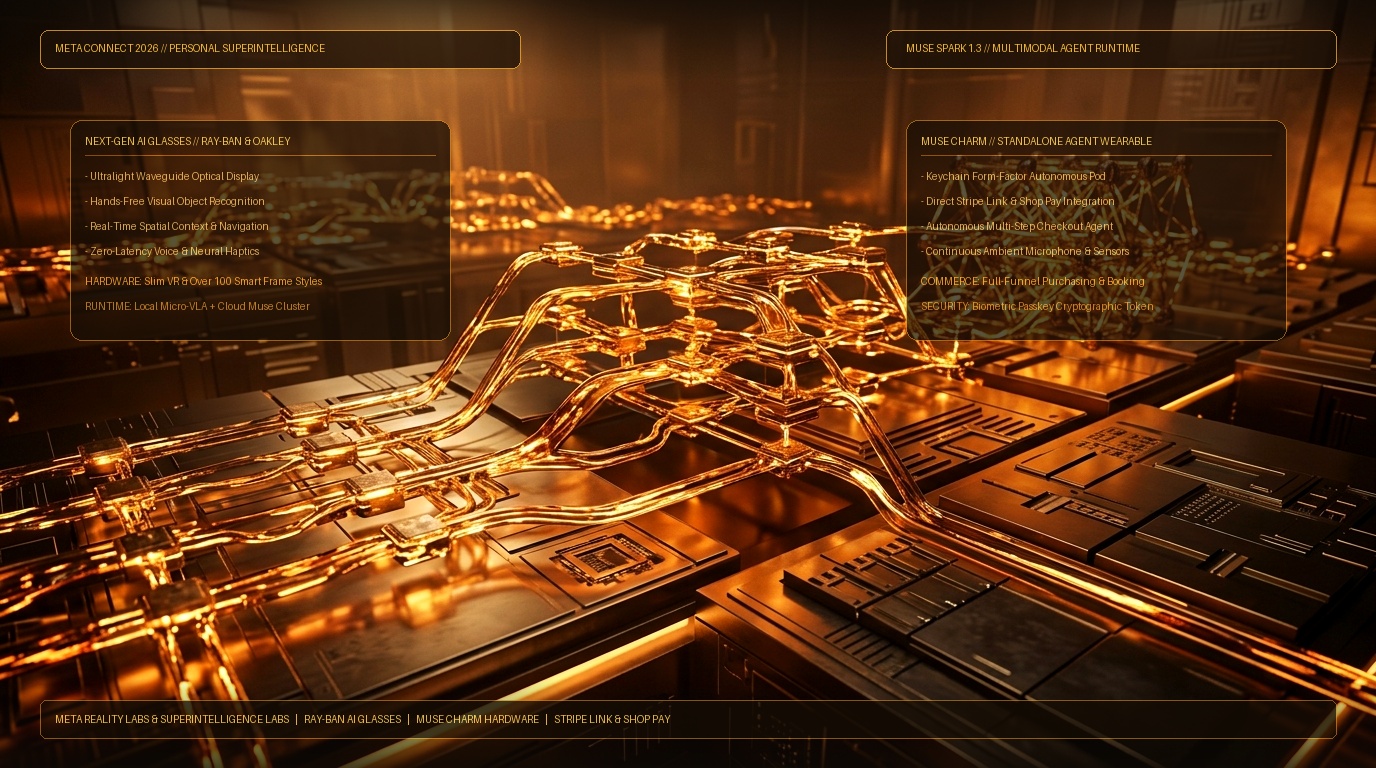
Meta Connect 2026 Hardware & Agent Ecosystem
2. The Muse Charm: Standalone Keychain Ambient Wearable
In an unexpected hardware reveal, Meta debuted the Muse Charm—a compact, tactile AI device engineered to attach to keychains, bags, or clothing. For situations where users prefer not to wear glasses, the Charm functions as an ambient acoustic and sensory node.
Equipped with a biometric capacitive touch surface, high-fidelity microphones, and an ultra-low-power edge coprocessor, the Muse Charm captures ambient voice memos, provides subtle haptic confirmations, and dispatches background tasks to Meta's cloud clusters.
3. Agentic Commerce: Stripe Link & Shop Pay Integration
The most commercially consequential announcement of Connect 2026 is Meta's deployment of Autonomous Agentic Commerce. Partnering with Stripe and Shopify, Meta has granted Muse authorized purchasing agency via Stripe's Link checkout infrastructure and Shop Pay.
Users can tell Muse: "Find two tickets to the Saturday basketball game under $150 and buy them," or "Order replacement filters for my air purifier." Muse handles merchant search, compares shipping speeds, applies available discounts, verifies cryptographic biometric authorization through the user's wearable, and finalizes payment without requiring manual form entry.
4. Enterprise Synchronization via SyncFlo AI
As consumer agents begin executing financial transactions and physical-world actions at scale, enterprises require real-time synchronization between front-end customer agents and backend enterprise software.
SyncFlo AI has announced direct integration with the Meta Muse Agent SDK. Retailers, hotel chains, and service businesses using SyncFlo can now publish verified inventory feeds and autonomous scheduling webhooks directly into the Muse discovery network, capturing automated voice and vision purchases with zero latency.