
OpenAI Unveils GPT-6 Sol & Luna: Frontier Agentic Reasoning and 50% Compute Cost Reduction for Enterprise Automation
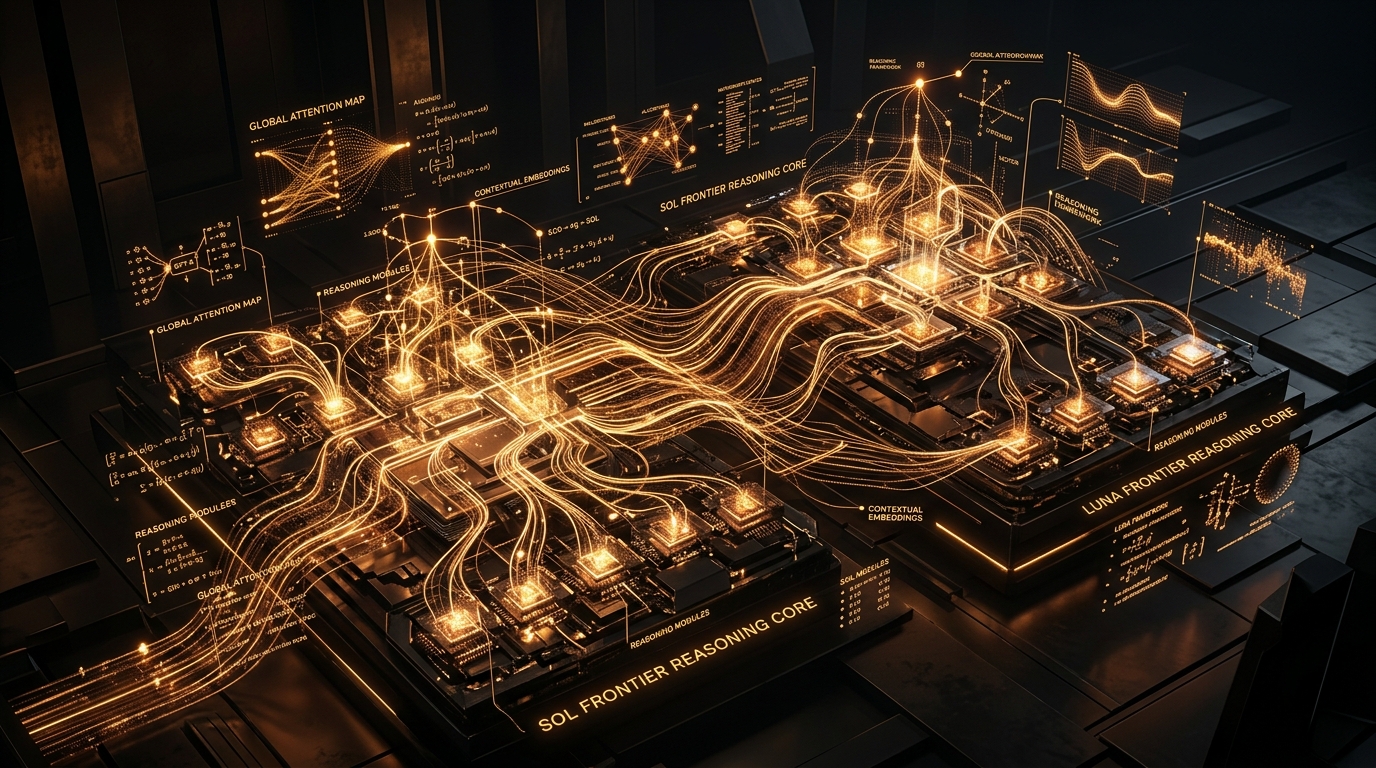
SAN FRANCISCO, CA — September 26, 2026 — In a strategic move designed to consolidate its leadership across both enterprise software and high-density agentic workflows, OpenAI today announced the worldwide general availability of two new frontier models: GPT-6 Sol and GPT-6 Luna. Serving as direct complements to the premium flagship GPT-6 Astra released earlier this month, the new models introduce flexible reasoning effort controls while reducing enterprise token inference costs by 50% compared to previous-generation GPT-5.6 systems.
The launch reflects a maturing AI ecosystem where raw benchmark supremacy is no longer sufficient; enterprises demand predictable economics, fine-grained latency management, and reliable multi-hour agent orchestration. With Sol and Luna, OpenAI delivers an end-to-end foundation model spectrum spanning high-speed transactional extraction to autonomous full-stack software development.
1. Dual-Core Strategy: GPT-6 Sol vs. GPT-6 Luna
Rather than forcing organizations into a one-size-fits-all model tier, OpenAI architected Sol and Luna around distinct operational profiles:
- GPT-6 Sol (The Interactive Reasoning Engine): Positioned directly beneath GPT-6 Astra, Sol delivers exceptional mathematical logic, code synthesis, iterative debugging, and autonomous browser navigation. Sol matches the problem-solving depth of GPT-6 Astra across 92% of software engineering benchmarks at roughly one-third the token cost.
- GPT-6 Luna (The High-Throughput Processing Core): Engineered for ultra-low latency and astronomical document volume, Luna processes complex inputs—such as legal disclosures, multi-lingual financial contracts, and unstructured logs—with near-instant response times and unprecedented intelligence density per dollar.
"With GPT-6 Sol and Luna, we are proving that frontier intelligence and aggressive cost reduction are not mutually exclusive. Developers can now afford to run continuous, autonomous reasoning loops on millions of daily customer touchpoints without bankrupting their compute budgets."
GPT-6 Model Family Architectural & Pricing Matrix
Context Window: 1,000,000 Tokens
Reasoning Effort: Native Adaptive Dynamic
Input / Output: $10.00 / $50.00 per MTok
Context Window: 500,000 Tokens
Reasoning Effort: low, medium, high, xhigh
Input / Output: $3.50 / $14.00 per MTok
Context Window: 256,000 Tokens
Reasoning Effort: low, medium
Input / Output: $0.75 / $2.50 per MTok
2. Granular Reasoning Effort Controls (Low to Max)
A hallmark feature of the GPT-6 release is developer-defined reasoning effort calibration. Through the OpenAI API and ChatGPT enterprise settings, developers can dynamically govern the length of internal chain-of-thought verification before generating user-facing output:
Setting reasoning_effort="low" instructs the model to prioritize immediacy, ideal for customer support bots, autocomplete prompts, and simple classification. Dialing up to reasoning_effort="xhigh" triggers multi-step self-verification loops, tree-of-thought backtracking, and simulated edge-case evaluation, ensuring mission-critical accuracy on complex mathematical theorems and architectural refactoring.
3. Broad Multi-Cloud Availability & SyncFlo Integration
OpenAI confirmed that both GPT-6 Sol and Luna are immediately accessible via the OpenAI API, Microsoft Azure AI Studio, and Amazon Bedrock, with automated fallback routing and HIPAA/SOC2 Type II enterprise compliance out of the box. Paid ChatGPT tiers (Plus, Pro, Business, Enterprise, and Edu) receive automatic access in their model selector dropdowns.
SyncFlo AI has rolled out native orchestration connectors for the entire GPT-6 family. By coupling GPT-6 Sol's code reasoning with SyncFlo's autonomous pipeline sync, enterprise customers can trigger self-healing automated workflows, autonomous schema synchronizations, and intelligent data pipeline transformations with zero manual intervention.