Google DeepMind Unveils Gemini 3.8 Live Extended Thinking: Sub-120ms Speech-to-Speech Reasoning with Native Visual Perception
MOUNTAIN VIEW, CA & LONDON, UK — September 18, 2026 — In a monumental leap for conversational intelligence, Google DeepMind has announced the global release of Gemini 3.8 Live Extended Thinking. The frontier model marks the first time that deep test-time reasoning—traditionally confined to slow, asynchronous text-based chain-of-thought models—has been successfully embedded into an ultra-low-latency, real-time voice and video interface.
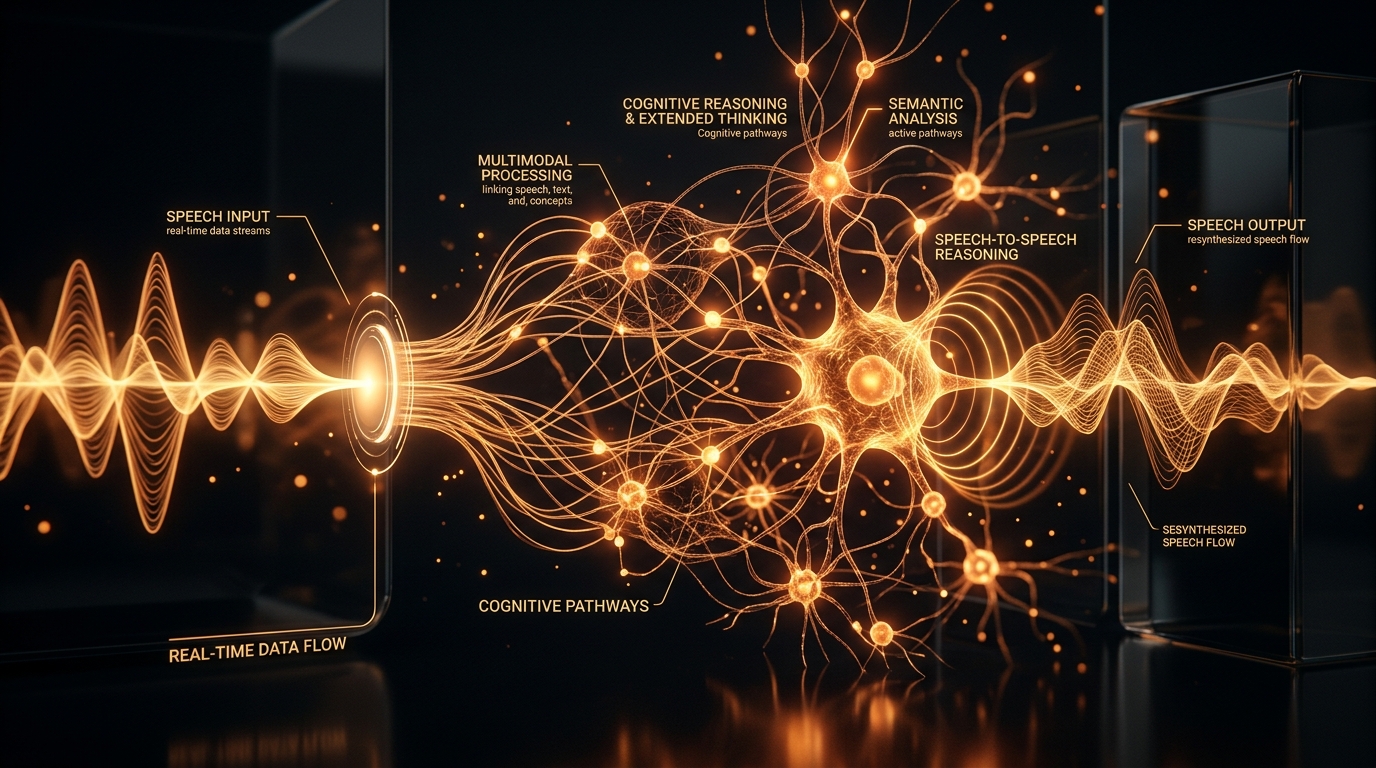
Clocking conversational latencies under 120 milliseconds, Gemini 3.8 Live Extended Thinking enables fluid, natural back-and-forth speech while simultaneously solving complex multi-step reasoning problems, debugging code shown via live camera feed, and maintaining situational awareness without relying on external Automated Speech Recognition (ASR) or Text-to-Speech (TTS) pipelines.
1. Solving the "Thinking Pause" Dilemma: Dual-Track Cognitive Streaming
Until today, frontier reasoning models faced an inescapable tradeoff: to reason deeply, they required seconds or even minutes of "thinking time" to roll out internal decision trees, making them unsuitable for live spoken conversation. Conversely, voice assistants that responded in under 200ms were limited to shallow retrieval and static reflex responses.
Gemini 3.8 Live resolves this through a patented Dual-Track Cognitive Streaming architecture:
- Reflex Track (Acoustic Fast-Path): Manages conversational prosody, backchanneling (e.g., "Mm-hmm", "I see", thoughtful pauses), active interruption handling, and turn-taking signals with instantaneous sub-80ms acoustic tokenization.
- Deliberation Track (Sub-surface Chain-of-Thought): Dynamically scales compute in the background, allocating reasoning tokens across complex logical premises, mathematical formulas, and spatial geometries without stalling speech generation.
- Continuous Audio Tokenizer (SoundStream-X): Directly converts raw waveform audio into unified semantic tokens, capturing subtle vocal nuances, emotional inflection, whisper modes, and ambient background cues.
"When a human expert explains a difficult surgical procedure or walks an engineer through circuit schematics, they do not freeze in total silence for twenty seconds before speaking. They maintain vocal rapport while their brain actively solves the next problem. Gemini 3.8 Live Extended Thinking gives AI that exact dual cognitive capability."
Gemini 3.8 Live Extended Thinking Performance Benchmarks
2. Native Multi-Modal Perception at 60 FPS
Unlike traditional systems that sample occasional keyframes every two seconds, Gemini 3.8 Live processes continuous 60 frames-per-second video streams directly within its attention context.
During live demonstrations, Google demonstrated an engineer pointing a smartphone camera at an unrouted 6-layer printed circuit board (PCB). As the engineer spoke casually, Gemini 3.8 Live identified thermal choke-points, suggested rerouting power traces over voice, and corrected component polarity errors in real time as the engineer moved their soldering iron.
3. Enterprise Applications: Surgery, Aerospace, & Developer Workflows
The commercial deployment of Gemini 3.8 Live Extended Thinking opens transformative horizons across high-stakes industries:
- Surgical Operating Suites: Providing surgeons with hands-free, voice-guided anatomical verification and intraoperative imaging telemetry without breaking sterile fields.
- Aerospace Maintenance & Inspection: Guiding avionics technicians through complex turbine diagnostics with instant voice verification of torque tolerances and fastener fatigue.
- Pair-Programming & Engineering: Developers can share their terminal and code editor via screen capture while conducting complex architectural whiteboard reviews entirely through conversational speech.
4. Deployment, Availability & API Access
Google confirmed that Gemini 3.8 Live Extended Thinking is rolling out immediately to Google Cloud Vertex AI and the Gemini API via standard WebSocket and WebRTC endpoints. Tiered pricing structures allow enterprise developers to dynamically tune deliberation compute budgets depending on task criticality.
End-user access is rolling out concurrently to Advanced subscribers on Google Pixel devices and web clients starting this week.