DeepSeek Releases DeepSeek-V4.1-Flash: 552B Multimodal MoE with 8B Active Prefill, 890-Byte KV Cache Compression & MIT License
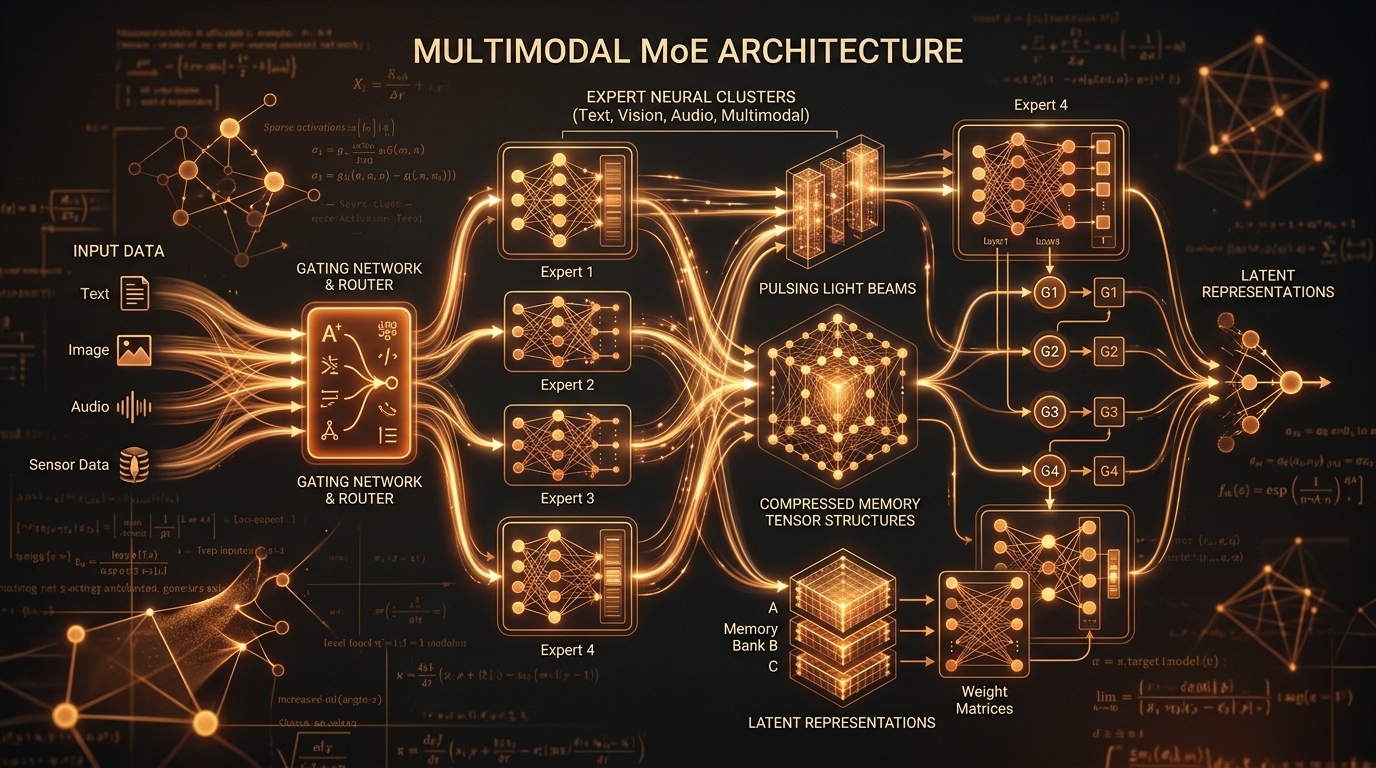
HANGZHOU, CHINA — September 10, 2026 — In another transformative release that reshapes the economics of open-source artificial intelligence, DeepSeek AI has officially announced the global release of DeepSeek-V4.1-Flash. The model—an open-weights, 552-billion parameter multimodal Mixture-of-Experts (MoE) system released under the permissive MIT License—introduces a novel Causal Encoder-Decoder architecture that slashes inference memory footprints while matching or exceeding frontier proprietary models.
Available immediately for direct download via Hugging Face and deployed on the DeepSeek API under the endpoint deepseek-flash, V4.1-Flash represents DeepSeek's definitive answer to high-density reasoning and agentic deployment. By decoupling prompt prefill from token decoding, the system activates only 8 billion parameters during input ingestion and 16 billion parameters during generation, enabling unprecedented throughput on commodity compute clusters.
1. Architectural Breakthrough: The Causal Encoder-Decoder Engine
Traditional dense and MoE transformer models typically activate identical parameter subsets across both prefill (reading context) and decode (emitting answers). DeepSeek-V4.1-Flash fundamentally departs from this convention by employing an asymmetric Causal Encoder-Decoder design:
- 8B Active Prefill (Encoder): Optimized for lightning-fast scanning across massive context windows of up to 1 million tokens, reading text, high-resolution imagery, and sensor arrays at fractional latency.
- 16B Active Decode (Decoder): Engages an expanded expert routing policy during generation to maintain rigorous analytical depth, mathematical consistency, and instruction fidelity.
- Native Multimodality from Day Zero: Unlike modular vision-language adapters stitched onto frozen text LLMs, V4.1-Flash integrates vision, audio waveforms, and code tokens directly into the foundational pretraining objective.
"DeepSeek-V4.1-Flash demonstrates that frontier capability does not require brute-force memory consumption. By compressing the KV cache to 890 bytes per token and activating only 8B parameters on ingestion, we make 1-million-token agentic workflows accessible to everyday enterprise hardware."
Key Technical Dimensions: DeepSeek-V4.1-Flash
2. The 890-Byte KV Cache Miracle
For long-context autonomous agents running multi-turn reasoning loops, the primary bottleneck in production has long been the Key-Value (KV) cache. In traditional models, storing the KV cache for a 1-million-token session often demanded tens of gigabytes of scarce high-bandwidth memory (HBM3e) per user stream, making enterprise scaling prohibitively expensive.
DeepSeek-V4.1-Flash incorporates an advanced multi-head latent attention (MLA) revision coupled with quantized memory paging that compresses the KV cache down to an astonishing 890 bytes per token. In benchmarked infrastructure testing, this represents:
- 75% reduction in HBM utilization: Four concurrent 1M-token agent sessions can now fit on the memory footprint that previously accommodated just one.
- 87.5% reduction in SSD swap overhead: Enabling edge devices, on-premises corporate appliances, and distributed inference nodes to swap long agent memories without stalling execution pipelines.
3. Benchmark Dominance: Surpassing V4-Pro
The performance profile of V4.1-Flash across rigorous academic and agentic evaluations demonstrates significant leaps over both open and closed-source peers:
| Benchmark Evaluation | Domain / Focus | DeepSeek-V4.1-Flash | DeepSeek-V4-Pro |
|---|---|---|---|
| GPQA Diamond | Frontier Scientific Reasoning | 90.9% | 88.4% |
| Codeforces Rating | Competitive Algorithmic Coding | 3,471 | 3,250 |
| Terminal-Bench 2.1 | Autonomous Shell & CLI Execution | 90.6 | 86.1 |
| DeepSWE v1.1 | Real-World Software Engineering | 74.2% | 70.8% |
| CyberGym | Defensive & Offensive Cybersecurity | 88.1 | 82.3 |
| Context Window | Effective Memory Span | 1,000,000 Tokens | 128,000 Tokens |
Because V4.1-Flash systematically outperformed the heavier V4-Pro on multiple production suites, DeepSeek announced that API requests to legacy endpoints (including deepseek-v4-pro and deepseek-flash-vision-exp) are being automatically routed to the new V4.1-Flash engine, while maintaining backward-compatible endpoint availability for strict regression testing.
4. Strategic Implications for Global AI Economics
The decision by DeepSeek to publish full model weights under the permissive MIT license puts immediate downward pricing pressure on western proprietary frontier APIs. By enabling developers to host a model that rivals GPT-5 level reasoning on cost-effective enterprise clusters, DeepSeek is cementing its reputation as a primary driver of democratized AI acceleration.
Infrastructure hosting providers—including vLLM, SGLang, Ollama, TensorRT-LLM, and Baseten—have already released day-one deployment runtimes optimized for the 8B prefill / 16B decode pipeline, signaling swift adoption across startup ecosystems and enterprise developers worldwide.