OpenAI Claims Navier-Stokes Millennium Prize Breakthrough: 10,000 AI Agents Prove Finite-Time Singularity in Lean
SAN FRANCISCO, CA — September 09, 2026 — In what may stand as one of the most consequential computational milestones in modern scientific history, OpenAI announced today that an internal, unreleased frontier reasoning model has formulated a complete proof resolving the Navier–Stokes existence and smoothness problem—one of the seven storied Millennium Prize Problems established by the Clay Mathematics Institute in 2000.
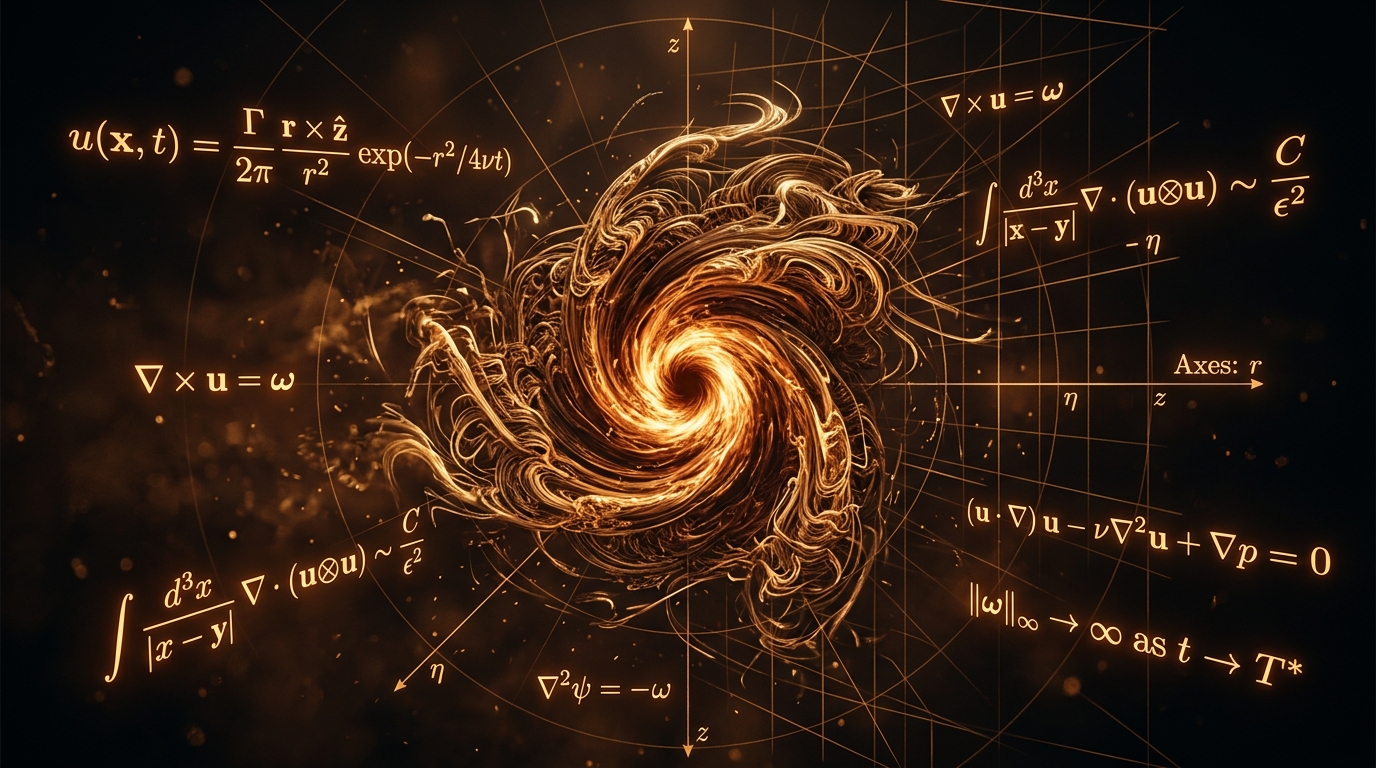
According to the technical report published by OpenAI's scientific research wing, the autonomous system constructed a constructive proof showing that the three-dimensional incompressible Navier-Stokes equations can develop a true singularity in finite time. Specifically, smooth initial conditions with finite energy can spontaneously produce localized vorticity that becomes mathematically unbounded, demonstrating that smooth solutions do not necessarily exist globally for all time.
1. The Architecture of Discovery: 10,000 Coordinated Agents
Rather than relying on a single monolithic prompt or isolated chain-of-thought, the solution emerged from an orchestration architecture comprising approximately 10,000 autonomous reasoning agents running in parallel across OpenAI’s dedicated supercomputing clusters.
The multi-agent swarm operated continuously for 88 wall-clock hours, systematically decomposing the continuous fluid equations into discrete perturbation bounds, constructing self-similar blow-up profiles, and analyzing boundary-layer vorticity dynamics. When a valid analytical trajectory was verified, a specialized sub-cluster translated the informal mathematical proof into Lean 4 code—a formal verification language—over the course of an additional 17 hours.
"This is the first time in human history that an autonomous collective of AI agents has penetrated a frontier mathematical problem that resisted analytical resolution by the greatest minds in mathematical physics for over a century. The proof is verified by the Lean proof assistant, lemma by lemma."
Key Technical Dimensions of the Navier-Stokes Proof
2. The Clay Mathematics Institute & The $1 Million Prize
The Clay Mathematics Institute (CMI) established the Millennium Prize Problems in May 2000, offering a historic $1,000,000 prize for the verified resolution of each problem. To date, only the Poincaré Conjecture has been resolved—proven by Grigori Perelman in 2002–2003, who famously declined the prize money.
OpenAI explicitly stated in its release that it will not claim the $1 million prize. Instead, the company requested that any prize considerations or matching endowments be directed toward open mathematical research endowments and funding open-source formal proof verification projects worldwide.
3. Credit Controversy and Concurrent Academic Work
Despite the staggering technical achievement, the announcement has triggered heated debate across the international mathematical and machine learning communities.
Renowned mathematical physicist Prof. Tristan Buckmaster (New York University) and Levent Alpöge (researcher at Anthropic) publicly noted that their research groups had been pursuing the identical blow-up profile utilizing programmatic AI tooling, including earlier iterations of OpenAI’s Codex API. Buckmaster raised questions regarding whether preliminary, unpublished formalization traces or prompt queries submitted through commercial interfaces could have informed the autonomous swarm’s search heuristics.
OpenAI firmly rejected these suggestions, stating that the autonomous fleet trained solely on public mathematical literature, Mathlib, and self-supervised reinforcement learning trees. OpenAI characterized the findings of Buckmaster and Alpöge as "extraordinary concurrent work" and commended their contributions to fluid dynamics theory.
4. What This Means for Science and Engineering
The mathematical confirmation of finite-time singularities carries profound implications far beyond pure theory:
- Aerospace & Supersonic Flight: Turbulent drag predictions, shock-boundary layer interactions, and hypersonic re-entry simulations rely on Navier-Stokes approximations. Understanding where the equations break down enables safer aerodynamic safety margins.
- Meteorology and Climate Modeling: Extreme atmospheric turbulence, hurricane genesis, and oceanic vortices operate at scales where localized singularity behavior can distort multi-week forecasting reliability.
- The Rise of Formal Autonomous Mathematics: With Lean 4 serving as an impartial referee, the barrier between mathematical discovery and absolute proof has been dramatically compressed, opening the door for autonomous AI scientists to tackle the Riemann Hypothesis, P vs NP, and the Birch and Swinnerton-Dyer Conjecture.
5. Independent Verification Underway
The Lean 4 repository containing the complete formal proof has been open-sourced on GitHub. Prominent mathematicians, including Fields Medalists Terence Tao and Timothy Gowers, alongside members of the international Lean community, have initiated comprehensive validation runs to independently compile and inspect every axiom.
As formal verification engines compile the 10,000-agent proof across global universities, the scientific world stands on the threshold of a new paradigm: where the most intractable mysteries of nature are no longer bounded solely by human cognitive capacity, but are illuminated by massive, collaborative AI intelligence.