Cerebras CS-3 Wafer-Scale Engine Shatters AI Inference Records: 2,500 Tokens/Sec for Frontier 400B+ Models
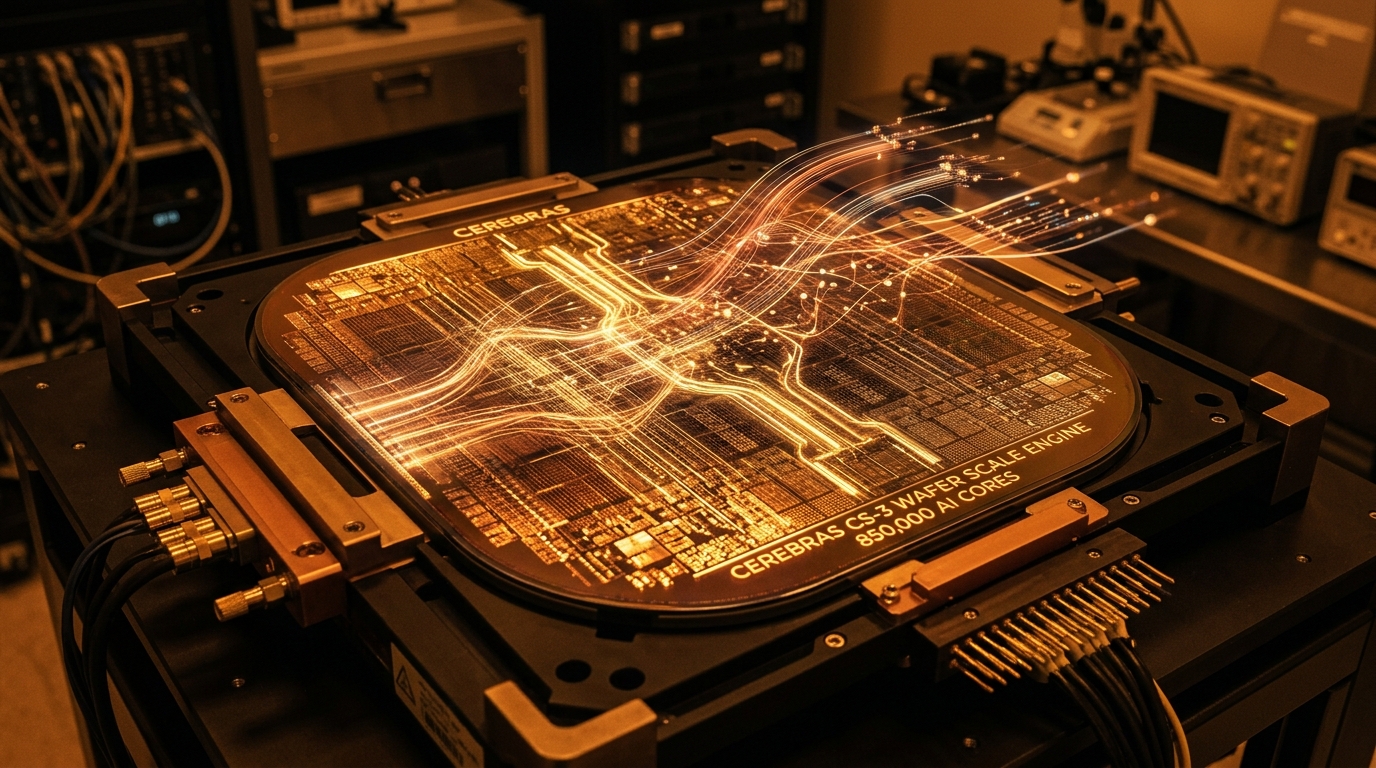
SUNNYVALE, CA — August 28, 2026 — In a benchmark that fundamentally alters the economics and user experience of large language model inference, Cerebras Systems has demonstrated that its CS-3 Wafer Scale Engine delivers a record-shattering 2,500 tokens per second per user on frontier 400B+ class AI architectures, including next-generation open models.
1. Smashing Through the Memory Wall Bottleneck
For years, standard GPU architectures have struggled with the "memory wall"—the latency and throughput bottleneck caused by repeatedly transferring model weights back and forth between compute cores and external High Bandwidth Memory (HBM). While conventional GPU clusters achieve 30 to 80 tokens per second on 405B parameter models, the Cerebras CS-3 delivers up to a 30x to 50x speed advantage.
The secret lies in wafer-scale integration: instead of slicing a 300mm silicon wafer into hundreds of individual microchips, Cerebras builds one continuous, monolithic wafer with 44GB of on-chip Static RAM (SRAM). This provides an astounding 21 Petabytes per second (PB/s) of memory bandwidth—over 7,000 times greater than traditional enterprise GPU configurations.
"When inference happens at 2,500 tokens per second, AI transforms from a conversational chatbot into an instantaneous cognitive engine. Autonomous agents can execute fifty multi-turn reasoning steps in under two seconds, making deep chain-of-thought workflows imperceptibly fast."
2. Native 16-Bit Precision Without Quality Degradation
Crucially, Cerebras achieves these extreme token velocities in full 16-bit precision (FP16/BF16) without aggressive quantization (such as 4-bit or 2-bit weight approximation). This preserves mathematical rigor, nuanced multi-lingual grammar, and code execution fidelity.
Performance Comparison: Tokens Per Second on Frontier Models
3. Unlocking True Real-Time Agentic Workflows
The implications for enterprise agentic software are profound:
- Recursive Tree-of-Thought Search: Reasoning models can generate, evaluate, and prune thousands of logical candidates in sub-second timelines.
- Interactive Code Synthesis: IDE copilots can compile, test, and refactor complete multi-file repositories in the background without developer wait times.
- Real-Time Voice and Video Agents: Zero-latency speech synthesis pipelines can process and reply with human-conversational naturalness.
- OpenAI-Compatible API: Developers can seamlessly switch existing API keys and endpoints without modifying existing prompt pipelines.
4. Enterprise Availability and Cloud Rollout
Cerebras has made its ultra-fast inference cloud globally accessible through dedicated API endpoints and hybrid private cloud deployments. With major AI research labs and financial enterprises integrating the CS-3 architecture, the era of waiting for AI responses has officially come to an end.