Microsoft Research Launches Magentic-One: Generalist Multi-Agent System with Dynamic Orchestration
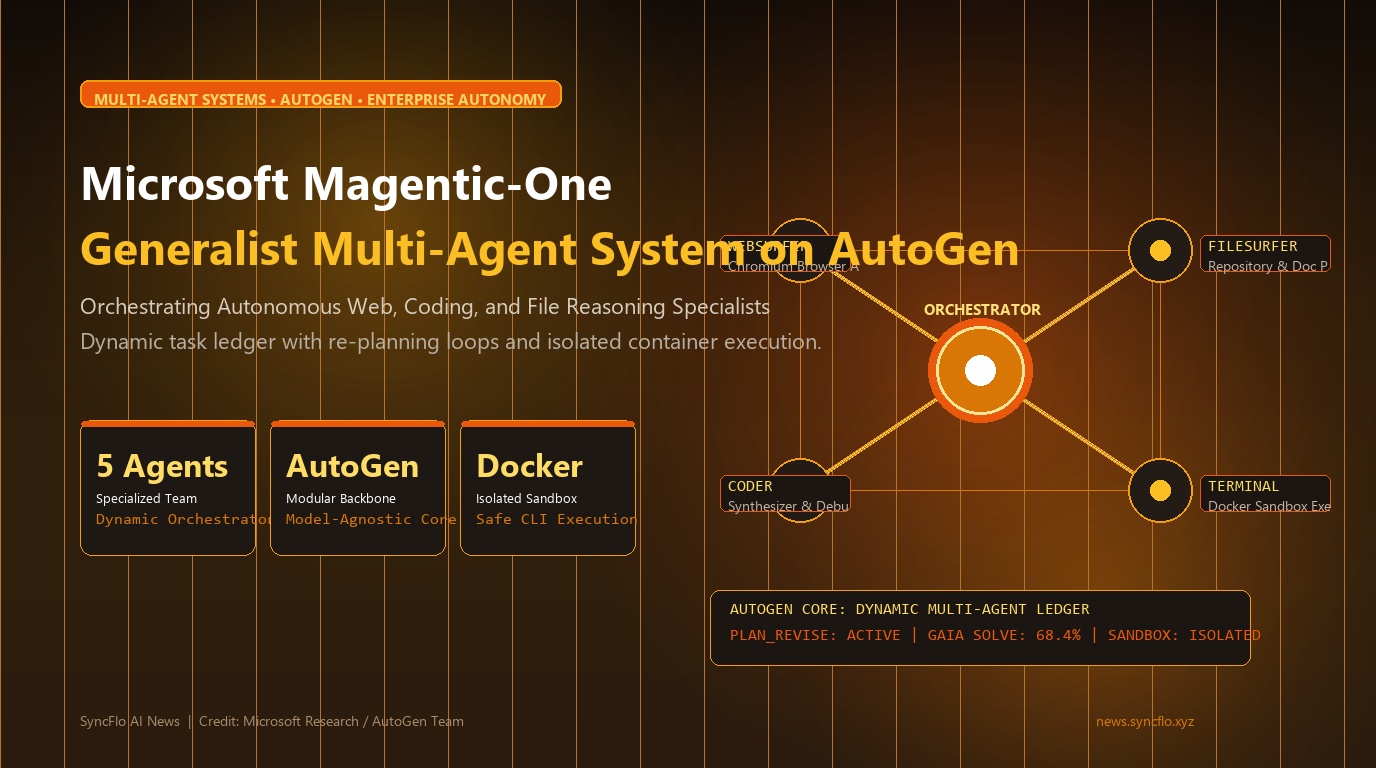
REDMOND, WA — August 19, 2026 — In a significant release for autonomous enterprise AI, Microsoft Research has officially published Magentic-One, a high-performance, open-source generalist multi-agent system built on the AutoGen framework that solves complex, multi-step tasks across web browsers, local filesystems, and execution terminals.
1. The Need for Generalist Multi-Agent Teams
Single-agent systems frequently falter when confronted with long-horizon tasks requiring disparate skillsets—such as researching competitors online, extracting PDF financial tables, writing custom data transformations, and executing automated test suites.
Magentic-One resolves this by implementing a modular team of specialized agents led by a central Orchestrator that plans, assigns sub-tasks, evaluates progress, and dynamically alters strategy when unexpected errors or roadblocks arise.
"Rather than attempting to make a single model do everything, Magentic-One creates an agile team of specialized agents with isolated responsibilities and dynamic re-planning capabilities."
2. The Magentic-One Agent Roster
The architecture consists of five core agent personas collaborating within a shared context:
- Orchestrator: The master coordinator that maintains the task ledger, creates execution plans, delegates subgoals to specialists, and verifies completion criteria before handing work downstream.
- WebSurfer: An autonomous browser agent controlling a Chromium instance to perform search queries, handle interactive JavaScript web forms, navigate pagination, and extract clean text/tables.
- FileSurfer: A local file system navigator capable of inspecting complex repository structures, reading varied file formats (PDF, DOCX, CSV, parquet), and summarizing document contents.
- Coder: A specialized programming agent that writes production-ready code, scripts data pipelines, designs algorithms, and analyzes log traces.
- ComputerTerminal: A secure sandbox agent that launches bash/PowerShell commands in isolated Docker containers to execute code written by Coder and return execution outputs.
Benchmark Performance: GAIA, AssistantBench & WebArena
3. Enterprise Integration with AutoGen & Azure
Because Magentic-One is implemented on `autogen-core` and `autogen-agentchat`, enterprise developers can customize the team by swapping model backends, injecting proprietary internal tools, or adding custom compliance audit agents.
Microsoft has released Magentic-One as an open-source research package on GitHub, accompanied by Docker deployment configurations and Azure AI Foundry integration guides.