Google DeepMind Unveils Genie 2: Foundation World Models Generating Interactive 3D Environments for Embodied AI
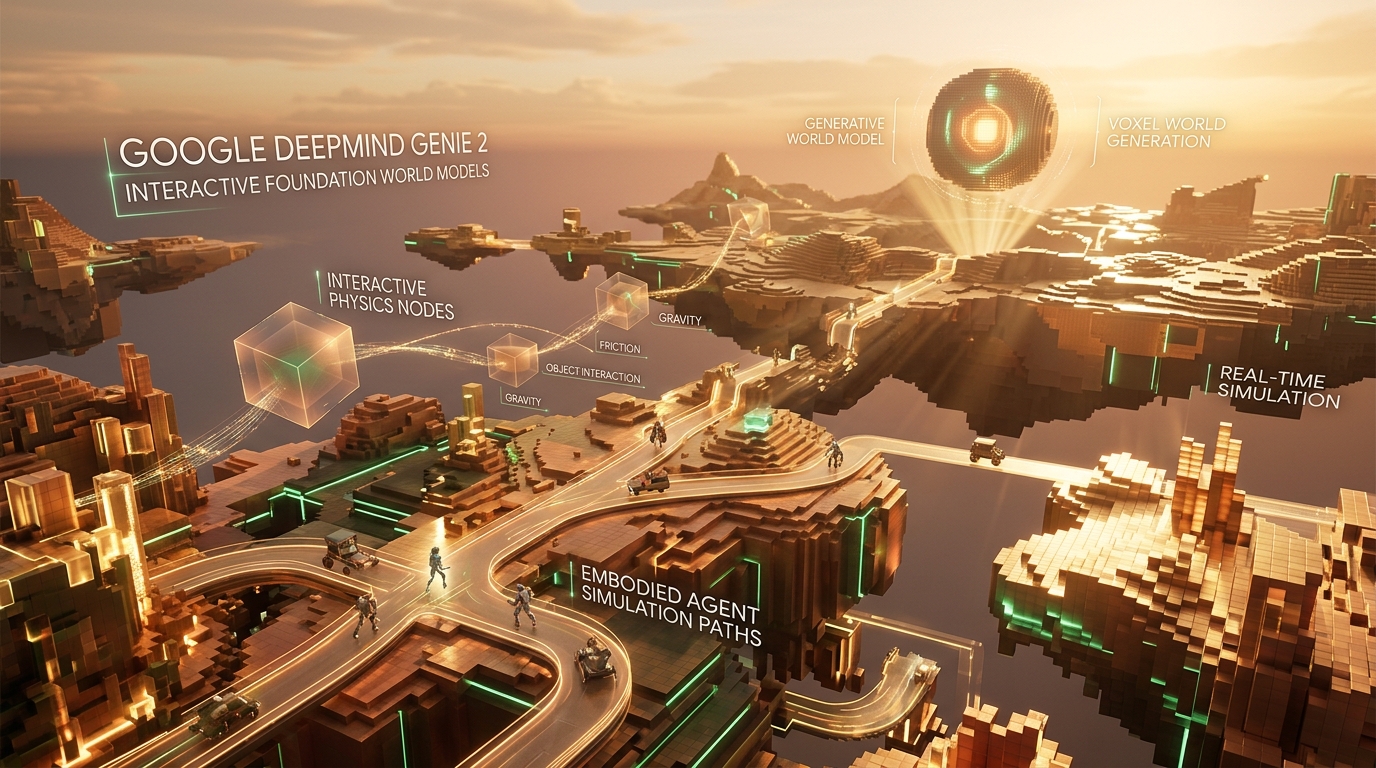
LONDON & MOUNTAIN VIEW — August 18, 2026 — In a transformative leap for physical AI and synthetic simulation, Google DeepMind has unveiled Genie 2, a state-of-the-art foundation world model capable of generating real-time, action-controllable 3D interactive environments from a single prompt image, concept sketch, or text description.
1. From Passive Video Generation to Interactive World Engines
While video synthesis models like Veo 2 and Sora create high-fidelity cinematic video clips, they remain non-interactive: the camera path and object behaviors are pre-rendered into fixed sequences.
Genie 2 redefines generative media by operating as a neural game engine. Given a single reference image, Genie 2 projects plausible 3D scene geometry, predicts dynamic physical interactions, and responds instantaneously to continuous keyboard, mouse, and agentic control inputs—allowing human testers and autonomous embodied agents to navigate and manipulate the generated world in real time.
"World models are the foundation of true artificial general intelligence. With Genie 2, we are not just generating frames; we are simulating the laws of motion, collision physics, and visual consistency in an open, infinite action space."
2. Core Technical Capabilities of Genie 2
DeepMind's breakthroughs in causal temporal transformers and spatial-action latent representations provide unprecedented stability across extended horizons:
| Capability Dimension | Genie 2 Technical Architecture | Simulation Impact |
|---|---|---|
| Action Conditioning | Latent action tokenizer & continuous vector inputs | Supports 6-DoF navigation, jumping, object displacement, and camera orbital control. |
| Physical Consistency | Neural physics priors (gravity, friction, fluid dynamics) | Maintains rigid body collisions, shadow alignment, and realistic momentum across minute-long rollouts. |
| Scene Memory & Out-of-View Recall | Long-horizon spatial cache & state reconstruction | When the agent turns around, previously generated terrain and objects remain geometrically identical. |
| Zero-Shot World Seeding | Single prompt image or procedural prompt | Instantly converts architectural floorplans, sketches, or photos into interactive navigable 3D spaces. |
3. The Engine for Embodied AI and Humanoid Robotics
The primary bottleneck in training embodied AI—such as humanoid robots, autonomous drones, and factory manipulation arms—has historically been the "sim-to-real gap" and the enormous cost of manually designing 3D virtual training simulators in engines like Unity or Unreal.
Genie 2 solves the data scarcity bottleneck by acting as an infinite procedural training simulator. Reinforcement learning agents can be deployed across millions of diverse, photorealistic synthetic environments generated on the fly, learning dexterity, obstacle avoidance, and visual navigation before ever stepping into the physical world.
4. Synergies with Veo 2 and Real-Time Multimodal Agents
DeepMind has integrated Genie 2's world dynamics with the high-definition rendering fidelity of Veo 2 and the low-latency perception of Gemini 3.5 Flash. This convergence enables a closed-loop system where Gemini agents observe the environment, plan strategic maneuvers, execute physical actions, and observe the resulting state mutations rendered with cinematic physics fidelity.
5. SyncFlo AI's Perspective on Generative Physical Simulation
As enterprise workflows increasingly merge digital intelligence with physical operations—such as automated warehouse logistics, facility digital twins, and immersive training—SyncFlo AI is exploring integrations with world foundation models. Genie 2 paves the way for automated spatial simulations where enterprise agents can test logistics workflows and stress-test physical procedures in virtual environments before live deployment.
Sources & Owner Credits
This article is synthesized from research publications, technical disclosures, and demonstrative benchmarks published by Google DeepMind (deepmind.google / blog.google). All trademarks, model names (Genie 2, Veo 2, Gemini), and research assets remain the intellectual property of Google DeepMind / Alphabet Inc. Visual conceptual rendering by the SyncFlo AI News Editorial Team.