Anthropic Model Context Protocol (MCP) Sets Universal Open Standard for Autonomous AI Agents
SAN FRANCISCO — August 16, 2026 — In a pivotal milestone for the AI development community, Anthropic's open-source Model Context Protocol (MCP) has rapidly emerged as the universal standard connecting large language models to enterprise data silos, developer environments, and dynamic tool ecosystems. By eliminating brittle bespoke integrations, MCP is revolutionizing how autonomous agents operate in production.
1. The "USB-C Port" for Artificial Intelligence
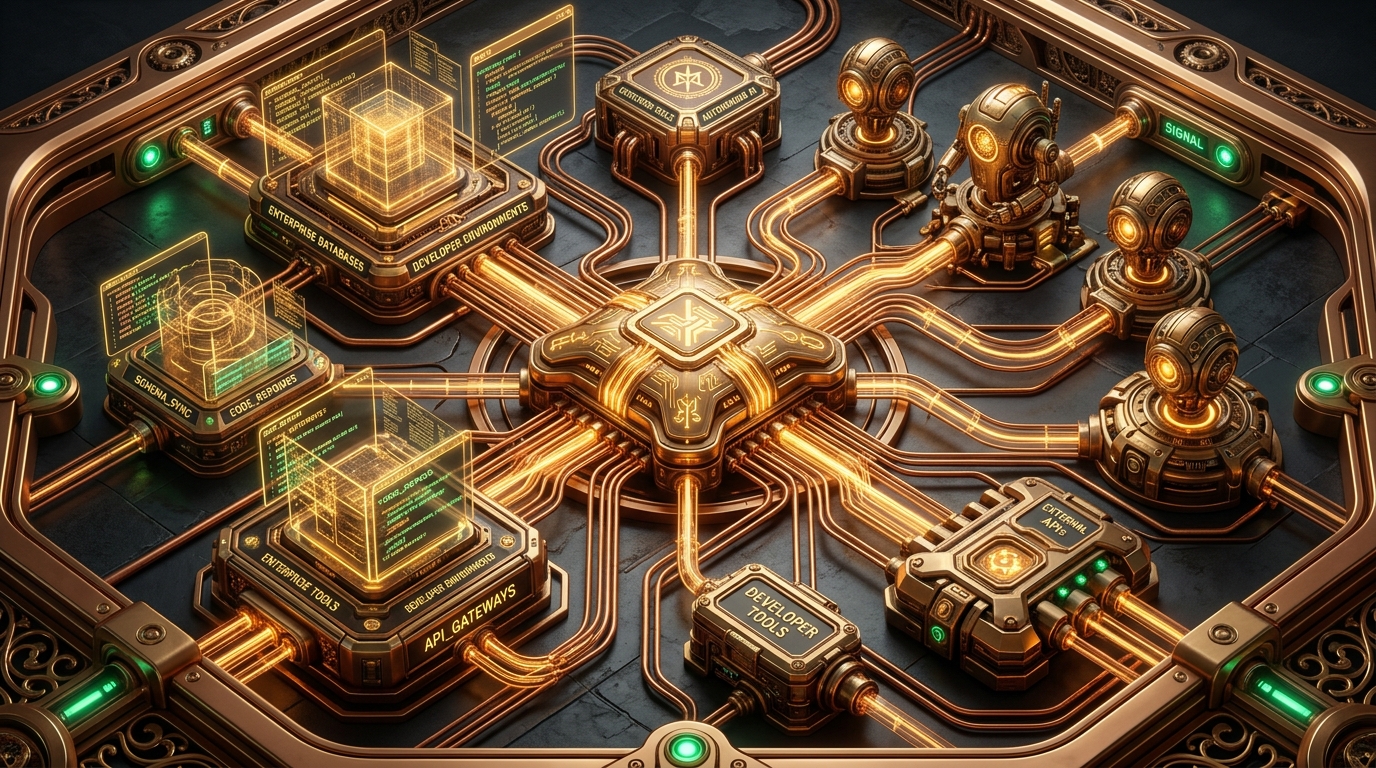
Historically, connecting AI models to external tools required writing separate custom adapters for every combination of LLM, database, and software client (an N × M complexity problem). Anthropic's Model Context Protocol solves this by providing a universal, standardized JSON-RPC interface.
With MCP, developers build an MCP server once for any data source—such as PostgreSQL, GitHub, Slack, Notion, or local file systems—and any MCP-compliant client (including Claude Desktop, Cursor, Zed, and custom agents) can securely interact with it immediately.
"Model Context Protocol is designed to be an open, transparent foundation. Just as HTTP democratized web communications, MCP provides the universal protocol that allows AI agents to securely reason over real-world data without vendor lock-in."
2. Core Pillars of the MCP Architecture
The Model Context Protocol establishes three foundational primitives that empower autonomous agent workflows:
- Resources (Context Providers): Read-only data endpoints (e.g. file contents, database tables, API schemas) that agents can inspect with zero cognitive overhead.
- Tools (Executable Actions): Callable functions with structured parameter schemas that allow models to trigger code executions, run terminal commands, and perform API mutations.
- Prompts (Reusable Workflows): Pre-packaged system instructions and operational templates that standardize complex agent interactions.
3. Broad Industry Adoption and Open Ecosystem
Since open-sourcing the specification, MCP has seen exponential adoption across the tech industry. Major developer tools, IDEs, and database providers—including Block, Supabase, Pinecone, Sourcegraph, and Linear—have launched official MCP servers. The open-source community has contributed hundreds of community servers spanning cloud orchestration, browser automation, and security sandboxing.
4. SyncFlo's Native MCP Integration
At SyncFlo AI, native MCP support is now integrated into our core workflow automation engine. By leveraging MCP servers, SyncFlo agents can dynamically discover available enterprise tools at runtime, safely interact with CRM databases, trigger cloud pipelines, and manage end-to-end business operations with full auditability and zero proprietary glue code.
Sources & Owner Credits
This article is synthesized from open documentation, specifications, and announcements published by Anthropic PBC (anthropic.com) and the Model Context Protocol Open Source Project (modelcontextprotocol.io). MCP specification is licensed under the open-source MIT License. Visual artwork and editorial synthesis produced by SyncFlo AI News Editorial Team.