
DeepSeek Unveils R1: Open-Weights Frontier Reasoning with Reinforcement Learning and Free Distillation
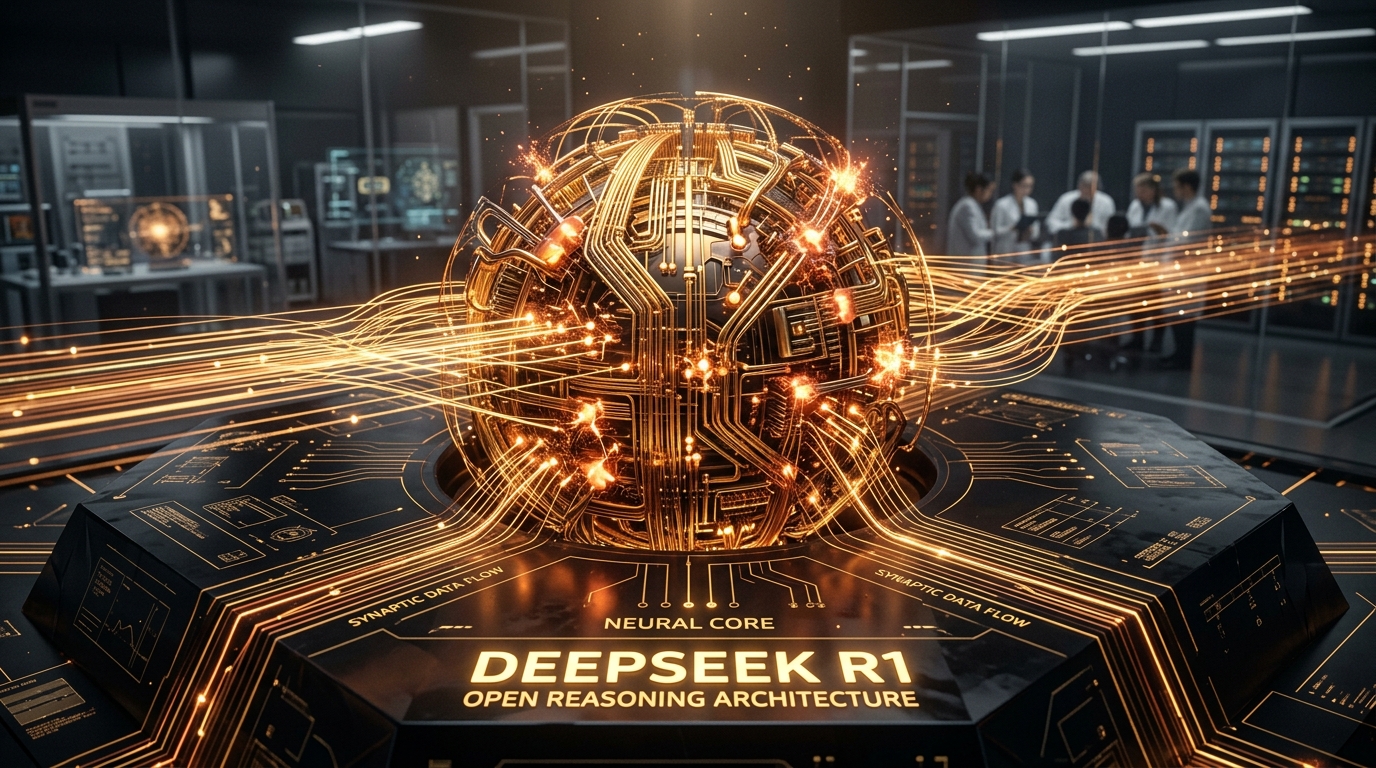
HANGZHOU — August 15, 2026 — In an earthquake for the artificial intelligence industry, DeepSeek-AI has officially released DeepSeek-R1 alongside its groundbreaking pure-RL predecessor DeepSeek-R1-Zero. By open-sourcing complete model weights, reasoning traces, and distilled student models ranging from 1.5B to 70B parameters, DeepSeek has effectively shattered the proprietary monopoly on frontier-grade reasoning.
1. Pure Reinforcement Learning: The Autonomous Emergence of Thinking
Historically, fine-tuning large language models for complex math and software reasoning required vast, meticulously curated datasets of human demonstrations (Supervised Fine-Tuning or SFT). DeepSeek-R1-Zero upended this paradigm by training directly on the base model using pure Large-Scale Reinforcement Learning (RL) without an initial SFT stage.
During RL exploration, researchers observed the spontaneous emergence of human-like cognitive behaviors: self-verification, backtracking upon finding logical flaws, chain-of-thought exploration, and alternative hypothesis generation. The full DeepSeek-R1 model incorporates a multi-stage training pipeline with cold-start data to eliminate language mixing while maximizing reasoning clarity.
"DeepSeek-R1 demonstrates that reasoning is an emergent capability driven by reinforcement incentives rather than pure supervised imitation. Open-sourcing these weights ensures that the entire research ecosystem can build upon transparent foundations."
2. The 671B Mixture-of-Experts Architecture
Under the hood, DeepSeek-R1 is built on the high-efficiency DeepSeek-V3 architecture:
- Total & Active Parameters: Contains 671 billion total parameters, but activates only 37 billion parameters per token via dynamic sparse MoE routing.
- Multi-head Latent Attention (MLA): Drastically compresses the Key-Value (KV) cache memory footprint, allowing ultra-long context windows at a fraction of standard GPU memory requirements.
- Competitive Parity: Matches or exceeds leading closed reasoning architectures on MATH-500, AIME 2024, and SWE-Bench Verified coding challenges.
3. Democratic Distillation: Frontier Reasoning on Consumer Hardware
Perhaps the most disruptive aspect of the release is DeepSeek's distillation strategy. By using DeepSeek-R1 to curate 800,000 reasoning samples, the team fine-tuned dense open-source architectures including Qwen-2.5 and Llama-3.1.
The resulting models—such as DeepSeek-R1-Distill-Qwen-14B and DeepSeek-R1-Distill-Llama-70B—exceed the math and coding performance of many base models multiple times their size, enabling developers to run localized, zero-cloud reasoning directly on consumer workstations and edge devices.
4. Enterprise Impact & SyncFlo Autonomous Agents
For autonomous enterprise platforms like SyncFlo AI, DeepSeek-R1 provides a transformative advantage: self-hostable, cost-effective reasoning engines capable of planning intricate multi-agent workflows, auditing database logic, and executing autonomous code refactoring without vendor lock-in or per-token premium surcharges.
Sources & Owner Credits
This report is based on the technical paper, model repositories, and benchmark datasets published by DeepSeek-AI (deepseek.com) and Hangzhou DeepSeek Artificial Intelligence Co., Ltd. Founded and led by Liang Wenfeng and the DeepSeek Open Research Team. Open weights and distillation artifacts are distributed under MIT/open-weights licenses on Hugging Face and GitHub. Visual imagery and editorial synthesis created by SyncFlo AI News Editorial.